Skip to main content
Microbiology
My Course
Learn
Exam Prep
AI Tutor
Study Guides
Textbook Solutions
Flashcards
Explore
Try the app
My Course
Learn
Exam Prep
AI Tutor
Study Guides
Textbook Solutions
Flashcards
Explore
Try the app
Back
Prototrophs vs. Auxotrophs quiz
You can tap to flip the card.
What is a prototroph?
You can tap to flip the card.
👆
What is a prototroph?
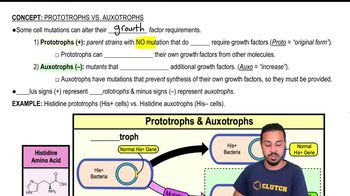
A prototroph is an original parent strain with no mutations that does not require additional growth factors to survive.
Track progress
Control buttons has been changed to "navigation" mode.
1/15
Related flashcards
Related practice
Recommended videos
Prototrophs vs. Auxotrophs definitions
Prototrophs vs. Auxotrophs
15 Terms
Prototrophs vs. Auxotrophs
16. Microbial Genetics
3 problems
Topic
Nicole
Mutant Detection
16. Microbial Genetics
3 problems
Topic
Monica
16. Microbial Genetics - Part 1 of 2
9 topics
14 problems
Chapter
Monica
16. Microbial Genetics - Part 2 of 2
8 topics
13 problems
Chapter
Nicole
01:54
Prototrophs vs. Auxotrophs Example 1
941
views
10
rank
07:37
Prototrophs vs. Auxotrophs
1752
views
15
rank
Terms in this set (15)
Hide definitions
What is a prototroph?
A prototroph is an original parent strain with no mutations that does not require additional growth factors to survive.
What does the root 'proto' in prototroph mean?
'Proto' means original form, indicating that prototrophs are the original, non-mutated strains.
How are prototrophs represented symbolically?
Prototrophs are represented with a plus sign, such as His+.
Why do prototrophs not require additional growth factors?
They have functional genes that allow them to synthesize their own growth factors from other molecules.
What is an auxotroph?
An auxotroph is a mutant strain with DNA mutations that require additional growth factors to survive.
What does the root 'auxo' in auxotroph mean?
'Auxo' means increase, referring to the increased growth factor requirements of auxotrophs.
How are auxotrophs represented symbolically?
Auxotrophs are represented with a minus sign, such as His-.
Why do auxotrophs require additional growth factors?
Mutations prevent auxotrophs from synthesizing their own growth factors, so they must obtain them from the environment.
What happens if an auxotroph does not receive the required growth factor from its environment?
The auxotroph will not be able to survive if the required growth factor is not available.
What is histidine in the context of prototrophs and auxotrophs?
Histidine is an amino acid used as a growth factor; prototrophs can synthesize it, while auxotrophs require it from the environment.
What does His+ indicate about a bacterial strain?
His+ indicates the strain is a prototroph with a normal, non-mutated gene for histidine synthesis.
What does His- indicate about a bacterial strain?
His- indicates the strain is an auxotroph with a mutated gene that cannot synthesize histidine.
Can prototrophs grow in the absence of a specific growth factor like histidine?
Yes, prototrophs can grow without histidine because they can synthesize it themselves.
How can a prototroph become an auxotroph?
A prototroph can become an auxotroph if a mutation occurs in its gene responsible for synthesizing a growth factor.
What is the main difference between prototrophs and auxotrophs regarding growth factor synthesis?
Prototrophs can synthesize their own growth factors, while auxotrophs cannot and must obtain them from the environment.
 BackBack
 01:54
01:54