Microbiology
My Course
Learn
Exam Prep
AI Tutor
Study Guides
Textbook Solutions
Flashcards
Explore
My Course
Learn
Exam Prep
AI Tutor
Study Guides
Textbook Solutions
Flashcards
Explore
Back
Pyruvate Oxidation definitions
You can tap to flip the card.
Define:
Pyruvate Oxidation
You can tap to
flip the card.
👆
Pyruvate Oxidation
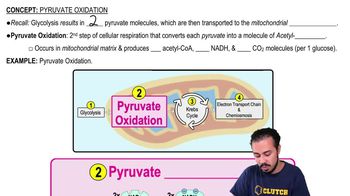
Second stage of cellular respiration, converting pyruvate into Acetyl CoA, NADH, and CO2 in the mitochondrial matrix.
Track progress
Control buttons has been changed to "navigation" mode.
1/13
Related practice
Recommended videos
Guided course
04:38
Pyruvate Oxidation
Jason
18637
views
274
rank
Terms in this set (13)
Hide definitions
Pyruvate Oxidation
Second stage of cellular respiration, converting pyruvate into Acetyl CoA, NADH, and CO2 in the mitochondrial matrix.
Mitochondrial Matrix
Innermost compartment of mitochondria where pyruvate oxidation and the Krebs cycle take place.
Glycolysis
Initial process of cellular respiration that splits glucose into two pyruvate molecules in the cytoplasm.
Acetyl CoA
Two-carbon molecule formed from pyruvate, serving as the entry substrate for the Krebs cycle.
NADH
High-energy electron carrier produced during pyruvate oxidation, later used in the electron transport chain.
CO2
Gaseous byproduct released when a carbon atom is removed from pyruvate during its conversion to Acetyl CoA.
Cellular Respiration
Multi-step metabolic pathway extracting energy from glucose, including glycolysis, pyruvate oxidation, and the Krebs cycle.
Krebs Cycle
Third stage of cellular respiration, utilizing Acetyl CoA to generate electron carriers and CO2.
Electron Carrier
Molecule, such as NADH, that temporarily holds electrons released during metabolic reactions.
NAD+
Oxidized form of a coenzyme that accepts electrons during pyruvate oxidation, becoming NADH.
Aerobic Respiration
Oxygen-dependent process involving glycolysis, pyruvate oxidation, the Krebs cycle, and the electron transport chain.
Carbon Atom
Elemental unit present in pyruvate; one is released as CO2 during pyruvate oxidation.
Glucose
Six-carbon sugar molecule serving as the starting substrate for glycolysis and cellular respiration.