Microbiology
My Course
Learn
Exam Prep
AI Tutor
Study Guides
Textbook Solutions
Flashcards
Explore
My Course
Learn
Exam Prep
AI Tutor
Study Guides
Textbook Solutions
Flashcards
Explore
Back
Selecting a Method to Control Microbial Growth definitions
You can tap to flip the card.
Define:
Microbial Growth Control
You can tap to
flip the card.
👆
Microbial Growth Control
A set of methods used to reduce or eliminate microorganisms on surfaces, items, or environments to prevent infection or contamination.
Track progress
Control buttons has been changed to "navigation" mode.
1/15
Related practice
Recommended videos
Guided course
03:59
Selecting a Method to Control Microbial Growth
Jason
2211
views
25
rank
Guided course
07:24
Types of Microbes (Microbial Characteristics)
Jason
1942
views
24
rank
Guided course
07:45
Number of Microbes
Jason
1712
views
23
rank
Terms in this set (15)
Hide definitions
Microbial Growth Control
A set of methods used to reduce or eliminate microorganisms on surfaces, items, or environments to prevent infection or contamination.
Disinfection
A process that eliminates most microbes, especially pathogens, but may not destroy all microbial forms such as endospores.
Sterilization
A procedure that destroys all forms of microbial life, including highly resistant endospores and prions.
Decimal Reduction Time
The specific time required under set conditions to kill 90% of a microbial population, indicating resistance to treatment.
Non-critical Instruments
Medical tools that contact only intact skin and pose a low risk of infection, requiring only low-level disinfection.
Semi-critical Instruments
Devices that contact mucous membranes but do not penetrate tissues, presenting a medium risk and needing high-level disinfection.
Critical Instruments
Items that penetrate sterile tissues or the vascular system, carrying a high risk of infection and requiring sterilization.
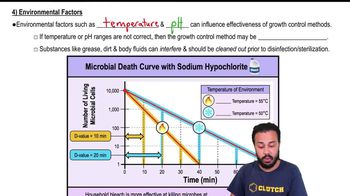
Environmental Factors
Conditions such as temperature, pH, and presence of organic matter that influence the effectiveness of microbial control methods.
Microbial Resistance
The ability of certain microbes to survive exposure to specific control methods, necessitating more stringent treatments.
Microbial Death Curve
A graphical representation showing the decline of a microbial population over time when exposed to a control method.
Composition
The material makeup of an item, which determines its compatibility with various microbial control methods to avoid damage.
Enveloped Viruses
Viruses surrounded by a lipid membrane, generally more susceptible to low-level disinfectants than non-enveloped types.
Bacterial Endospores
Highly resistant, dormant structures formed by certain bacteria, requiring sterilization for effective elimination.
Prions
Infectious protein particles that are extremely resistant to standard sterilization, demanding specialized elimination techniques.
D Value
A shorthand for decimal reduction time, indicating how long it takes to reduce a microbial population by 90% under specific conditions.