Back

Sporulation definitions

Control buttons has been changed to "navigation" mode.
1/13
  • Sporulation

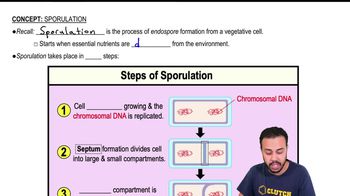
    A survival mechanism where a vegetative cell initiates endospore formation in response to nutrient depletion and harsh conditions.
  • Endospore

    A highly resistant, dormant structure released from a lysed cell, capable of surviving extreme environmental stress.
  • Vegetative Cell

    A metabolically active, normal bacterial cell that can initiate endospore formation when stressed.
  • Nutrient Depletion

    A state where essential resources are exhausted, triggering the onset of endospore formation in bacteria.
  • Septum

    A dividing structure that forms within a cell, separating it into a larger and a smaller compartment during sporulation.
  • Chromosomal DNA

    The genetic material that is replicated at the onset of sporulation to ensure genetic continuity in the endospore.
  • Forespore

    A precursor structure to the endospore, formed after engulfment and undergoing dehydration to enter dormancy.
  • Cortex

    A protective layer formed around the forespore, contributing to the endospore's resistance to environmental stress.
  • Coat

    An outer layer produced during sporulation that shields the endospore from physical and chemical damage.
  • Dehydration

    A process where water exits the forespore, halting enzyme activity and inducing a dormant state.
  • Dormant State

    A metabolically inactive condition allowing the endospore to withstand unfavorable environments for extended periods.
  • Lysis

    The breakdown of the parent cell, resulting in the release of the mature endospore into the environment.
  • Germination

    A process where an endospore detects favorable conditions and reverts to a metabolically active vegetative cell.