Skip to main content
Microbiology
My Course
Learn
Exam Prep
AI Tutor
Study Guides
Textbook Solutions
Flashcards
Explore
Try the app
My Course
Learn
Exam Prep
AI Tutor
Study Guides
Textbook Solutions
Flashcards
Explore
Try the app
Back
Steps to DNA Cloning definitions
You can tap to flip the card.
Recombinant DNA
You can tap to flip the card.
👆
Recombinant DNA
A single molecule containing genetic material from two different sources, such as a bacterial plasmid and a gene of interest.
Track progress
Control buttons has been changed to "navigation" mode.
1/14
Related flashcards
Related practice
Recommended videos
Steps to DNA Cloning quiz
Steps to DNA Cloning
15 Terms
Steps to DNA Cloning
17. Biotechnology
4 problems
Topic
Nicole
Introduction to Polymerase Chain Reaction
17. Biotechnology
4 problems
Topic
Nicole
17. Biotechnology
10 topics
14 problems
Chapter
Brendan
04:42
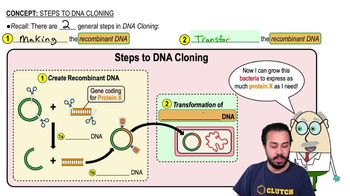
Steps to DNA Cloning
6540
views
64
rank
04:58
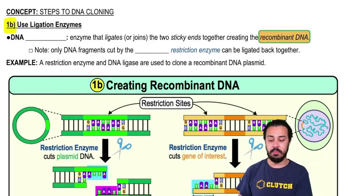
1b) Use Ligation Enzymes
5238
views
49
rank
03:27
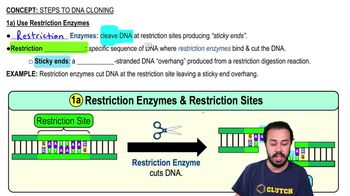
1a) Use Restriction Enzymes
5978
views
48
rank
Terms in this set (14)
Hide definitions
Recombinant DNA
A single molecule containing genetic material from two different sources, such as a bacterial plasmid and a gene of interest.
Restriction Enzyme
A protein acting as a molecular scissor, recognizing specific DNA sequences and cleaving DNA at those sites.
Restriction Site
A specific DNA sequence recognized and cut by a restriction enzyme, enabling precise DNA manipulation.
Sticky End
A single-stranded DNA overhang created by staggered cuts, allowing complementary base pairing with matching sequences.
DNA Ligase
An enzyme functioning like molecular glue, covalently joining DNA fragments with compatible sticky ends.
Plasmid
A small, circular DNA molecule in bacteria, often used as a vector to carry foreign genes during cloning.
Gene of Interest
A specific DNA segment, often from another species, targeted for insertion and expression in a host organism.
Cloning Vector
A DNA molecule, such as a plasmid, used to deliver foreign genetic material into a host cell.
Transformation
A process where a cell uptakes external DNA, allowing the introduction of recombinant molecules into bacteria.
Transgenic Organism
A living entity that contains and expresses genetic material originating from a different species.
Phenotypic Marker
A detectable trait, such as antibiotic resistance, used to identify cells that have incorporated recombinant DNA.
Antibiotic Resistance
A trait enabling bacteria to survive in the presence of antibiotics, often used as a selection marker in cloning.
Insulin
A protein hormone produced via recombinant DNA technology in bacteria for therapeutic use in diabetics.
E. coli
A common bacterial species frequently used as a host for DNA cloning and protein expression.
 BackBack
 04:42
04:42