Skip to main content
Microbiology
My Course
Learn
Exam Prep
AI Tutor
Study Guides
Textbook Solutions
Flashcards
Explore
Try the app
My Course
Learn
Exam Prep
AI Tutor
Study Guides
Textbook Solutions
Flashcards
Explore
Try the app
Back
The Griffith Experiment definitions
You can tap to flip the card.
Griffith Experiment
You can tap to flip the card.
👆
Griffith Experiment
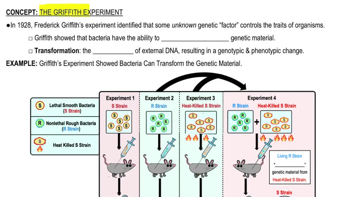
A 1928 study revealing that bacteria can acquire genetic traits from external sources, leading to changes in their characteristics.
Track progress
Control buttons has been changed to "navigation" mode.
1/15
Related flashcards
Related practice
Recommended videos
The Griffith Experiment quiz #1
The Griffith Experiment
10 Terms
The Griffith Experiment
14. DNA Replication
3 problems
Topic
Nicole
The Hershey-Chase Experiment
14. DNA Replication
3 problems
Topic
Monica
14. DNA Replication
10 topics
14 problems
Chapter
Brendan
08:56
The Griffith Experiment
18179
views
268
rank
Terms in this set (15)
Hide definitions
Griffith Experiment
A 1928 study revealing that bacteria can acquire genetic traits from external sources, leading to changes in their characteristics.
Transformation
The process where bacteria uptake external DNA, resulting in changes to both genotype and phenotype.
S Strain
A lethal, smooth-surfaced pneumococcus variant with a capsule, capable of killing mice in experiments.
R Strain
A nonlethal, rough-surfaced pneumococcus variant lacking a capsule, unable to kill mice.
Capsule
A protective outer layer found on certain bacteria, contributing to their smooth appearance and virulence.
Heat-Killed S Strain
A form of the lethal smooth bacteria rendered nonviable by exposure to high temperatures, unable to reproduce or cause disease.
Genetic Material
The substance responsible for controlling traits in organisms, later identified as DNA.
Phenotypic Change
An observable alteration in an organism's traits resulting from the acquisition of new genetic information.
Genotypic Change
A modification in the genetic composition of an organism due to the uptake of external DNA.
Oswald Avery
A scientist who, along with colleagues, identified DNA as the transforming substance in bacterial transformation.
DNA
A molecule later proven to be the hereditary material responsible for transmitting genetic information in living organisms.
Protein
A macromolecule once considered a candidate for genetic material due to its complexity and abundance in cells.
Virulence
The degree to which a microorganism can cause disease, often influenced by structural features like capsules.
Uptake
The absorption of external genetic material by a living cell, leading to transformation.
Skepticism
The scientific doubt regarding DNA's role as genetic material, prevalent before its function was fully established.
 BackBack
 08:56
08:56