Skip to main content
Microbiology
My Course
Learn
Exam Prep
AI Tutor
Study Guides
Textbook Solutions
Flashcards
Explore
Try the app
My Course
Learn
Exam Prep
AI Tutor
Study Guides
Textbook Solutions
Flashcards
Explore
Try the app
Back
The Hershey-Chase Experiment quiz
You can tap to flip the card.
Who conducted the Hershey-Chase experiment and in what year?
You can tap to flip the card.
👆
Who conducted the Hershey-Chase experiment and in what year?
Alfred Hershey and Martha Chase conducted the experiment in 1952.
Track progress
Control buttons has been changed to "navigation" mode.
1/15
Related flashcards
Related practice
Recommended videos
The Hershey-Chase Experiment definitions
The Hershey-Chase Experiment
14 Terms
The Hershey-Chase Experiment
14. DNA Replication
3 problems
Topic
Monica
Chargaff's Rules
14. DNA Replication
3 problems
Topic
Nicole
14. DNA Replication
10 topics
14 problems
Chapter
Brendan
03:59
The Hershey-Chase Experiment
12554
views
155
rank
03:44
Bacteriophages
13748
views
202
rank
Terms in this set (15)
Hide definitions
Who conducted the Hershey-Chase experiment and in what year?
Alfred Hershey and Martha Chase conducted the experiment in 1952.
What type of organism did Hershey and Chase use in their experiment?
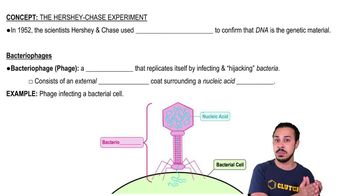
They used bacteriophages, which are viruses that infect bacteria.
What are bacteriophages also commonly called?
Bacteriophages are also called phages.
What are the two main components of a bacteriophage?
A bacteriophage consists of an external protein coat and a nucleic acid core.
What was the main scientific debate before the Hershey-Chase experiment?
Scientists debated whether DNA or protein was the genetic material.
How did Hershey and Chase label the protein coat of the bacteriophage?
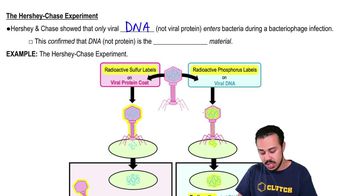
They used radioactive sulfur to label the protein coat.
How did Hershey and Chase label the DNA of the bacteriophage?
They used radioactive phosphorus to label the DNA.
During infection, which part of the bacteriophage entered the bacterial cell?
Only the viral DNA entered the bacterial cell.
What happened to the radioactively labeled protein during the experiment?
The radioactively labeled protein remained outside the bacterial cell.
What did the presence of radioactive DNA inside bacteria indicate?
It indicated that DNA, not protein, is the genetic material.
Why was radioactive sulfur used to label protein but not DNA?
Because sulfur is found in proteins but not in DNA.
Why was radioactive phosphorus used to label DNA but not protein?
Because phosphorus is found in DNA but not in proteins.
What did the Hershey-Chase experiment conclusively demonstrate?
It conclusively demonstrated that DNA is the genetic material.
How did the Hershey-Chase experiment end the scientific controversy?
It provided clear evidence that DNA, not protein, carries genetic information.
What process do bacteriophages use to replicate themselves?
Bacteriophages replicate by infecting and hijacking bacterial cells.
 BackBack
 03:59
03:59