Skip to main content
Microbiology
My Course
Learn
Exam Prep
AI Tutor
Study Guides
Textbook Solutions
Flashcards
Explore
Try the app
My Course
Learn
Exam Prep
AI Tutor
Study Guides
Textbook Solutions
Flashcards
Explore
Try the app
Back
Transduction definitions
You can tap to flip the card.
Transduction
You can tap to flip the card.
👆
Transduction
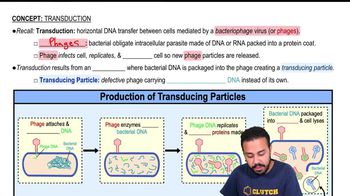
A horizontal gene transfer process where bacterial DNA is moved between cells via bacteriophage particles.
Track progress
Control buttons has been changed to "navigation" mode.
1/15
Related flashcards
Related practice
Recommended videos
Transduction quiz
Transduction
15 Terms
Transduction
16. Microbial Genetics
4 problems
Topic
Brendan
Introduction to Conjugation
16. Microbial Genetics
1 problem
Topic
Nicole
16. Microbial Genetics - Part 1 of 2
9 topics
14 problems
Chapter
Monica
16. Microbial Genetics - Part 2 of 2
8 topics
13 problems
Chapter
Nicole
04:24
Generalized Transduction
1578
views
15
rank
06:49
Transduction
2184
views
21
rank
06:34
Specialized Transduction
1515
views
14
rank
Terms in this set (15)
Hide definitions
Transduction
A horizontal gene transfer process where bacterial DNA is moved between cells via bacteriophage particles.
Bacteriophage
A virus that infects bacteria, using their cellular machinery for replication and often causing cell lysis.
Horizontal Gene Transfer
The movement of genetic material between organisms other than by descent from parent to offspring.
Phage
A viral particle specialized for infecting bacterial cells, sometimes carrying bacterial DNA.
Transducing Particle
A defective phage containing bacterial DNA, capable of transferring it to another bacterium.
Generalized Transduction
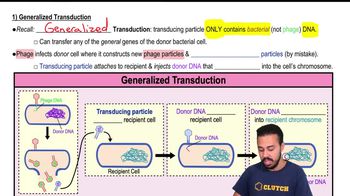
A process where any bacterial gene can be transferred by a phage carrying only bacterial DNA.
Specialized Transduction
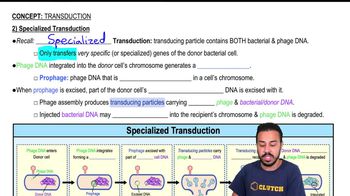
A process where only specific bacterial genes, along with phage DNA, are transferred by a phage.
Prophage
Phage DNA integrated into a bacterial chromosome, capable of excision during specialized transduction.
Cell Lysis
The rupture of a bacterial cell, releasing new phage particles into the environment.
Recipient Cell
A bacterial cell that receives foreign DNA from a transducing particle during transduction.
Donor Cell
A bacterial cell whose DNA is accidentally packaged into a phage and transferred to another cell.
Viral Protein
A structural or enzymatic molecule produced by phage genes during infection and assembly.
Chromosome
A circular DNA molecule in bacteria, serving as the main genetic material subject to gene transfer.
Phage DNA
Genetic material of a bacteriophage, which can be replicated, integrated, or packaged during infection.
Gene Integration
The incorporation of foreign DNA into a bacterial chromosome, enabling expression of new traits.
 BackBack
 04:24
04:24