Skip to main content
Microbiology
My Course
Learn
Exam Prep
AI Tutor
Study Guides
Textbook Solutions
Flashcards
Explore
Try the app
My Course
Learn
Exam Prep
AI Tutor
Study Guides
Textbook Solutions
Flashcards
Explore
Try the app
Back
Type II Hypersensitivities definitions
You can tap to flip the card.
Type II Hypersensitivity
You can tap to flip the card.
👆
Type II Hypersensitivity
Immune reaction where IgG or IgM antibodies target cell surface antigens, often resulting in cell destruction or altered cell function.
Track progress
Control buttons has been changed to "navigation" mode.
1/15
Related flashcards
Related practice
Recommended videos
Type II Hypersensitivities quiz
Type II Hypersensitivities
15 Terms
Type II Hypersensitivities
27. Immunological Disorders
4 problems
Topic
Type III Hypersensitivities
27. Immunological Disorders
5 problems
Topic
27. Immunological Disorders - Part 1 of 2
4 topics
11 problems
Chapter
27. Immunological Disorders - Part 2 of 2
4 topics
6 problems
Chapter
06:45
Type II Hypersensitivity
201
views
3
rank
02:17
Type II Hypersensitivities Example 1
140
views
3
rank
03:07
Improper Blood Transfusion Reactions
148
views
3
rank
Terms in this set (15)
Hide definitions
Type II Hypersensitivity
Immune reaction where IgG or IgM antibodies target cell surface antigens, often resulting in cell destruction or altered cell function.
Cytotoxic Hypersensitivity
Immune response causing cell death through antibody binding, leading to lysis or tissue damage, often via complement activation.
IgG
Antibody class involved in targeting antigens on cell surfaces, capable of crossing the placenta and mediating cytotoxic effects.
IgM
Large antibody class that initiates immune responses against cell-bound antigens, especially in early stages of Type II reactions.
Antigen
Molecule on cell surfaces recognized by antibodies, determining blood type compatibility and triggering immune responses.
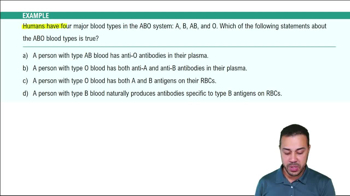
ABO Blood System
Classification based on presence or absence of A and B carbohydrate antigens on red blood cells, crucial for transfusion safety.
Rh Factor
Protein antigen on red blood cells that determines positive or negative blood type status and influences transfusion compatibility.
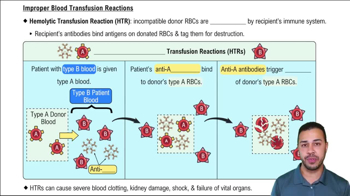
Hemolytic Transfusion Reaction
Destructive immune response where recipient antibodies attack incompatible donor red blood cells, causing lysis and organ damage.
Hemolytic Disease of the Newborn
Condition where maternal antibodies destroy fetal red blood cells, leading to anemia and severe complications in Rh-positive fetuses.
Antibody-Dependent Cellular Cytotoxicity
Mechanism where antibodies tag cells for destruction by immune cells, resulting in targeted cell death.
Complement System
Cascade of plasma proteins activated by antibodies, leading to cell lysis and amplification of immune responses.
RhoGAM
Medication containing anti-Rh antibodies, administered to prevent maternal sensitization and protect future Rh-positive pregnancies.
Autoimmune Hemolytic Anemia
Disorder where antibodies target and destroy one's own red blood cells, resulting in anemia.
Isohemagglutinin
Naturally occurring antibody against ABO blood group antigens not present on an individual's own red blood cells.
Universal Donor
Blood type lacking A, B, and Rh antigens, allowing safe donation to all recipients regardless of their blood type.
 BackBack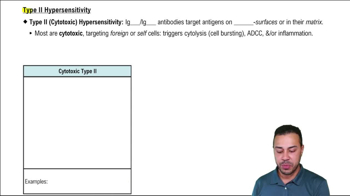
 06:45
06:45