What initiates tissue damage in type III hypersensitivities?
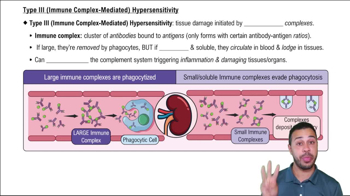
Tissue damage is initiated by immune complexes, which are clusters of antibodies bound to antigens.
Why are small, soluble immune complexes more problematic than large ones?
Small, soluble immune complexes can evade phagocytosis, circulate in the blood, and deposit in tissues, leading to inflammation and tissue damage.
What role does the complement system play in type III hypersensitivities?
The complement system is activated by deposited immune complexes, which triggers inflammation and contributes to tissue damage.
What are two examples of diseases caused by type III hypersensitivities?
Examples include rheumatoid arthritis and glomerulonephritis.
How do immune complexes form?
Immune complexes form when antibodies bind to antigens in the right ratio.
What is the difference between localized and systemic type III hypersensitivity reactions?
Localized reactions, like the Arthus reaction, affect a specific tissue, while systemic reactions, like serum sickness, impact multiple tissues throughout the body.
What is the Arthus reaction and what causes it?
The Arthus reaction is a localized type III hypersensitivity caused by immune complexes forming at the site of antigen injection, such as after a booster vaccine.
What is serum sickness and how does it differ from the Arthus reaction?
Serum sickness is a systemic type III hypersensitivity where immune complexes form in the blood and affect multiple body parts, unlike the localized Arthus reaction.
Why can type III hypersensitivities be considered autoimmune disorders?
They can be autoimmune if the immune complexes form with self antigens, leading the immune system to attack the body's own tissues.
What is glomerulonephritis and how is it related to type III hypersensitivity?
Glomerulonephritis is inflammation of the kidney's glomeruli caused by immune complexes depositing in the kidneys, leading to tissue damage.
How do neutrophils contribute to tissue damage in type III hypersensitivities?
Neutrophils are attracted to sites of immune complex deposition and release enzymes from their granules, which damage inflamed tissues.
What distinguishes rheumatoid arthritis from osteoarthritis?
Rheumatoid arthritis is caused by immune complex-mediated inflammation due to immune system dysfunction, while osteoarthritis results from mechanical wear and tear.
What is systemic lupus erythematosus (SLE) and how do immune complexes play a role?
SLE is a chronic autoimmune disorder where autoantibodies form immune complexes with self antigens like DNA, causing widespread inflammation and tissue damage.
Why do we not fully understand why immune complexes deposit in specific tissues?
The exact reasons why immune complexes lodge in certain tissues, such as joints or kidneys, are still unclear and under research.
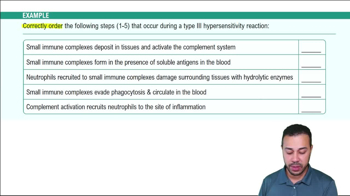
What is the first step in the development of a type III hypersensitivity reaction?
The first step is the formation of immune complexes when antibodies bind to antigens.
 Back
Back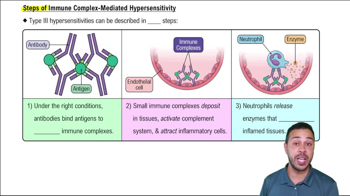
 02:22
02:22