Skip to main content
Microbiology
My Course
Learn
Exam Prep
AI Tutor
Study Guides
Textbook Solutions
Flashcards
Explore
Try the app
My Course
Learn
Exam Prep
AI Tutor
Study Guides
Textbook Solutions
Flashcards
Explore
Try the app
Back
Type IV Hypersensitivities definitions
You can tap to flip the card.
Type IV Hypersensitivity
You can tap to flip the card.
👆
Type IV Hypersensitivity
A delayed immune overreaction mediated by T cells, peaking 24-72 hours after antigen re-exposure, distinct from antibody-driven responses.
Track progress
Control buttons has been changed to "navigation" mode.
1/15
Related flashcards
Related practice
Recommended videos
Type IV Hypersensitivities quiz
Type IV Hypersensitivities
15 Terms
Type IV Hypersensitivities
27. Immunological Disorders
5 problems
Topic
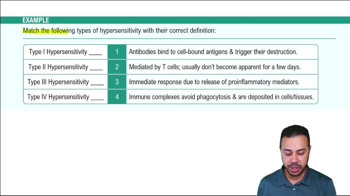
Reviewing the 4 Types of Hypersensitivities
27. Immunological Disorders
4 problems
Topic
27. Immunological Disorders - Part 1 of 2
4 topics
11 problems
Chapter
27. Immunological Disorders - Part 2 of 2
4 topics
6 problems
Chapter
04:10
Type IV Hypersensitivity
183
views
3
rank
01:53
Type IV Hypersensitivities Example 1
170
views
5
rank
03:47
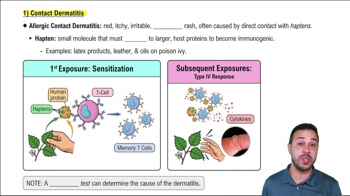
1) Contact Dermatitis
170
views
3
rank
Terms in this set (15)
Hide definitions
Type IV Hypersensitivity
A delayed immune overreaction mediated by T cells, peaking 24-72 hours after antigen re-exposure, distinct from antibody-driven responses.
T Cell
A lymphocyte responsible for mediating delayed hypersensitivity reactions and forming immune memory after antigen exposure.
Sensitization
The initial immune process where T cells are primed by first antigen exposure, enabling a stronger response upon re-exposure.
Memory T Cell
A long-lived lymphocyte formed after sensitization, enabling rapid and robust responses to previously encountered antigens.
Contact Dermatitis
A red, itchy, inflamed skin rash resulting from T cell-mediated response to haptens after repeated contact.
Hapten
A small molecule that becomes immunogenic only after binding to a host protein, triggering T cell-mediated reactions.
Patch Test
A diagnostic method used to identify the specific substance causing allergic contact dermatitis by observing skin reactions.
Tuberculin Skin Test
A screening procedure using purified protein derivative to detect immune memory of tuberculosis exposure, not active infection.
Purified Protein Derivative (PPD)
A protein extract from Mycobacterium tuberculosis used in skin testing to assess prior immune exposure.
Induration
A raised, red, and firm area on the skin indicating a positive delayed hypersensitivity reaction in tests like the tuberculin skin test.
Autoimmune Disorder
A condition where the immune system attacks self antigens, sometimes triggered by T cell-mediated hypersensitivity.
Self Tolerance
A mechanism preventing immune responses against the body's own antigens; its failure can lead to autoimmunity.
Cytokine
A signaling molecule released by T cells that orchestrates inflammation and tissue changes during delayed hypersensitivity.
Adaptive Immunity
A branch of the immune system involving memory and specificity, crucial for delayed T cell-mediated responses.
Mycobacterium tuberculosis
The bacterium whose proteins are used in PPD testing to check for immune memory of tuberculosis exposure.
 BackBack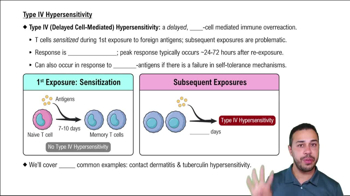
 04:10
04:10