Back

Types of Phosphorylation definitions

Control buttons has been changed to "navigation" mode.
1/14
  • Aerobic Cellular Respiration

    A multi-stage process in cells that generates ATP using oxygen, producing the majority of cellular energy.
  • ATP

    A high-energy molecule that stores and supplies energy for many cellular processes.
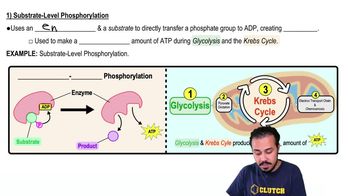
  • Substrate-Level Phosphorylation

    A process where an enzyme transfers a phosphate group from a substrate directly to ADP, forming ATP.
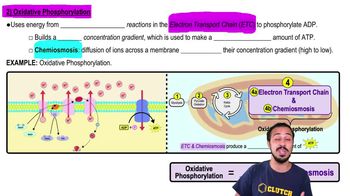
  • Oxidative Phosphorylation

    A two-step process using redox reactions and a hydrogen ion gradient to produce large amounts of ATP.
  • Glycolysis

    The first stage of aerobic respiration, breaking down glucose and producing a small amount of ATP.
  • Krebs Cycle

    A stage in aerobic respiration that generates electron carriers and a small amount of ATP via substrate-level phosphorylation.
  • Electron Transport Chain

    A series of protein complexes that transfer electrons, creating a hydrogen ion gradient across a membrane.
  • Chemiosmosis

    The movement of hydrogen ions down their concentration gradient across a membrane, driving ATP synthesis.
  • Redox Reactions

    Chemical reactions involving the transfer of electrons, providing energy for ATP production in cells.
  • Hydrogen Ion Concentration Gradient

    A difference in hydrogen ion levels across a membrane, used to power ATP synthesis during chemiosmosis.
  • ADP

    A low-energy molecule that is converted into ATP by the addition of a phosphate group.
  • Phosphate Group

    A chemical group transferred to ADP during phosphorylation, enabling the formation of ATP.
  • Enzyme

    A protein that catalyzes biochemical reactions, such as transferring phosphate groups during ATP production.
  • Pyruvate Oxidation

    A stage in aerobic respiration that links glycolysis to the Krebs cycle but does not produce ATP via substrate-level phosphorylation.