Back

Types of Phosphorylation quiz

Control buttons has been changed to "navigation" mode.
1/15
  • What are the two types of phosphorylation that produce ATP during aerobic cellular respiration?

    The two types are substrate-level phosphorylation and oxidative phosphorylation.
  • During which stages of aerobic cellular respiration does substrate-level phosphorylation occur?

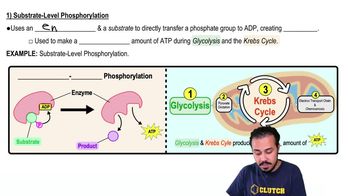
    Substrate-level phosphorylation occurs during glycolysis and the Krebs cycle.
  • How does substrate-level phosphorylation generate ATP?

    It directly transfers a phosphate group from a phosphorylated substrate to ADP using an enzyme.
  • Does substrate-level phosphorylation produce a large or small amount of ATP?

    It produces a small amount of ATP.
  • Which stages of aerobic cellular respiration do NOT involve substrate-level phosphorylation?

    Pyruvate oxidation and the electron transport chain do not involve substrate-level phosphorylation.
  • How many ATP molecules are produced by substrate-level phosphorylation in glycolysis and the Krebs cycle each?

    Each produces 2 ATP molecules.
  • What are the two steps involved in oxidative phosphorylation?

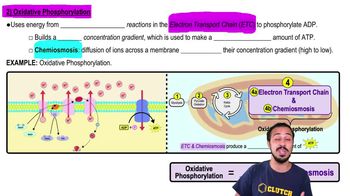
    The two steps are the electron transport chain (ETC) and chemiosmosis.
  • What is the main function of the electron transport chain in oxidative phosphorylation?

    It builds a hydrogen ion (H+) concentration gradient using energy from redox reactions.
  • What is chemiosmosis?

    Chemiosmosis is the diffusion of hydrogen ions across a membrane down their concentration gradient, which is used to phosphorylate ADP into ATP.
  • In which stage of aerobic cellular respiration does oxidative phosphorylation occur?

    It occurs in the fourth and final stage, which includes the electron transport chain and chemiosmosis.
  • Does oxidative phosphorylation produce more or less ATP than substrate-level phosphorylation?

    Oxidative phosphorylation produces much more ATP than substrate-level phosphorylation.
  • What type of reactions provide the energy for oxidative phosphorylation?

    Oxidation-reduction (redox) reactions provide the energy.
  • What is the main purpose of oxidative phosphorylation in cellular respiration?

    Its main purpose is to generate a large amount of ATP for the cell.
  • What two processes must occur together for oxidative phosphorylation to take place?

    Both the electron transport chain and chemiosmosis must occur together.
  • Which process is responsible for generating the vast majority of ATP in aerobic cellular respiration?

    Oxidative phosphorylation is responsible for generating the vast majority of ATP.