Skip to main content
Microbiology
My Course
Learn
Exam Prep
AI Tutor
Study Guides
Textbook Solutions
Flashcards
Explore
Try the app
My Course
Learn
Exam Prep
AI Tutor
Study Guides
Textbook Solutions
Flashcards
Explore
Try the app
Back
Adaptive Immunity in Microbiology
You can tap to flip the card.
What distinguishes adaptive immunity from innate immunity?
You can tap to flip the card.
👆
What distinguishes adaptive immunity from innate immunity?
Adaptive immunity is specific to particular antigens, takes longer to respond, and has memory, while innate immunity is immediate and nonspecific.
Track progress
Control buttons has been changed to "navigation" mode.
1/29
Recommended videos
04:57
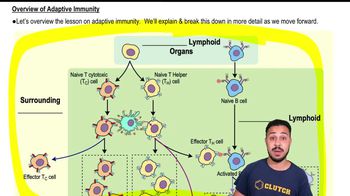
Overview of Adaptive Immunity
1841
views
13
rank
04:58
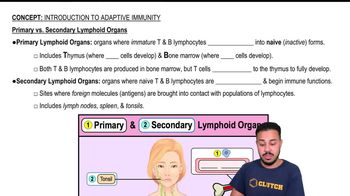
Primary vs. Secondary Lymphoid Organs
2332
views
27
rank
05:47
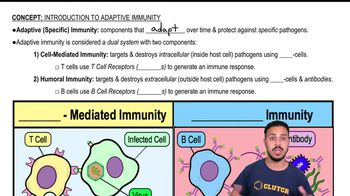
Introduction to Adaptive Immunity
2930
views
50
rank
Terms in this set (29)
Hide definitions
What distinguishes adaptive immunity from innate immunity?
Adaptive immunity is specific to particular antigens, takes longer to respond, and has memory, while innate immunity is immediate and nonspecific.
What are the two main branches of the adaptive immune system?
Cellular response (T cell–mediated immunity) and humoral response (antibody–mediated immunity).
Where do T cells mature and what is their role?
T cells mature in the thymus and play roles in both humoral and cellular immunity.
What is the primary function of B cells in adaptive immunity?
B cells coordinate the humoral response by producing antibodies.
What are the four main stages of adaptive immune responses?
1) Antigen presentation, 2) Lymphocyte activation, 3) Lymphocyte proliferation and differentiation, 4) Antigen elimination and memory.
What is an antigen?
Any substance, mostly proteins or polysaccharides, that can trigger an immune response.
What factors impact an antigen's immunogenicity?
Antigen size, molecular complexity, and chemical composition.
What are epitopes?
Specific parts of an antigen recognized by B and T cells.
How do T cells recognize antigens?
T cells recognize antigens presented by major histocompatibility complex (MHC) molecules using T cell receptors (TCRs).
What is the difference between MHC I and MHC II molecules?
MHC I presents intracellular antigens to CD8+ cytotoxic T cells; MHC II presents extracellular antigens to CD4+ helper T cells.
What are the two main lineages of T cells and their markers?
T cytotoxic cells (CD8+) and T helper cells (CD4+).
What is the role of helper T cells (TH cells)?
They release cytokines to activate B cells, macrophages, and cytotoxic T cells.
How do cytotoxic T cells kill infected cells?
By releasing perforins that form pores and granzymes that induce apoptosis.
What is clonal expansion in adaptive immunity?
Activated B or T cells divide to produce clones that recognize the same antigen epitope.
What are plasma cells?
Effector B cells that produce and secrete antibodies.
What are memory cells?
Long-lived lymphocytes that provide rapid response upon re-exposure to the same antigen.
What are the five antibody isotypes?
IgG, IgA, IgM, IgE, and IgD.
Which antibody is most abundant in blood and crosses the placenta?
IgG.
What antibody is prevalent in mucous membranes and secretions?
IgA.
What antibody is produced early in infection and exists as a pentamer?
IgM.
Which antibody mediates allergic responses and fights parasites?
IgE.
What is the difference between T-dependent and T-independent B cell activation?
T-dependent activation requires helper T cells; T-independent activation involves repetitive antigens directly binding multiple BCRs.
What is isotype switching in B cells?
The process by which B cells change the class of antibody they produce without altering antigen specificity.
What are the four classifications of adaptive immunity?
Naturally acquired active, artificially acquired active, naturally acquired passive, and artificially acquired passive immunity.
What is the role of antigen-presenting cells (APCs)?
APCs, like dendritic cells, engulf pathogens and present antigens to T cells to initiate adaptive immunity.
What is the significance of self-tolerance in adaptive immunity?
It prevents T and B cells from attacking the body's own cells by eliminating self-reactive lymphocytes.
What is a superantigen?
An antigen that non-specifically activates large numbers of T helper cells, causing excessive cytokine release and potential shock.
How do helper T cells influence the development of TH1 and TH2 cells?
Cytokines IL-12 and INF-γ promote TH1 cells; IL-2 and IL-4 promote TH2 cells.
What is the role of interferons in viral infections?
They recruit cytotoxic T cells and enhance MHC I production to alert the immune system.
 BackBack
 04:57