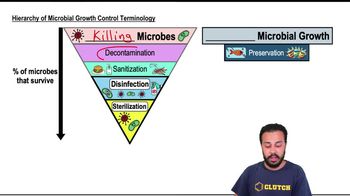
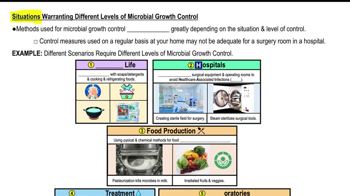
Sepsis refers to microbial contamination. Asepsis is the absence of significant contamination, often maintained by aseptic surgical techniques.
Who were early contributors to aseptic techniques?
Ignatz Semmelweiss (handwashing), Florence Nightingale (battlefield aseptic techniques), and John Lister (aseptic surgery and use of phenol).
What is Decimal Reduction Time (DRT)?
The time required to kill 90% of a bacterial population at a given temperature, indicating microbial death at a constant logarithmic rate.
List key selection criteria for antimicrobial procedures.
Type and number of microorganisms, environmental conditions (pH, temperature, organic matter), infection risk, compatibility, residue, cost, storage, toxicity, and odor.
What are sterilants and how do they differ from disinfectants?
Sterilants kill all living organisms including endospores. Disinfectants vary in level and may not kill all spores.
Describe the action of microbial control agents.
They alter membrane permeability, damage proteins and nucleic acids, and disrupt energy-producing systems.
What is the thermal death point (TDP)?
The lowest temperature at which all cells in a culture are killed in 10 minutes.
Explain Tyndallization.
A method of intermittent boiling to destroy bacterial endospores by repeated heating and incubation cycles.
What is pasteurization and its types?
A process to reduce spoilage organisms: HTST (15 sec at 72°C) and UHT (1-3 sec at 140°C) for pathogen destruction and extended storage.
How does an autoclave sterilize?
Uses moist heat (steam under pressure) at 121°C and 15 PSI to denature proteins and kill all microorganisms including spores.
What are common dry heat sterilization methods?
Flaming, incineration (1 sec at 1000°C), and hot-air sterilization (170°C for 2 hours).
Name physical methods of microbial control besides heat.
 Back
 07:36