Back

Microbial Control Methods and Terminology

Control buttons has been changed to "navigation" mode.
1/27
  • Sepsis vs Asepsis and antisepsis


    Sepsis refers to bacterial contamination, while

    asepsis is the absence of significant contamination.

    antisepsis destroys harmful microbes on living tissue.

  • Sterilization

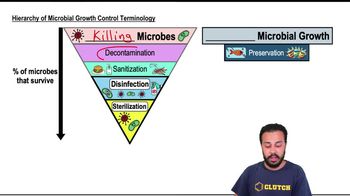
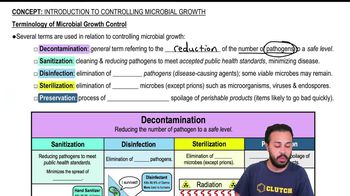
    Sterilization is the process of removing and destroying all microbial life, including endospores.
  • Commercial Sterilization

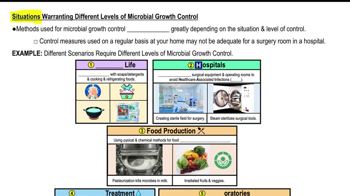
    Killing Clostridium botulinum endospores from canned goods to prevent foodborne illness.
  • Disinfection


    Disinfection destroys harmful microorganisms on inanimate objects;

  • Degerming and Sanitization

    Degerming is the mechanical removal of microbes from a limited area;

    sanitization lowers microbial counts on eating utensils to safe levels.

  • Bacteriostasis

    Inhibiting microbial growth without killing the microbes.
  • Thermal Death Point (TDP)

    Lowest temperature at which all cells in a liquid culture are killed in 10 minutes.
  • Thermal Death Time (TDT)

    Minimum time required to kill all bacteria in a liquid culture at a specific temperature.
  • Decimal Reduction Time (DRT)

    Time needed to kill 90% of a bacterial population at a given temperature.
  • Autoclave conditions for sterilization

    Steam under pressure at 121°C and 15 psi for 15 minutes kills all organisms and endospores.
  • Pasteurization

    Reduces spoilage organisms and pathogens using high-temperature short-time (72°C for 15 seconds).
  • Dry Heat Sterilization methods

    Kills microbes by oxidation using flaming, incineration, or hot-air sterilization.
  • Filtration for microbial control

    Passage through screenlike material; HEPA filters remove microbes >0.3 μm; membrane filters remove >0.22 μm.
  • Effect of low temperature on microbes

    Bacteriostatic effect via refrigeration, deep-freezing, or lyophilization (freeze drying).
  • Ionizing vs Nonionizing Radiation

    Ionizing radiation creates hydroxyl radicals damaging DNA; nonionizing UV radiation causes thymine dimers in DNA.
  • Use-Dilution Test

    Tests disinfectant efficacy by exposing bacteria-coated cylinders to disinfectant and checking survival.
  • Disk-Diffusion Method

    Evaluates chemical agent efficacy by measuring zone of inhibition around soaked filter paper disks on cultures.
  • Phenol and Phenolics action

    Injure lipids of plasma membranes causing leakage and cell damage.
  • Biguanides (e.g., Chlorhexidine)

    Disrupt plasma membranes; used in surgical hand scrubs.
  • Halogens as antimicrobial agents

    Iodine impairs protein synthesis and disrupts membranes; chlorine oxidizes and shuts down enzyme systems.
  • Alcohols for microbial control

    Denature proteins and dissolve lipids; effective at ~70% concentration; no effect on endospores or nonenveloped viruses.
  • Oligodynamic action of heavy metals

    Small amounts of metals like Ag, Hg, Cu, Zn denature proteins and exert antimicrobial effects.
  • Quaternary Ammonium Compounds (Quats)

    Surface-active agents that disrupt membranes and are used as disinfectants.
  • Chemical food preservatives

    Sulfur dioxide prevents wine spoilage; organic acids inhibit metabolism; nitrites prevent endospore germination.
  • Chemical sterilization with gaseous sterilants

    Alkylation replaces hydrogen atoms, cross-linking nucleic acids and proteins; used for heat-sensitive materials.
  • Plasma in microbial control

    Electrically excited gas producing free radicals that destroy microbes; used for sterilizing tubular instruments.
  • Peroxygens and other oxygen forms

    Oxidizing agents like O3, H2O2, and peracetic acid used for contaminated surfaces and food packaging.