 Back
BackMicrobial Control Methods in Microbiology
 07:36
07:36
Terms in this set (22)
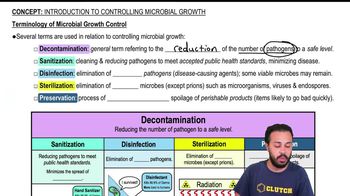
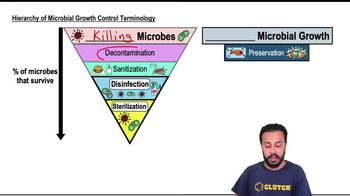
Sterilization is the complete removal or destruction of all viable microorganisms, including bacterial endospores.
Disinfection is the destruction of most microbial life, excluding endospores, on inanimate surfaces.
Antisepsis is the application of chemical agents to exposed body surfaces to destroy or inhibit vegetative pathogens.
Most resistant: Prions > Bacterial endospores > Mycobacterium > Staphylococcus and Pseudomonas > Protozoan cysts; Moderately resistant: Protozoan trophozoites, most Gram-negative bacteria, fungi, nonenveloped viruses; Least resistant: Most Gram-positive bacteria, enveloped viruses.
Microbicidal agents kill microorganisms; microbistatic agents inhibit growth without killing.
Cell wall, cytoplasmic membrane, cellular synthetic processes (DNA, RNA), and proteins.
Number of microbes, nature of microbes, temperature and pH, agent concentration and mode of action, presence of organic matter.
Moist heat denatures proteins and destroys membranes; methods include boiling, pasteurization, and autoclaving.
Dry heat dehydrates cells, denatures proteins, and oxidizes cell components; methods include incineration and hot air ovens.
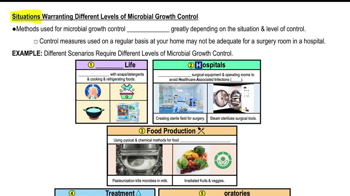
Pasteurization disinfects beverages by killing pathogens and reducing spoilage organisms while preserving flavor and nutrients.
Autoclaving uses steam at 121°C and 15 psi for 15–20 minutes to sterilize most heat-resistant materials.
Incineration uses direct flame or high heat to reduce microbes to ashes, sterilizing inoculating loops and disposing of waste.
Cold slows microbial growth (microbistatic) but does not kill most microbes; used for food preservation and culture storage.
Lyophilization is freeze-drying used for long-term preservation of microbial cultures.
Ionizing radiation (gamma rays, X-rays) penetrates deeply and sterilizes heat-sensitive materials by damaging DNA.
UV radiation causes DNA mutations like thymine dimers, used for surface disinfection.
Filtration physically removes microbes from air and liquids using filters with defined pore sizes; used for sterilizing heat-sensitive solutions.
High salt or sugar concentrations create hypertonic environments causing plasmolysis and inhibiting microbial growth; used in food preservation.
Rapid action, broad-spectrum activity, non-toxic, surface penetration, stability, noncorrosive, affordable, and available.
High-level kills endospores; intermediate kills fungal spores and resistant pathogens; low-level kills vegetative bacteria and some viruses.
TDT is the shortest time required to kill all microbes at a specified temperature.
TDP is the lowest temperature required to kill all microbes in 10 minutes.