 Back
BackMicrobial Metabolism - Microbiology
 02:17
02:17
Terms in this set (29)
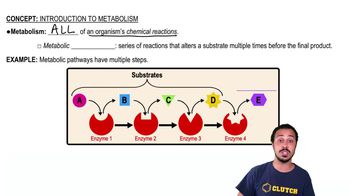
Metabolism is the sum of all chemical reactions within a living organism that provide energy and create substances sustaining life.
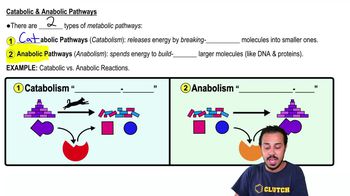
Catabolism breaks down complex molecules, releasing energy (exergonic). Anabolism builds complex molecules using energy (endergonic).
ATP stores energy released by catabolic reactions and provides energy for anabolic reactions.
Enzymes are biological catalysts that speed up chemical reactions by lowering activation energy without being consumed.
Activation energy is the minimum collision energy required for a chemical reaction to occur.
Enzymes bind substrates at their active site, form an enzyme-substrate complex, transform substrates into products, and release them unchanged.
Apoenzyme (protein part, inactive alone), cofactor (nonprotein activator), and holoenzyme (active enzyme = apoenzyme + cofactor).
Temperature, pH, substrate concentration, and inhibitors affect enzyme activity; extreme temperature or pH can denature enzymes.
Competitive inhibitors bind the active site, blocking substrate binding. Noncompetitive inhibitors bind allosteric sites, changing enzyme shape and function.
End-product of a metabolic pathway binds allosterically to the first enzyme, inhibiting the pathway to regulate product levels.
Ribozymes are RNA molecules that act as catalysts, often involved in RNA splicing and protein synthesis.
Oxidation is the loss of electrons; reduction is the gain of electrons; redox reactions involve both processes.
ATP is generated by phosphorylation of ADP via substrate-level, oxidative, or photophosphorylation.
ATP is formed by direct transfer of a phosphate group from a phosphorylated substrate to ADP.
Electrons pass through an electron transport chain, creating a proton gradient used by ATP synthase to generate ATP.
Light energy excites electrons in photosynthetic cells, driving ATP synthesis via an electron transport chain.
Glycolysis oxidizes glucose to pyruvic acid, producing a net gain of 2 ATP and 2 NADH through 10 enzymatic steps.
Alternative pathways to glycolysis that produce NADPH and intermediates for biosynthesis; Entner-Doudoroff also produces ATP.
Acetyl CoA is oxidized, producing NADH, FADH2, ATP, and releasing CO2 as waste.
Oxygen (O2) is the final electron acceptor in aerobic respiration, forming water.
Aerobic uses oxygen as final electron acceptor; anaerobic uses other inorganic molecules, yielding less energy.
Energy-releasing process that does not require oxygen, uses organic molecules as final electron acceptors, and produces small ATP amounts.
Lactic acid, ethanol, CO2, propionic acid, butanol, acetone, and others depending on the organism.
Lipids are broken into glycerol and fatty acids; proteins into amino acids, which enter metabolic pathways after modification.
By detecting enzymes through tests like fermentation, oxidase, decarboxylation, deamination, and H2S production.
Cyclic photophosphorylation recycles electrons to produce ATP only; noncyclic produces ATP and NADPH with oxygen release.
Light-independent reaction using ATP and NADPH to fix CO2 into sugars.
Chemoautotrophs use inorganic chemicals and CO2; chemoheterotrophs use organic chemicals for energy and carbon.
Metabolic pathways functioning in both anabolism and catabolism, sharing intermediates.