 Back
BackMicrobial Nutrition and Growth
 02:20
02:20
Terms in this set (20)
Macronutrients are needed in large amounts and are essential for cell structure and metabolism. Examples include carbon, hydrogen, and oxygen.
Micronutrients are needed in small amounts and are important for enzyme function and protein structure. Examples include manganese, zinc, and nickel.
Inorganic nutrients lack both carbon and hydrogen (e.g., water, salts). Organic nutrients contain both carbon and hydrogen, often from living things (e.g., carbohydrates, proteins).
Elements CHONPS (carbon, hydrogen, oxygen, nitrogen, phosphorus, sulfur) make up 96% of dry cell weight.
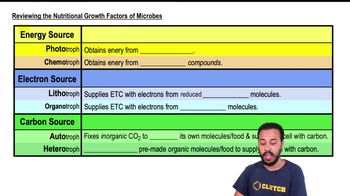
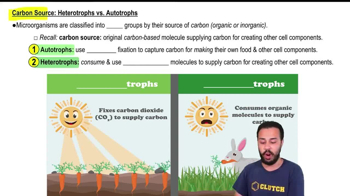
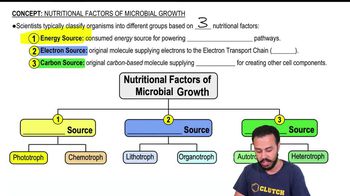
Heterotrophs obtain carbon from organic sources. Autotrophs use inorganic CO2 as a carbon source and convert it into organic compounds.
Phototrophs use light as an energy source. Chemotrophs use chemical compounds for energy.
Potassium is essential for protein synthesis and membrane function.
Passive transport includes diffusion and facilitated diffusion, moving substances from high to low concentration without energy.
Active transport requires energy (ATP) and membrane proteins to move substances against the concentration gradient.
Osmosis is water diffusion through a membrane. In hypotonic solutions, cells swell; in hypertonic, cells shrink (plasmolysis); isotonic solutions cause no net water movement.
Psychrophiles grow optimally below 15°C and can grow at 0°C.
Facultative anaerobes use oxygen if present but can grow without it.
Mutualism is a relationship where both organisms benefit.
Pioneer bacteria colonize a surface, secrete extracellular material, other species join, and biofilms release bacteria to become free-living.
Binary fission involves cell enlargement, chromosome duplication, septum formation, and division into two daughter cells.
Lag phase (adjustment), exponential phase (rapid growth), stationary phase (birth=death), death phase (cell decline).
Viable plate count, turbidity measurement, direct microscopic count, Coulter counter, flow cytometer, and genetic probing (PCR).
Iron is essential for cytochrome proteins involved in respiration.
Magnesium is a component of chlorophyll and stabilizes membranes and ribosomes.
Plasmolysis is the shrinking of the cell membrane away from the cell wall due to water loss in hypertonic environments.