Skip to main content
Microbiology
My Course
Learn
Exam Prep
AI Tutor
Study Guides
Textbook Solutions
Flashcards
Explore
Try the app
My Course
Learn
Exam Prep
AI Tutor
Study Guides
Textbook Solutions
Flashcards
Explore
Try the app
Back
Microbiology: Changes in Genetic Material
You can tap to flip the card.
What is a mutation?
You can tap to flip the card.
👆
What is a mutation?
A
mutation
is a permanent change in the base sequence of DNA that can alter the function of the encoded gene product.
Track progress
Control buttons has been changed to "navigation" mode.
1/21
Recommended videos
02:47
Spontaneous vs. Induced Mutations
2224
views
21
rank
00:37
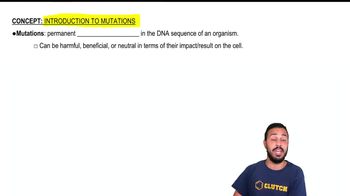
Introduction to Mutations
2222
views
29
rank
08:44
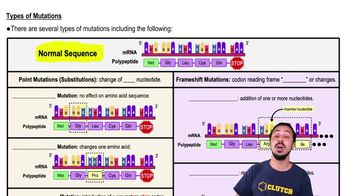
Types of Mutations
11396
views
122
rank
Terms in this set (21)
Hide definitions
What is a mutation?
A
mutation
is a permanent change in the base sequence of DNA that can alter the function of the encoded gene product.
What is natural selection in bacteria?
The survival and reproduction of bacteria with new genotypes favored by environmental conditions is called
natural selection
.
What is a base substitution mutation?
A
base substitution
or point mutation replaces a single base pair in DNA, potentially changing an amino acid in the protein.
Define missense mutation.
A
missense mutation
is a base substitution that changes one amino acid in the protein sequence.
What is a nonsense mutation?
A
nonsense mutation
creates a stop codon prematurely, resulting in a truncated, usually nonfunctional protein.
What is a frameshift mutation?
A
frameshift mutation
involves insertion or deletion of nucleotides that shifts the reading frame, altering many downstream amino acids.
What causes spontaneous mutations?
Spontaneous mutations occur due to occasional errors during DNA replication without external mutagenic agents.
What are mutagens?
Mutagens
are environmental agents like chemicals or radiation that increase the mutation rate by damaging DNA.
How does nitrous acid act as a mutagen?
Nitrous acid alters adenine so it pairs with cytosine instead of thymine, causing base-pair substitutions during replication.
What are nucleoside analogs?
Nucleoside analogs are chemical mutagens structurally similar to normal bases but cause incorrect base pairing when incorporated into DNA.
How does UV light cause mutations?
UV light induces thymine dimers by covalently linking adjacent thymines, distorting DNA and blocking replication and transcription.
What is photoreactivation?
Photoreactivation
uses light-repair enzymes (photolyases) to reverse thymine dimers caused by UV light.
Describe nucleotide excision repair.
Nucleotide excision repair removes damaged DNA segments and fills the gap with newly synthesized DNA complementary to the correct strand.
What is the typical spontaneous mutation rate?
The spontaneous mutation rate is about \(10^{-6}\) mutations per replicated gene.
How do mutagens affect mutation rates?
Mutagens increase mutation rates by 10 to 1000 times, raising the rate from \(10^{-6}\) to between \(10^{-5}\) and \(10^{-3}\).
What is positive (direct) selection of mutants?
Positive selection identifies mutants by allowing only mutant cells with a specific trait (e.g., antibiotic resistance) to grow.
What is negative (indirect) selection using replica plating?
Negative selection identifies mutants that cannot perform a function by comparing growth on media with and without a required nutrient.
Define auxotroph.
An
auxotroph
is a mutant microorganism that requires a specific growth factor absent in the parent strain.
What is the Ames test used for?
The Ames test detects mutagenic and potential carcinogenic chemicals by measuring the reversion of histidine auxotrophs to prototrophs in bacteria.
Why is rat liver extract used in the Ames test?
Rat liver extract provides enzymes that activate chemicals into mutagenic forms, mimicking metabolism in animals.
Are all mutagens carcinogens?
No, but about 90% of substances positive in the Ames test are also carcinogenic in animals.
 BackBack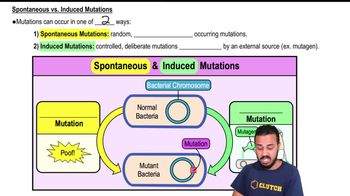
 02:47
02:47