Skip to main content
Microbiology
My Course
Learn
Exam Prep
AI Tutor
Study Guides
Textbook Solutions
Flashcards
Explore
Try the app
My Course
Learn
Exam Prep
AI Tutor
Study Guides
Textbook Solutions
Flashcards
Explore
Try the app
Back
Microbiology: Classification and Identification of Microorganisms
You can tap to flip the card.
What is taxonomy in microbiology?
You can tap to flip the card.
👆
What is taxonomy in microbiology?
Taxonomy
is the science of classifying organisms to reflect their similarities and evolutionary relationships.
Track progress
Control buttons has been changed to "navigation" mode.
1/20
Recommended videos
01:37
Introduction to Taxonomy Example 2
14320
views
303
rank
06:14
Categorizing Life Based on Energy Acquisition
15664
views
379
rank
02:23
Introduction to Taxonomy
26688
views
595
rank
Terms in this set (20)
Hide definitions
What is taxonomy in microbiology?
Taxonomy
is the science of classifying organisms to reflect their similarities and evolutionary relationships.
Define phylogeny.
Phylogeny
is the evolutionary history and relationships among organisms.
What are the three domains of life according to Woese's system?
Bacteria
,
Archaea
, and
Eukarya
based on rRNA sequences and molecular evidence.
Key difference in cell wall composition between Archaea and Bacteria?
Archaea have cell walls that
vary in composition and lack peptidoglycan
, while Bacteria have cell walls containing
peptidoglycan
.
What is the first amino acid in protein synthesis for Archaea and Bacteria?
Archaea use
methionine
, while Bacteria use
formylmethionine
.
Describe the endosymbiont theory.
Eukaryotic organelles like mitochondria and chloroplasts originated from
prokaryotic cells living inside ancestral eukaryotes
.
How do prokaryotic and eukaryotic cells differ in DNA structure?
Prokaryotes have
one circular DNA molecule
, while eukaryotes have
linear DNA
.
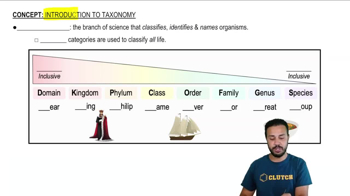
What is the taxonomic hierarchy from broadest to most specific?
Domain, Kingdom, Phylum, Class, Order, Family, Genus, Species
.
What is binomial nomenclature?
A system assigning each organism a two-part name:
Genus (capitalized)
and
species (lowercase)
, both italicized.
What is Bergey’s Manual used for?
It is the standard reference for
prokaryotic classification and identification
based on morphology, staining, and biochemical tests.
How does Gram staining differentiate bacteria?
It differentiates bacteria based on
cell wall properties
, classifying them as Gram-positive or Gram-negative.
What is the principle of the slide agglutination test?
Bacteria clump when mixed with specific antibodies, indicating a
positive antigen-antibody reaction
.
What does ELISA detect in microbiology?
ELISA detects
antigens or antibodies
in a sample for rapid diagnostics.
What is phage typing used for?
Determines bacterial susceptibility to specific bacteriophages for
epidemiological tracing
.
How does flow cytometry help in microbial identification?
Analyzes physical and chemical characteristics of cells using lasers to distinguish species often
without culturing
.
What does nucleic acid hybridization measure?
The ability of DNA from different organisms to hybridize; >70% hybridization indicates the
same species
.
What is the role of PCR in microbial identification?
PCR amplifies DNA for identification, even from
unculturable organisms
.
What is a dichotomous key?
A tool for identification based on a series of
choices between two alternatives
.
What is a cladogram?
A branching diagram depicting
evolutionary relationships
based on genetic data.
How do Archaea membrane lipids differ from Bacteria?
Archaea have
branched carbon chains attached by ether linkages
, while Bacteria have
straight chains with ester linkages
.
 BackBack
 01:37
01:37