 Back
BackMicrobiology: Classification and Identification of Microorganisms
 01:37
01:37

Terms in this set (21)
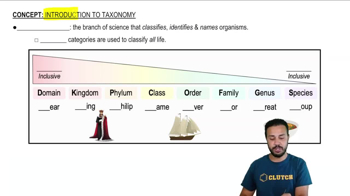
Taxonomy is the science of classifying organisms, showing the degree of similarity among them.
Systematics, or phylogeny, is the study of the evolutionary history of organisms.
Woese developed the three-domain system in 1978 based on sequences of nucleotides in rRNA.
The three domains are Bacteria, Archaea, and Eukarya.
Archaea have unique membrane lipids, no peptidoglycan in cell walls, and include methanogens and extremophiles, differing from bacteria.
Endosymbiotic bacteria developed into organelles like mitochondria and chloroplasts in eukaryotes.
Binomial nomenclature uses a two-part name: genus and specific epithet to consistently name organisms worldwide.
A prokaryotic species is a population of cells with similar characteristics.
Culture: bacteria grown in lab media; Clone: cells from a single parent; Strain: genetically different cells within a clone.
Eukarya includes kingdoms Fungi, Plantae, Animalia, and Protista.
Viruses are not composed of cells and require a host cell, so they are not part of any domain.
Bergey’s Manual provides identification schemes for bacteria and archaea.
Biochemical tests detect bacterial enzymes to differentiate species based on metabolic characteristics.
Bacteria agglutinate when mixed with specific antibodies, indicating antigen-antibody reaction.
ELISA uses enzyme-linked antibodies to detect antigens, producing a visible color change to identify bacteria.
Western blotting identifies antibodies in patient serum to confirm infections like HIV and Lyme disease.
Phage typing determines which bacteriophages infect and lyse a bacterial strain, shown by clear plaques on a plate.
DNA fingerprinting uses electrophoresis of restriction enzyme-digested DNA to compare genetic similarities.
It measures the ability of DNA strands from different organisms to hybridize; >70% hybridization indicates the same species.
A DNA chip contains probes that detect pathogens by hybridization with sample DNA, detected by fluorescence.
A cladogram is a map showing evolutionary relationships among organisms based on rRNA sequences.