 Back
BackMicrobiology Exam 4 Study Aid
 02:41
02:41
Terms in this set (41)
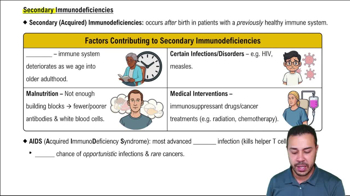
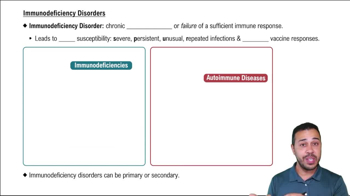
Immunodeficiency is a state where the immune system's ability to fight infectious disease is compromised or absent.
Autoimmunity is when the immune system attacks the body's own cells and tissues.
Hypersensitivity is an exaggerated or inappropriate immune response to an antigen causing inflammation and tissue damage.
An allergen is a substance that causes an allergic reaction by triggering an abnormal immune response.
Type I hypersensitivity is a rapid allergic reaction mediated by IgE antibodies, examples include asthma and hay fever.
An autoimmune disorder occurs when the immune system attacks the body's own tissues; examples include lupus and type 1 diabetes.
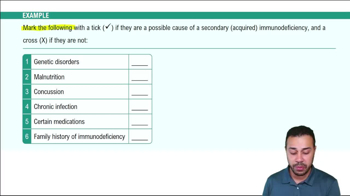
Primary immunodeficiencies are genetic and present at birth; secondary immunodeficiencies are acquired later due to external factors.
Type I: Allergic, Type II: Cytotoxic, Type III: Immune complex, Type IV: Delayed hypersensitivity.
Degranulation is the release of inflammatory mediators from mast cells or basophils after allergen binding to IgE.
Systemic anaphylaxis is a severe, life-threatening allergic reaction affecting multiple organs, potentially causing shock.
Type II hypersensitivity involves IgG or IgM antibodies binding to cell surface antigens, leading to cell destruction; example: hemolytic transfusion reaction.
ABO blood types depend on A and B antigens; Rh factor presence defines positive or negative. Compatibility prevents immune reactions during transfusions.
HDN is caused by maternal IgG antibodies attacking fetal RBCs due to Rh incompatibility; prevented by RhoGAM injection.
Type III hypersensitivity involves immune complex deposition in tissues causing inflammation; example: systemic lupus erythematosus.
Serum sickness is a type III hypersensitivity reaction to foreign proteins causing immune complex formation and inflammation.
Type IV hypersensitivity is a delayed T-cell mediated response causing tissue damage 24-72 hours after antigen exposure.
Autoimmune: type 1 diabetes, celiac disease; Non-autoimmune: allergic contact dermatitis (e.g., nickel allergy).
Autografts: same individual; Isografts: identical twins; Allografts: same species, different genetics; Xenografts: different species.
GVHD occurs when donor immune cells attack recipient tissues after transplant, especially if recipient immunity is suppressed.
Herd immunity is indirect protection when a large population is immune, reducing pathogen spread to non-immune individuals.
Contain weakened live pathogens, induce strong, long-lasting immunity; example: MMR vaccine.
Contain killed pathogens, provide moderate immunity, often require boosters; example: IPV vaccine.
Use specific pathogen parts (proteins or sugars), safer with adjuvants, but may induce weaker immunity; example: Hepatitis B vaccine.
Substances added to vaccines to enhance immune response, especially important for subunit vaccines.
Use DNA or RNA to instruct host cells to produce antigens, triggering immunity without using whole pathogens.
PCR amplifies specific DNA sequences through repeated heating and cooling cycles, enabling detection of small DNA amounts.
Converts RNA into complementary DNA before amplification, allowing detection of RNA viruses or gene expression.
Substances that kill or inhibit microorganisms including bacteria, viruses, fungi, and protozoa.
The ability of an antimicrobial to harm pathogens without damaging host cells.
Ratio of toxic dose to effective dose; a higher index means a safer drug.
Broad spectrum target many types of microbes; narrow spectrum target specific groups. Broad spectrum used empirically when pathogen unknown.
Lab method placing antibiotic disks on bacteria-inoculated agar to measure zones of inhibition and determine susceptibility.
Lowest antimicrobial concentration that prevents visible microbial growth after incubation.
Lowest antimicrobial concentration that kills 99.9% of bacteria.
Microorganisms' ability to survive or grow despite antimicrobial drugs that normally inhibit or kill them.
Proteins that bacteria use to pump antimicrobial drugs out of the cell, reducing drug effectiveness.
Fleming discovered penicillin from Penicillium mold that killed bacteria on contaminated culture plates.
Bacteriostatic inhibit growth relying on immune clearance; bactericidal kill bacteria directly, useful in severe infections.
Targets include viral attachment, uncoating, replication, integration, protein processing, and assembly/release.
Caused by Mycobacterium tuberculosis; symptoms include persistent cough and night sweats; transmitted by airborne droplets.
Caused by Plasmodium spp.; symptoms include cyclic fevers and anemia; transmitted by Anopheles mosquito bites.