Skip to main content
Microbiology
My Course
Learn
Exam Prep
AI Tutor
Study Guides
Textbook Solutions
Flashcards
Explore
Try the app
My Course
Learn
Exam Prep
AI Tutor
Study Guides
Textbook Solutions
Flashcards
Explore
Try the app
Back
Microbiology Exam I Key Concepts
You can tap to flip the card.
Koch's postulates
You can tap to flip the card.
👆
Koch's postulates
A set of criteria to establish a causative relationship between a microbe and a disease.
Track progress
Control buttons has been changed to "navigation" mode.
1/29
Recommended videos
01:36
Koch's Postulates
3766
views
52
rank
03:31
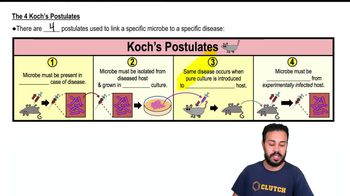
The 4 Koch's Postulates
3734
views
46
rank
02:58
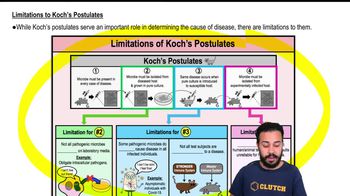
Limitations to Koch's Postulates
2660
views
28
rank
Terms in this set (29)
Hide definitions
Koch's postulates
A set of criteria to establish a causative relationship between a microbe and a disease.
Gram stain purpose
Differentiates bacteria into Gram-positive and Gram-negative based on cell wall structure.
Difference between prokaryotes and eukaryotes
Prokaryotes lack a nucleus and membrane-bound organelles; eukaryotes have both.
Role of Pasteur in microbiology
Disproved spontaneous generation and developed pasteurization.
Major macromolecules in cells
Lipids, carbohydrates, proteins, and nucleic acids.
Function of ATP
ATP
is the main energy currency of the cell.
Types of chemical bonds important in biology
Covalent, ionic, hydrogen bonds, and van der Waals forces.
Hydrogen bond significance
Stabilizes protein and nucleic acid structures and affects water properties.
Dehydration synthesis
A chemical reaction that joins monomers by removing water.
Function of buffers in cells
Maintain pH stability by neutralizing acids or bases.
Bacterial cell wall composition
Made primarily of peptidoglycan, varying between Gram-positive and Gram-negative bacteria.
Difference between Gram-positive and Gram-negative walls
Gram-positive have thick peptidoglycan; Gram-negative have thin peptidoglycan and an outer membrane.
Function of glycocalyx
Protects cells and helps in attachment; includes capsules and slime layers.
Purpose of bacterial flagella
Enable motility.
Role of pili
Facilitate attachment and conjugation between bacteria.
Endospores
Dormant, resistant structures formed by some bacteria for survival.
Endosymbiotic theory
Eukaryotic organelles like mitochondria originated from prokaryotic cells.
Microscopy magnification vs. resolution
Magnification enlarges image; resolution distinguishes two close points.
Bright-field vs. dark-field microscopy
Bright-field uses light through specimen; dark-field shows light scattered by specimen.
Difference between TEM and SEM
TEM shows internal structures; SEM shows surface details.
Basic vs. acidic dyes
Basic dyes stain cells (positive charge); acidic dyes stain background (negative charge).
Binomial nomenclature
Two-part naming system for organisms: genus and species.
Role of LPS (endotoxin)
Component of Gram-negative outer membrane that can trigger immune responses.
Osmosis in cells
Movement of water across a membrane from low to high solute concentration.
Active transport
Energy-dependent movement of substances against their concentration gradient.
Protein shape importance
Determines protein function and is stabilized by hydrogen bonds.
Chemical structure of DNA vs. RNA
DNA has deoxyribose sugar and thymine; RNA has ribose sugar and uracil.
Public health impact of microbiology
Understanding microbes helps control infectious diseases and improve sanitation.
Magic bullet concept
A targeted antimicrobial agent that kills pathogens without harming the host.
 BackBack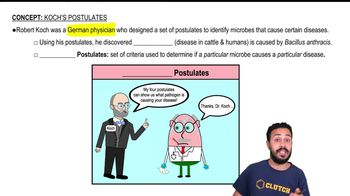
 01:36
01:36