What are mutations and recombination in bacterial populations?
Mutations are random changes in nucleotide sequences causing protein changes; recombination is the exchange of DNA strands creating new sequences, both providing genetic diversity.
Define vertical gene transfer.
Vertical gene transfer is the transfer of genetic material from parent to offspring during reproduction, producing genetically identical daughter cells.
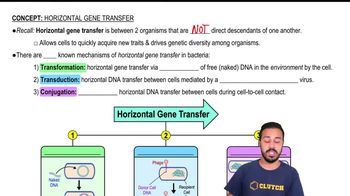
What is horizontal gene transfer?
Horizontal gene transfer is the transfer of genes between cells of the same generation, often leading to recombinant cells with new genetic traits.
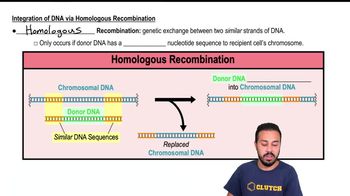
Describe homologous recombination in bacteria.
It is the exchange of DNA between two similar or nearly identical DNA sequences, facilitated by enzymes like RecA, resulting in new genetic combinations.
What role do nucleases play in recombination?
Nucleases degrade donor DNA if they act before strand exchange, preventing recombination; if strand exchange occurs first, recombination proceeds.
Explain the process of bacterial transformation.
Transformation is the uptake of naked DNA by a competent recipient cell, which incorporates it into its genome, potentially gaining new traits.
What is bacterial competence?
Competence is a physiological state where bacteria produce proteins to uptake DNA from the environment, either naturally or induced artificially.
How does conjugation differ from transformation?
Conjugation requires direct cell-to-cell contact and a conjugative plasmid, transferring DNA between cells of the same type, unlike transformation which involves free DNA uptake.
What is the function of sex pili in conjugation?
Sex pili are plasmid-encoded structures produced by donor cells to attach to recipient cells and establish a cytoplasmic bridge for DNA transfer.
Describe the F plasmid and its role in E. coli conjugation.
The F plasmid carries genes for sex pili and DNA transfer; F+ cells have it and act as donors, while F- cells lack it and act as recipients.
What is rolling circle replication during conjugation?
It is the process where one strand of the F plasmid is nicked and transferred to the recipient while the complementary strand is synthesized, producing two double-stranded plasmids.
Define Hfr cells and their significance.
Hfr cells have the F plasmid integrated into their chromosome, enabling high-frequency transfer of chromosomal genes during conjugation.
What happens during specialized transduction?
A temperate phage excises incorrectly, carrying specific adjacent bacterial genes which are transferred to a new host, altering its genotype.
Explain generalized transduction.
A bacteriophage mistakenly packages random bacterial DNA fragments during lytic cycle and transfers them to another bacterium, enabling gene transfer.
Outline the lytic cycle of a T-even bacteriophage.
Phage attaches, injects DNA, replicates viral components, assembles new virions, and lyses the host cell to release progeny viruses.
What is the lysogenic cycle in bacteriophages?
Phage DNA integrates into host chromosome as a prophage, replicates with host, and can later excise to enter the lytic cycle under stress.
How did Griffith's experiment demonstrate transformation?
Heat-killed encapsulated bacteria transferred DNA to live non-encapsulated bacteria, transforming them to produce capsules and cause disease.
What is the role of DNase in Griffith's experiment?
DNase destroyed DNA from heat-killed bacteria, preventing transformation and showing DNA is the genetic material.
How is transformation monitored experimentally?
By observing phenotypic changes such as capsule formation or marker gene exchange after DNA uptake and recombination.
What is electroporation in bacterial genetics?
A lab technique using high voltage to temporarily increase membrane permeability, allowing DNA to enter bacterial cells.
 Back
Back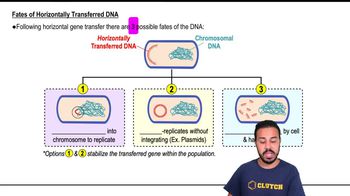
 03:13
03:13