 Back
BackMicrobiology: Genetics and Molecular Biology
 02:04
02:04
Terms in this set (29)
Genetics is the science of heredity, studying genes, how they carry information, replicate, and express traits in organisms.
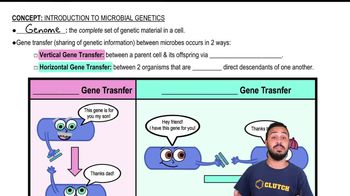
The genome is the complete set of genetic information in a cell, including chromosomes and plasmids.
Genes are segments of DNA (or RNA in some viruses) that code for functional products, usually proteins or RNA molecules.
DNA is a double helix of two strands with sugar-phosphate backbones and complementary nitrogenous bases: adenine pairs with thymine, cytosine pairs with guanine.
The central dogma states that genetic information flows from DNA to RNA to protein.
Genotype is the genetic makeup (DNA) of an organism; phenotype is the expressed traits or characteristics resulting from gene expression.
Bacteria usually have a single circular chromosome of DNA, supercoiled and attached to the plasma membrane.
Vertical gene transfer is the replication and transfer of DNA from parent to offspring cells during cell division.
Horizontal gene transfer is the transfer of genetic material between cells of the same generation, not from parent to offspring.
Each new DNA molecule contains one original (parental) strand and one newly synthesized strand.
Key enzymes include helicase (unwinds DNA), DNA polymerase (synthesizes new strands), primase (makes RNA primers), ligase (joins fragments), and topoisomerase (relaxes supercoiling).
DNA strands run in opposite directions (5' to 3' and 3' to 5') to allow complementary base pairing and proper replication.
Short DNA fragments synthesized discontinuously on the lagging strand during DNA replication.
Energy comes from hydrolysis of nucleoside triphosphates, releasing phosphate groups to form new DNA bonds.
Methylases add methyl groups to new DNA strands to help distinguish them from template strands for repair.
Transcription is the synthesis of messenger RNA (mRNA) from a DNA template.
In RNA, uracil (U) replaces thymine (T) and pairs with adenine (A) during transcription.
RNA polymerase synthesizes RNA by copying the DNA template strand during transcription.
Translation is the process of decoding mRNA codons to assemble amino acids into a protein at the ribosome.
A codon is a sequence of three nucleotides in mRNA that specifies a particular amino acid.
Most amino acids are encoded by multiple codons, allowing some mutations without changing the protein.
The start codon is AUG, coding for formylmethionine (fMet) in bacteria, initiating protein synthesis.
tRNA molecules carry amino acids and have anticodons that base-pair with mRNA codons to add amino acids to the growing protein.
The A site (aminoacyl), P site (peptidyl), and E site (exit) coordinate tRNA binding and peptide chain elongation.
Translation stops when the ribosome reaches a stop codon (UAA, UAG, or UGA) on the mRNA, releasing the completed polypeptide.
Because prokaryotes lack a nucleus, ribosomes can bind mRNA while it is still being transcribed in the cytoplasm.
Eukaryotic mRNA undergoes splicing to remove introns and join exons before translation.
The promoter is a DNA sequence where RNA polymerase binds to initiate transcription.
Tetracyclines block the binding of aminoacyl-tRNA to the A site of the ribosome, halting translation elongation.