 Back
BackMicrobiology Metabolism and Microbial Physiology
 02:17
02:17
Terms in this set (23)
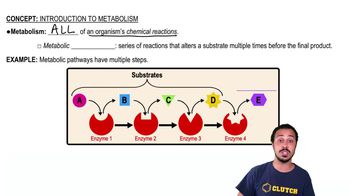
Metabolism is the sum of all chemical reactions in a cell, including both energy-releasing and energy-consuming processes.
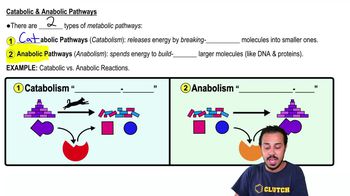
Anabolism builds complex molecules from simpler ones, consuming energy. Catabolism breaks down complex molecules into simpler ones, releasing energy.
Substrate-level phosphorylation, oxidative phosphorylation, and photophosphorylation are the three types of ATP phosphorylation.
Apoenzyme is the protein part of an enzyme. Cofactor is a non-protein component needed for activity. Coenzyme is an organic cofactor. Active site is where substrate binds. Substrate is the molecule acted upon.
Enzyme activity increases with temperature up to an optimum, then decreases due to denaturation.
Each enzyme has an optimal pH; deviations can reduce activity by altering enzyme shape or charge.
Increasing substrate concentration increases enzyme activity until the enzyme becomes saturated.
Competitive inhibitors bind the active site, blocking substrate. Noncompetitive inhibitors bind elsewhere, changing enzyme shape.
Glycolysis, Krebs cycle, and electron transport chain are the three stages of aerobic glucose catabolism.
Substrate: glucose. Products: 2 pyruvate, 2 ATP (net), 2 NADH.
Produces CO2, NADH, FADH2, and 2 ATP (or GTP) per glucose molecule.
ETC transfers electrons to oxygen (aerobic) or other acceptors (anaerobic), creating a proton gradient for ATP synthesis.
Aerobic uses oxygen as final electron acceptor; anaerobic uses other molecules like nitrate or sulfate.
Flavoproteins, cytochromes, iron-sulfur proteins, and quinones are four classes of electron carriers.
Movement of protons across membrane drives ATP synthase to produce ATP from ADP and Pi.
EMP pathway converts glucose to pyruvate, producing 2 ATP (net) and 2 NADH molecules.
Fermentation regenerates NAD+ without an electron transport chain; respiration uses ETC and produces more ATP.
Tests detect metabolic enzymes and products to differentiate bacterial species based on biochemical capabilities.
Lipids break down into glycerol and fatty acids; proteins into amino acids, both entering metabolic pathways for energy.
Both convert light to chemical energy, but prokaryotes lack chloroplasts and have different pigments and pathways.
Reactants: CO2, ATP, NADPH. Products: glucose and other carbohydrates.
Use capsule staining and microscopy to visualize the capsule surrounding the cell.
Method to isolate single colony-forming units to obtain a pure microbial culture.