 Back
BackMicrobiology: Prokaryotic Cell Structure and Function
 04:26
04:26
Terms in this set (21)
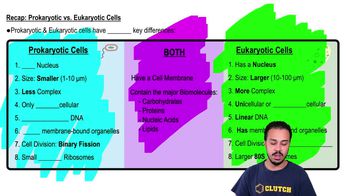
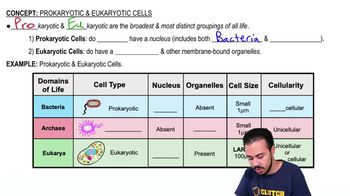
Prokaryotic cells lack a nucleus and membrane-bound organelles, reproduce by binary fission, and have simpler structures. Eukaryotic cells have a nucleus, organelles, and reproduce by mitosis or meiosis.
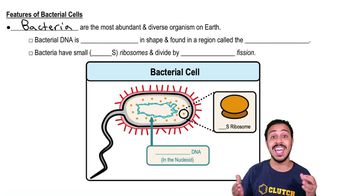
Include the cytoplasm, ribosomes, nucleoid (DNA region), and sometimes endospores.
Include glycocalyx (slime layer or capsule), flagella, axial filaments, fimbriae, and pili.
All bacteria have a plasma membrane, ribosomes, cytoplasm, and a cell wall (except some like Mycoplasma). Other structures like flagella and pili are optional.
The glycocalyx is a sticky outer layer; the capsule is organized and protects against phagocytosis, while the slime layer is loose and helps in attachment.
Flagella are long, whip-like structures used for motility, allowing bacteria to move toward or away from stimuli.
Axial filaments are internal flagella found in spirochetes that enable corkscrew movement.
Fimbriae are short, hair-like structures that allow bacteria to adhere to surfaces and each other.
Pili are longer than fimbriae and facilitate DNA transfer between bacteria during conjugation.
The cell wall provides shape and protection; it is made of peptidoglycan in bacteria.
Gram-positive walls have thick peptidoglycan layers; Gram-negative have thin peptidoglycan and an outer membrane. This affects antibiotic susceptibility and disease mechanisms.
Osmosis is the passive movement of water across a membrane from low to high solute concentration without energy.
Simple diffusion is the passive movement of small or lipid-soluble molecules across membranes down their concentration gradient.
Facilitated diffusion uses protein channels or carriers to move molecules down their gradient without energy.
Active transport moves molecules against their concentration gradient using energy, usually ATP.
Because they move substances from low to high concentration, which is against the natural gradient and requires cellular energy.
Acid-fast bacteria have waxy mycolic acid in their cell walls, making them resistant to staining and some antibiotics.
Archaea lack peptidoglycan and have unique cell wall components like pseudopeptidoglycan or other polymers.
Mycoplasma lack a cell wall entirely, making them resistant to antibiotics targeting cell wall synthesis.
Bacteria commonly have three shapes: coccus (spherical), bacillus (rod-shaped), and spirillum (spiral-shaped).
Arrangements include chains (strepto-), clusters (staphylo-), pairs (diplo-), and tetrads (groups of four).