Skip to main content
Microbiology
My Course
Learn
Exam Prep
AI Tutor
Study Guides
Textbook Solutions
Flashcards
Explore
Try the app
My Course
Learn
Exam Prep
AI Tutor
Study Guides
Textbook Solutions
Flashcards
Explore
Try the app
Back
Microbiology: Yeasts and Fungi
You can tap to flip the card.
What is mycology and what are mycoses?
You can tap to flip the card.
👆
What is mycology and what are mycoses?
Mycology
is the study of fungi, and
mycoses
are diseases caused by fungi.
Track progress
Control buttons has been changed to "navigation" mode.
1/20
Recommended videos
01:27
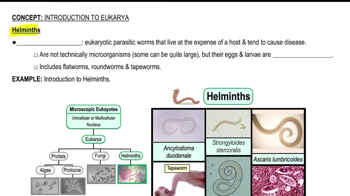
Helminths
4960
views
88
rank
02:49
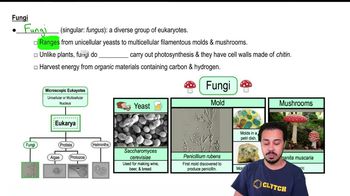
Fungi
5874
views
134
rank
03:28
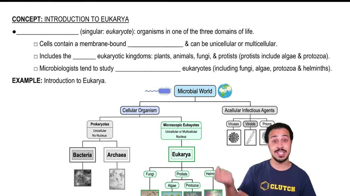
Introduction to Eukarya
7075
views
158
rank
Terms in this set (20)
Hide definitions
What is mycology and what are mycoses?
Mycology
is the study of fungi, and
mycoses
are diseases caused by fungi.
What are fungi and what are the two main forms?
Fungi are
eukaryotic organisms
that include
yeasts
(unicellular) and
molds
(multinucleated, filamentous).
How do yeasts differ from molds?
Yeasts are
unicellular, oval or spherical fungi
that divide by budding, while molds are filamentous fungi with hyphae.
What mode of nutrition do fungi use?
Fungi are
chemoheterotrophs
requiring organic compounds for energy and carbon.
Where do saprophytic fungi obtain nutrients?
Saprophytic fungi live off
decaying organic material
.
Where do parasitic fungi obtain nutrients?
Parasitic fungi get nutrients from
living plants or animals
.
What are the two modes of metabolism exhibited by yeasts?
Yeasts are
facultative anaerobes
that obtain energy via
aerobic respiration
or
fermentation
.
How do yeasts reproduce?
Yeasts reproduce by
budding
, where a new daughter cell forms from the mother cell.
What are hyphae in yeasts and their role?
Hyphae are
fragile branching filaments
formed when buds remain attached; they help yeasts invade deeper tissues.
What are blastoconidia and chlamydoconidia?
Blastoconidia
are asexual spores formed in clusters along hyphae;
chlamydoconidia
are thick-walled survival spores at hyphal tips.
How do yeast colonies appear on solid media?
Yeast colonies appear similar to
bacterial colonies
due to their unicellular and microscopic nature.
What is Sabouraud Dextrose Agar (SDA) and its purpose?
SDA has higher sugar and lower pH than TSA, inhibiting bacteria and promoting fungal growth; it is
selective for fungi
.
What is Mycosel agar selective for?
Mycosel agar contains chloramphenicol and cycloheximide, inhibiting bacteria and saprophytic fungi; it is
selective for pathogenic fungi
.
What is the use of Rice Extract agar in yeast culture?
Rice Extract agar stimulates formation of
hyphae, blastoconidia, and chlamydoconidia
in pathogenic yeasts like Candida albicans.
What is the significance of budding in yeast cells?
Budding allows yeast cells to reproduce asexually, producing a new daughter cell from the mother cell.
What structures can be identified in Candida albicans during its filamentous form?
In filamentous form, Candida albicans shows
hyphae
,
blastoconidia
, and
chlamydoconidia
.
What is the role of mitochondria in yeast cells?
Mitochondria provide energy through
aerobic cellular respiration
in yeast cells.
What is the function of the cell wall in fungi?
The cell wall provides
structural support and protection
to fungal cells.
Why is SDA selective for fungi?
SDA's high sugar and low pH inhibit bacterial growth, allowing fungi to grow selectively.
What is the difference between blastoconidia and chlamydoconidia?
Blastoconidia are
asexual spores
formed in clusters; chlamydoconidia are
thick-walled survival spores
formed under stress.
 BackBack
 01:27