 Back
BackA Brief History of Microbiology: Foundations, Discoveries, and Modern Developments
Study Guide - Smart Notes
 Tailored notes based on your materials, expanded with key definitions, examples, and context.
Chapter 1: A Brief History of Microbiology
The Early Years of Microbiology
The field of microbiology began with the discovery and observation of microscopic life forms. Early pioneers used primitive microscopes to reveal a previously unseen world, laying the foundation for modern microbiology.
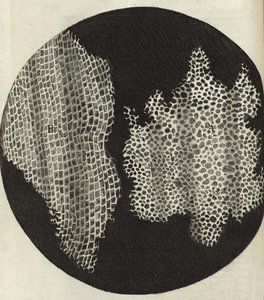
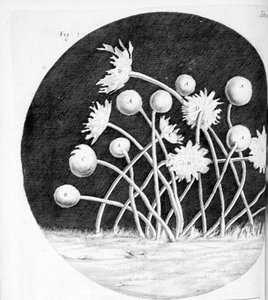
Robert Hooke (1665): Published Micrographia, observed cork and coined the term 'cell' for the basic structural units of life. He was also the first to draw and describe a microorganism (mold).
Observation of Mold: Hooke's detailed drawings of mold structures marked the first recorded observation of a microorganism.
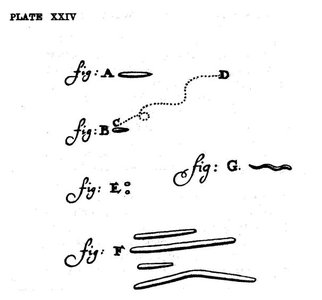
Anton van Leeuwenhoek (1674–1683): Improved microscope design, achieving up to 200X magnification. He observed and described 'animalcules' (protozoa and bacteria) in water, rainwater, and dental plaque, providing the first descriptions of bacteria.
Classification of Microbes
Microorganisms are classified into several major groups based on their characteristics. The taxonomic system, first developed by Carolus Linnaeus, provides a uniform method for naming and grouping organisms.
Major Groups of Microbes:
Bacteria
Archaea
Fungi
Protozoa
Algae
Small Multicellular Animals
Viruses
Microbiology: The study of microorganisms (bacteria, fungi, algae, protozoa) and viruses.
Bacteriology: Study of bacteria; includes pathogens, decomposers, and beneficial species.
Archaea: Prokaryotes distinct from bacteria; often live in extreme environments and engage in mutualistic or commensal relationships.
Mycology: Study of fungi; includes pathogens, antibiotic producers, and food industry contributors.
Protozoology: Study of protozoa; includes free-living and parasitic species, some of which are pathogens.
Phycology: Study of algae; important for food chains and some are pathogens.
Virology: Study of viruses; obligate parasites that require host cells to replicate.
The Golden Age of Microbiology
The period from the mid-1800s to early 1900s saw rapid advances in microbiology, including the disproof of spontaneous generation, the development of the scientific method, and the establishment of germ theory.
Spontaneous Generation
Spontaneous Generation: The belief that life could arise from non-living matter was widely held until the 19th century.
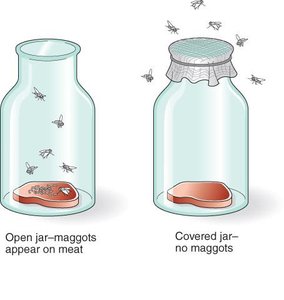
Francesco Redi (1668): Demonstrated that maggots on meat came from fly eggs, not the meat itself, using controlled experiments.
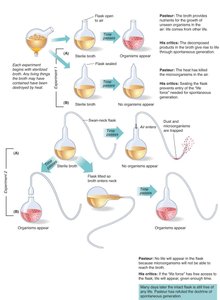
John Needham (1748): Claimed that boiled broths still produced microorganisms, supporting spontaneous generation.
Lazzaro Spallanzani (1765): Improved Needham's experiment by boiling broths longer and sealing them tightly, preventing microbial growth.
Louis Pasteur (1861): Definitively disproved spontaneous generation with his swan-neck flask experiments, showing that life does not arise from non-living material without contamination.
The Scientific Method
The scientific method is a systematic approach to research, involving observation, hypothesis formation, experimentation, analysis, and conclusion. It is fundamental to scientific inquiry in microbiology.
Steps: Observation, Background Research, Hypothesis, Experimentation (with controls), Analysis, Conclusion.
Scientific Theory: A hypothesis repeatedly supported by evidence.
Scientific Law: A generalization based on consistent observations.

Fermentation and Germ Theory
Fermentation: Louis Pasteur demonstrated that yeasts convert sugars to alcohol (fermentation) and that bacteria can produce acids, not alcohol.
Pasteurization: Pasteur developed a method to heat liquids and kill pathogens without altering their properties.
Germ Theory (1862): Pasteur proposed that specific microorganisms (germs) cause specific diseases.
Disease Causation and Koch's Postulates
Epidemiology: The study of disease transmission, sources, and causes.
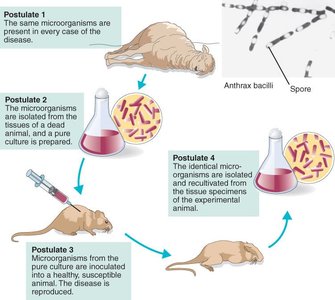
Robert Koch: Developed Koch's Postulates, a systematic method to link specific microbes to specific diseases (e.g., anthrax, tuberculosis, cholera).
Koch's Postulates:
The microorganism must be present in every case of the disease.
It must be isolated and grown in pure culture.
The cultured microbe must cause disease when introduced into a healthy host.
The same microbe must be reisolated from the newly diseased host.
Other Discoveries in Microbiology
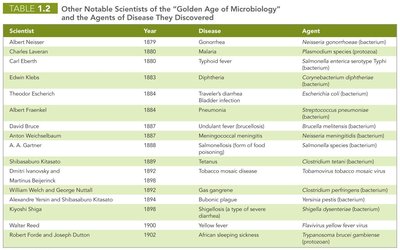
Virology: Ivanowsky, Beijerinck, and Reed discovered viruses as filterable infectious agents.
Environmental Microbiology: Winogradsky discovered bacteria involved in sulfur and nitrogen cycles (e.g., nitrogen fixation).
Gram Stain
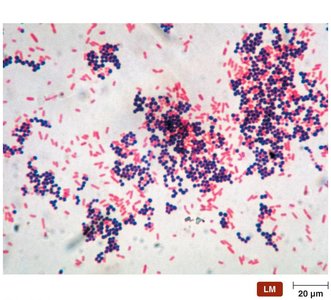
Hans Christian Gram: Developed the Gram stain, a differential staining technique that distinguishes Gram-positive (purple) from Gram-negative (pink) bacteria, aiding in bacterial identification.
Disease Prevention
Semmelweis (1847): Introduced handwashing to prevent childbed fever.
Joseph Lister: Developed antiseptic surgery using phenol.
Florence Nightingale: Advanced antiseptic techniques in nursing.
John Snow (1854): Conducted the first epidemiological study, tracing cholera to contaminated water.
Variolation and Vaccination: Early methods to induce immunity, culminating in Edward Jenner's smallpox vaccine using cowpox.
Antibiotics: Paul Ehrlich developed Salvarsan for syphilis; Alexander Fleming discovered penicillin; Florey and Chain purified penicillin; Waksman discovered streptomycin and coined 'antibiotic.'
Modern Disciplines and Fields of Microbiology
Microbiology has diversified into numerous specialized fields, each focusing on different organisms, processes, or applications.
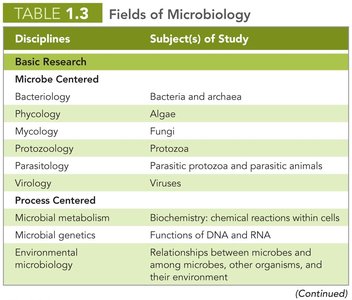
Discipline | Subject of Study |
|---|---|
Bacteriology | Bacteria and archaea |
Phycology | Algae |
Mycology | Fungi |
Protozoology | Protozoa |
Parasitology | Parasitic protozoa and animals |
Virology | Viruses |
Microbial Metabolism | Biochemistry of cellular reactions |
Microbial Genetics | Functions of DNA and RNA |
Environmental Microbiology | Microbe interactions with environment |
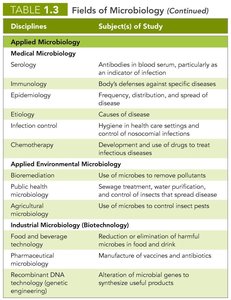
Discipline | Subject of Study |
|---|---|
Serology | Antibodies in blood serum |
Immunology | Body's defenses against disease |
Epidemiology | Disease frequency and spread |
Etiology | Causes of disease |
Chemotherapy | Development of antimicrobial drugs |
Bioremediation | Use of microbes to remove pollutants |
Industrial Microbiology | Production of useful products (e.g., antibiotics, vaccines) |
The Modern Age of Microbiology
Technological advances have revolutionized microbiology, enabling the study of cell structure, genetics, and microbial communities.
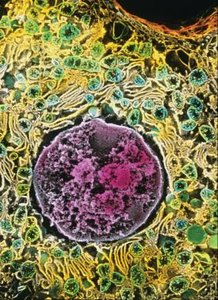
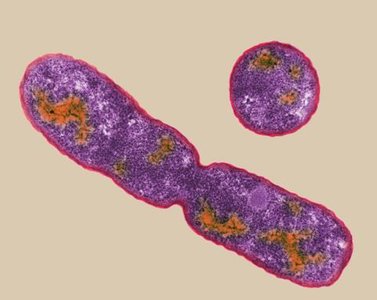
Electron Microscope (1932): Allowed visualization of cellular ultrastructure and differentiation between prokaryotic and eukaryotic cells.
Prokaryotes vs. Eukaryotes: Prokaryotes (bacteria, archaea) lack a membrane-bound nucleus; eukaryotes (plants, animals, fungi, protists) have a true nucleus.
Molecular Biology: Microbes have been essential in understanding genetics, gene function, and evolutionary relationships.
Biotechnology: Genetic engineering using microbes produces insulin, vaccines, and other products.
Microbial Ecology: Study of microbial communities (biofilms) and their roles in the environment, including bioremediation.
Current Challenges: Infectious diseases remain a major cause of death; antibiotic resistance and emerging diseases (e.g., AIDS, SARS, Swine Flu) are ongoing concerns. Old diseases are reemerging due to resistance, increased susceptibility, and climate change. Bioterrorism is a modern threat.
Summary: Microbiology has evolved from simple observations of microscopic life to a complex science that impacts medicine, industry, and environmental management. The field continues to address global health challenges and drive scientific innovation.
