 Back
A Brief History of Microbiology: Foundations, Classification, and Key Discoveries
Study Guide - Smart Notes
 Tailored notes based on your materials, expanded with key definitions, examples, and context.
Introduction to Microbiology
What Does Life Really Look Like?
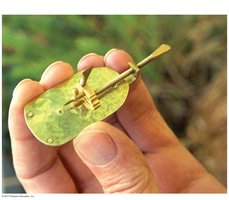
Microbiology is the study of organisms too small to be seen with the naked eye, known as microorganisms or microbes. The field began with the pioneering work of Antoni van Leeuwenhoek, who developed simple microscopes and was the first to observe and describe microorganisms, which he called "animalcules." By the late 19th century, these organisms were collectively referred to as microorganisms.

Microbial Classification
Taxonomic Systems and the Six Major Groups
Carolus Linnaeus developed a taxonomic system for naming and classifying organisms. Leeuwenhoek's microorganisms are now grouped into six categories:
Bacteria
Archaea
Fungi
Protozoa
Algae
Small multicellular animals
Bacteria and Archaea
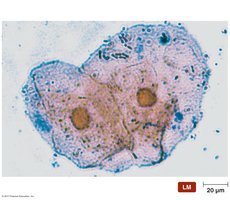
Bacteria and Archaea are prokaryotic (lack a nucleus), unicellular, and generally much smaller than eukaryotes. They reproduce asexually and are found in diverse environments. Bacterial cell walls contain peptidoglycan (though some lack cell walls), while archaeal cell walls are composed of polymers other than peptidoglycan.
Fungi
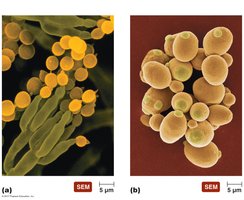
Fungi are eukaryotic organisms that obtain food from other organisms and possess cell walls. They include:
Molds: Multicellular, grow as long filaments, reproduce by sexual and asexual spores.
Yeasts: Unicellular, reproduce asexually by budding, some produce sexual spores.
Protozoa
Protozoa are single-celled eukaryotes similar to animals in their nutritional needs and cellular structure. They live freely in water or as parasites in animal hosts. Most reproduce asexually, though some have sexual reproduction. Modes of locomotion include:
Pseudopods: Cell extensions that flow in the direction of travel.
Cilia: Numerous short protrusions for movement.
Flagella: Fewer, longer, and more whiplike than cilia.

Algae
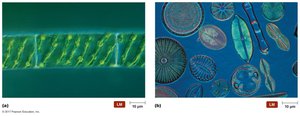
Algae are unicellular or multicellular, photosynthetic organisms with simple reproductive structures. They are categorized based on pigmentation and cell wall composition.
Small Multicellular Animals and Parasites
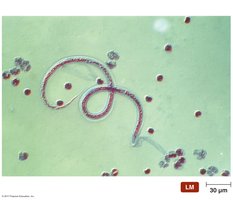
Some small multicellular animals, such as parasitic worms (helminths), are studied in microbiology due to their microscopic life stages.
Viruses
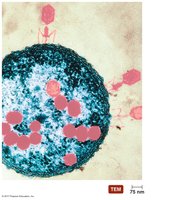
Viruses are acellular entities composed of genetic material (DNA or RNA) surrounded by a protein coat. They require host cells to reproduce and are much smaller than prokaryotic and eukaryotic cells.
The Golden Age of Microbiology
Major Questions and Discoveries
During the late 19th and early 20th centuries, microbiologists addressed four fundamental questions:
Is spontaneous generation of microbial life possible?
What causes fermentation?
What causes disease?
How can we prevent infection and disease?
What Causes Disease? Koch’s Experiments
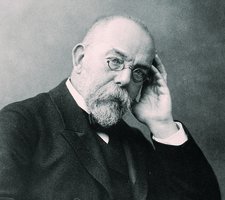
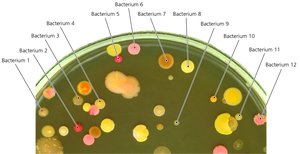
Robert Koch established the field of etiology (study of disease causation) by demonstrating that specific bacteria cause specific diseases, such as anthrax. He developed laboratory techniques including simple staining, photomicrography, and the use of solid media (agar and Petri dishes) for isolating pure cultures.
Koch’s Postulates
Koch’s postulates are a series of criteria used to establish a causative relationship between a microbe and a disease:
The suspected causative agent must be found in every case of the disease and absent from healthy hosts.
The agent must be isolated and grown outside the host.
When the agent is introduced to a healthy, susceptible host, the host must develop the disease.
The same agent must be re-isolated from the diseased experimental host.
Gram’s Stain
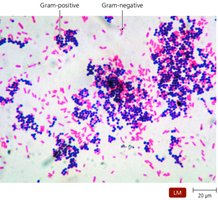
The Gram stain is the most widely used staining technique in microbiology and is one of the first steps in identifying bacteria. It differentiates bacteria into Gram-positive (purple) and Gram-negative (pink) based on cell wall structure.
Prevention of Infection and Disease
Key figures and their contributions to infection control and disease prevention include:
Semmelweis: Advocated handwashing to prevent puerperal fever.
Joseph Lister: Developed antiseptic surgical techniques.
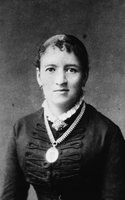
Florence Nightingale: Advanced nursing and hospital sanitation.
John Snow: Pioneered infection control and epidemiology.
Edward Jenner: Developed the first vaccine (smallpox), founding immunology.
Paul Ehrlich: Searched for "magic bullets" (selective antimicrobial agents), founding chemotherapy.
Alexander Fleming: Discovered penicillin, the first antibiotic.
Modern Disciplines and Fields of Microbiology
Major Subfields
Microbiology has diversified into numerous specialized fields, including:
Bacteriology: Study of bacteria
Mycology: Study of fungi
Protozoology: Study of protozoa
Phycology: Study of algae
Parasitology: Study of parasites
Virology: Study of viruses
Immunology: Study of immune responses
Serology: Study of blood serum and immune factors
Chemotherapy: Use of chemicals to treat disease
Genetic engineering: Manipulation of microbial genes for useful products

Industrial and Applied Microbiology
Microbes are used in the production of foods, beverages, antibiotics, and other products. They are also essential in biotechnology, waste treatment, and environmental management.
Fields of Microbiology (Summary Table)
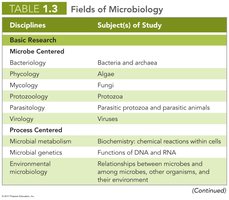
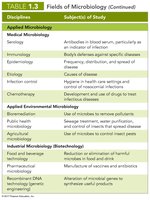
The following table summarizes the main fields of microbiology and their subjects of study:
Discipline | Subject(s) of Study |
|---|---|
Bacteriology | Bacteria and archaea |
Phycology | Algae |
Mycology | Fungi |
Protozoology | Protozoa |
Parasitology | Parasitic protozoa and animals |
Virology | Viruses |
Microbial metabolism | Biochemistry; chemical reactions within cells |
Microbial genetics | Functions of DNA and RNA |
Environmental microbiology | Relationships among microbes, other organisms, and their environment |
Discipline | Subject(s) of Study |
|---|---|
Serology | Antibodies in blood serum |
Immunology | Body's defenses against specific diseases |
Etiology | Causes of disease |
Chemotherapy | Development and use of drugs to treat infectious disease |
Applied environmental microbiology | Use of microbes in waste treatment, bioremediation, and pest control |
Industrial microbiology | Production of industrial products using microbes |
Recombinant DNA technology | Manipulation of microbial genes to synthesize useful products |
Defenses Against Diseases
Serology, Immunology, and Chemotherapy
Serology is the study of blood serum and its immune factors. Immunology focuses on the body's defenses against specific pathogens. Chemotherapy involves the use of chemicals (such as antibiotics and sulfa drugs) to treat infectious diseases. Key discoveries include penicillin (Fleming) and sulfa drugs (Domagk).
Conclusion
The field of microbiology has evolved from the discovery of microscopic life to a complex science with numerous subdisciplines. Its advances have revolutionized medicine, industry, and our understanding of life itself.
