 Back
BackAcellular Infectious Agents and Microbial Growth: Study Guide
Study Guide - Smart Notes
 Tailored notes based on your materials, expanded with key definitions, examples, and context.
Characterizing and Classifying Viruses, Viroids, and Prions
Viroids
Viroids are unique acellular infectious agents that consist solely of RNA and lack a protein coat. They are primarily known for infecting plants and causing various diseases.
Definition: Viroids are small, circular, single-stranded RNA molecules (239–399 nucleotides) that do not encode proteins.
Structure: Their RNA folds to form double-stranded regions, creating a secondary structure that is essential for their function and stability.

Replication: Viroids rely entirely on host cell machinery for replication and cannot replicate independently.
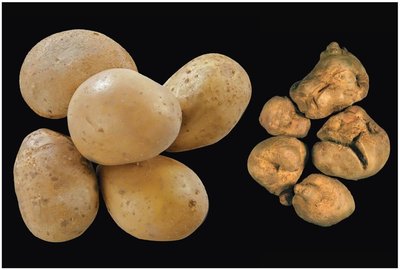
Examples: Potato spindle tuber viroid, avocado sunblotch viroid, apple dimple fruit viroid, coconut cadang-cadang viroid.
Pathogenicity: Viroids cause disease in plants, often resulting in visible symptoms such as stunted growth or deformities.
Prions
Prions are infectious proteins that cause fatal neurodegenerative diseases in animals and humans. Unlike viruses and viroids, prions lack nucleic acids and propagate by inducing misfolding of normal proteins.
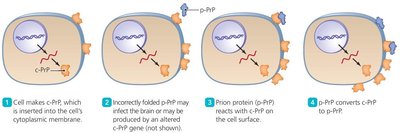
Definition: Prions are misfolded proteins (p-PrP) that aggregate and disrupt normal cellular function, especially in neural tissue.
Diseases: Prions cause transmissible spongiform encephalopathies, including Creutzfeldt-Jakob disease, kuru, fatal familial insomnia, bovine spongiform encephalopathy (mad cow disease), and chronic wasting disease in cervids.
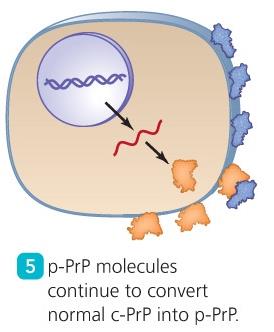
Mechanism: The normal prion protein (c-PrP) is expressed in neurons. The pathogenic form (p-PrP) interacts with c-PrP, converting it to the infectious form. This conversion is self-propagating and leads to accumulation of aggregates.
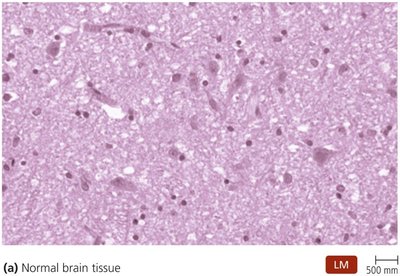
Histopathology: Prion diseases result in spongiform changes in brain tissue, characterized by vacuolation and cell death.
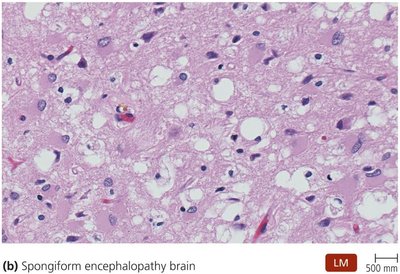
Resistance: Prion aggregates are highly resistant to proteases, disinfectants, heat, and radiation. Destruction requires extreme measures (e.g., immersion in 1N NaOH and autoclaving at 482°C for 4 hours).
Transmission: Prion diseases can be transmitted via contaminated surgical instruments, as highlighted in public health reports.

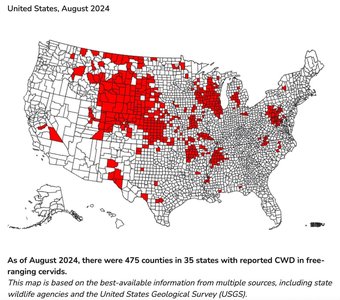
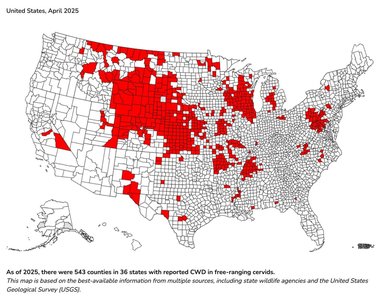
Chronic Wasting Disease: CWD affects cervids and is spreading across the United States, with prion proteins found in various tissues and bodily fluids.
Comparison of Bacteria, Viruses, Viroids, and Prions
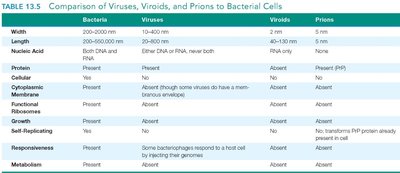
These infectious agents differ in structure, genetic material, and replication mechanisms. The following table summarizes their key properties:
Property | Bacteria | Viruses | Viroids | Prions |
|---|---|---|---|---|
Width | 200–1000 nm | 10–400 nm | 2–10 nm | 5 nm |
Nucleic Acid | Both DNA and RNA | Either DNA or RNA | RNA | None |
Protein | Present | Present | Absent | Present (PrP) |
Cytoplasmic Membrane | Present | Absent | Absent | Absent |
Functional Ribosomes | Present | Absent | Absent | Absent |
Growth | Present | Absent | Absent | Absent |
Self-Replicating | Present | Some viruses | Absent | No; transforms PrP protein already present in cell |
Metabolism | Present | Absent | Absent | Absent |
Microbial Nutrition and Growth
Binary Fission
Binary fission is the primary method of reproduction in unicellular bacteria. It involves the division of a mother cell into two genetically identical daughter cells.
Process: The cell grows, replicates its chromosome, and forms a septum that separates the two new cells.
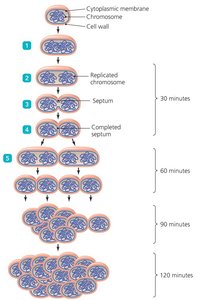
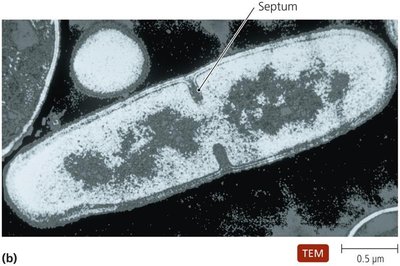
Generation Time: The time required for a cell to divide and double its population. Generation times vary widely (20 minutes to several hours).
Mathematical Model: Bacterial growth is logarithmic, not arithmetic. The equation for population growth is: where = final number of cells = initial number of cells = number of generations
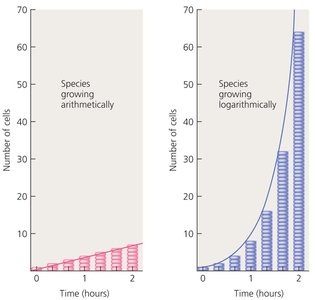
Example: Starting with 3 cells and a generation time of 30 minutes, after 2 hours (4 generations), there will be 48 cells.

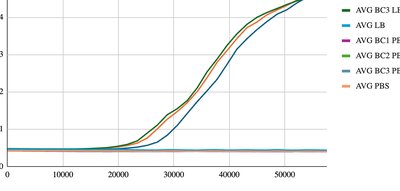
Bacterial Growth Curve
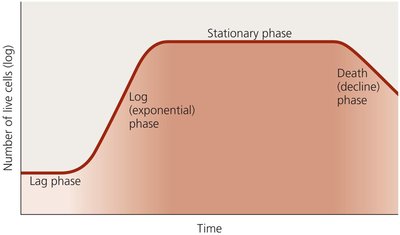
Bacterial populations in a closed system exhibit a characteristic growth curve with four distinct phases.
Lag Phase: Cells adjust to the environment; minimal growth.
Log (Exponential) Phase: Rapid cell division; peak metabolic activity; most susceptible to antibiotics.
Stationary Phase: Nutrient depletion; cell death balances cell growth; metabolic activity slows.
Death Phase: Cell death exceeds cell production; population declines; endospore formation may occur.
Cellular Composition and Nutritional Requirements
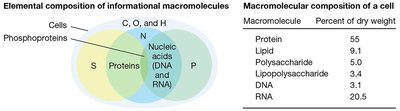
Bacterial cells require macronutrients and micronutrients for growth and maintenance. The composition of cellular macromolecules reflects these requirements.
Macronutrients: Carbon, nitrogen, oxygen, hydrogen, phosphorus, sulfur, potassium, magnesium, calcium, sodium.
Micronutrients: Iron and other trace metals.
Cellular Composition: Cells are approximately 50% carbon (dry weight). Proteins, lipids, polysaccharides, DNA, and RNA make up the bulk of cellular material.
Microbial Environmental Preferences
Oxygen Requirements
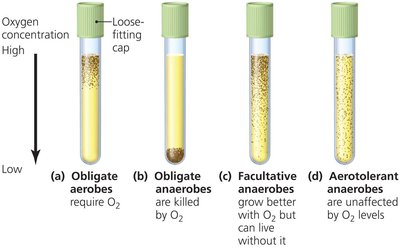
Microbes vary in their requirements and tolerance for oxygen, which impacts their growth and survival.
Obligate Aerobes: Require oxygen for growth.
Obligate Anaerobes: Killed or inhibited by oxygen; require oxygen-free environments.
Facultative Anaerobes: Prefer oxygen but can grow without it.
Aerotolerant Anaerobes: Tolerate oxygen but do not use it for respiration.
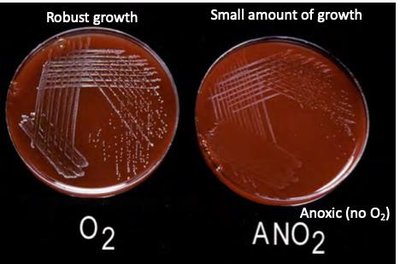
Growth Patterns: Growth can be observed on plates incubated under different oxygen conditions.
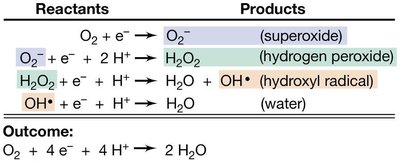
Toxic Byproducts: Oxygen exposure leads to formation of reactive oxygen species (ROS) such as hydrogen peroxide, superoxide anion, hydroxyl radical, and singlet oxygen. Some bacteria possess enzymes (e.g., catalase) to neutralize these byproducts.
Temperature Preferences
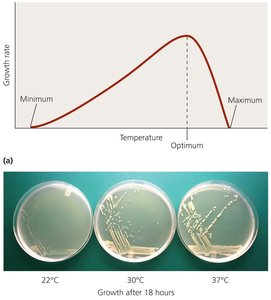
Microbes have specific temperature ranges for optimal growth, which are determined by their cellular components.
Minimum Temperature: Below this, cellular processes slow or stop.
Optimum Temperature: Highest growth rate.
Maximum Temperature: Above this, cellular structures are damaged and cells die.
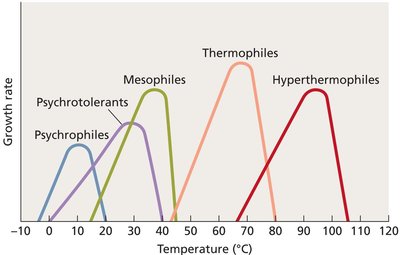
Temperature Classes:
Psychrophiles: Grow at low temperatures.
Mesophiles: Grow at moderate temperatures; most human pathogens.
Thermophiles: Grow at high temperatures.
Hyperthermophiles: Grow at extremely high temperatures (hot springs, hydrothermal vents).
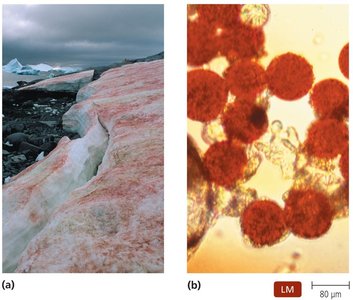
Adaptation: Organisms in extreme environments evolve genetic changes to modify membranes, proteins, and DNA for survival. Some can tolerate brief temperature extremes and repair damage.
Study Strategies for Microbiology
Effective Study Techniques
Success in microbiology requires active learning and regular review. Recommended strategies include:
Flash cards (handwritten or digital)
Whiteboarding and concept mapping
Teaching others and explaining concepts aloud
Practice questions and quizzes
Acronyms and mnemonic devices
Supplemental videos and resources
Scheduled review sessions and Pomodoro technique
Homework and Lab Preparation
Read assigned textbook sections on metabolism and catabolism.
Prepare for lab by reviewing handouts and bringing necessary equipment.
Participate in sequencing analysis and antimicrobial assays.
Additional info: These notes expand on brief points from the original materials, providing definitions, examples, and academic context for each topic. All included images directly reinforce the explanations and are relevant to the adjacent paragraphs.
