 Back
Adaptive and Innate Immunity: Host Defenses, Antigen Processing, and Lymphocyte Function
Study Guide - Smart Notes
 Tailored notes based on your materials, expanded with key definitions, examples, and context.
Host Defenses: Overview of Immune System Lines
Three Lines of Defense
The immune system protects the body from pathogens through a hierarchical set of defenses, each with distinct mechanisms and roles.
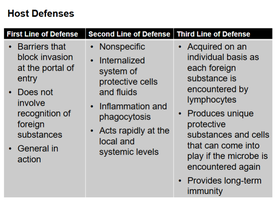
First Line of Defense: Physical and chemical barriers that prevent pathogen entry (e.g., skin, mucous membranes).
Second Line of Defense: Nonspecific internal responses such as inflammation and phagocytosis, acting rapidly at both local and systemic levels.
Third Line of Defense: Adaptive immunity, involving lymphocytes that recognize specific antigens and provide long-term immunity.
First Line of Defense | Second Line of Defense | Third Line of Defense |
|---|---|---|
Barriers that block invasion at the portal of entry Does not involve recognition of foreign substances General in action | Nonspecific Internalized system of protective cells and fluids Inflammation and phagocytosis Acts rapidly at the local and systemic levels | Acquired on an individual basis as each foreign substance is encountered by lymphocytes Produces unique protective substances and cells that can come into play if the microbe is encountered again Provides long-term immunity |
Adaptive Immunity: Lymphocyte Development and Function
T Cells (Cell-Mediated Immunity)
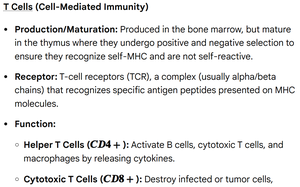
T cells are central to cell-mediated immunity, recognizing and responding to infected or abnormal cells.
Production/Maturation: Produced in the bone marrow, mature in the thymus where they undergo selection to ensure self-tolerance.
Receptor: T-cell receptors (TCRs) recognize antigen peptides presented on MHC molecules.
Function:
Helper T Cells (CD4+): Activate B cells, cytotoxic T cells, and macrophages via cytokine release.
Cytotoxic T Cells (CD8+): Destroy infected or tumor cells.
B Cells (Humoral Immunity)
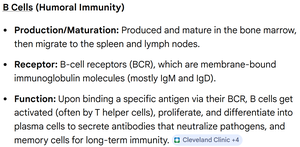
B cells mediate humoral immunity by producing antibodies against extracellular pathogens.
Production/Maturation: Produced and mature in the bone marrow, then migrate to secondary lymphoid organs.
Receptor: B-cell receptors (BCRs), membrane-bound immunoglobulins (mainly IgM and IgD).
Function: Upon antigen binding, B cells activate, proliferate, and differentiate into plasma cells (antibody secretion) and memory cells (long-term immunity).
Clonal Selection and Clonal Expansion
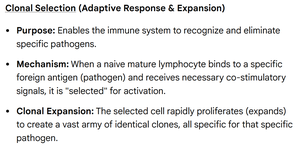
Clonal selection and expansion are fundamental to the adaptive immune response, ensuring specificity and memory.
Purpose: Enables recognition and elimination of specific pathogens.
Mechanism: Naive lymphocytes bind to specific antigens and, upon receiving co-stimulatory signals, are selected for activation.
Clonal Expansion: Activated cells proliferate to form a large population of identical, antigen-specific cells.
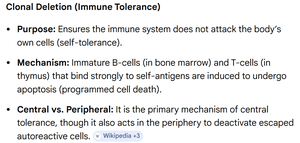
Clonal Deletion (Immune Tolerance)
Clonal deletion is a mechanism to prevent autoimmunity by eliminating self-reactive lymphocytes during development.
Purpose: Ensures self-tolerance by removing cells that recognize self-antigens.
Mechanism: Immature B and T cells that bind strongly to self-antigens undergo apoptosis.
Central vs. Peripheral: Central tolerance occurs in primary lymphoid organs; peripheral tolerance deactivates escaped autoreactive cells.
Antigens and Immunogenicity
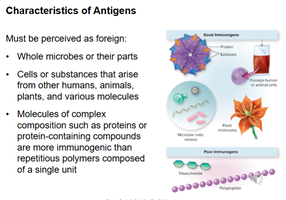
Characteristics of Antigens
Antigens are substances that provoke an immune response. Their immunogenicity depends on several factors:
Must be perceived as foreign (non-self).
Can be whole microbes, microbial parts, or foreign molecules from other organisms.
Complex molecules (e.g., proteins) are more immunogenic than simple, repetitive polymers.
Characteristics of Immunogenicity
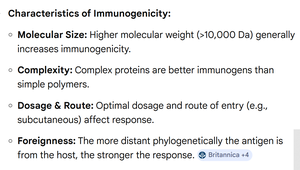
Molecular Size: Larger molecules (>10,000 Da) are generally more immunogenic.
Complexity: Complex proteins elicit stronger immune responses than simple polymers.
Dosage & Route: The amount and method of antigen entry affect the immune response.
Foreignness: The greater the phylogenetic distance from the host, the stronger the response.
Definitions: Antigen, Immunogen, Epitope
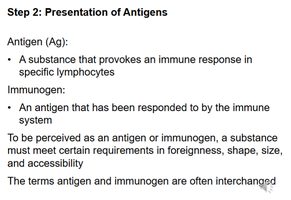
Antigen (Ag): Any substance that provokes an immune response in specific lymphocytes.
Immunogen: An antigen that has been responded to by the immune system; all immunogens are antigens, but not all antigens are immunogens.
Epitope: The specific part of an antigen recognized by a lymphocyte.
Antigen Processing and Presentation
Steps in Antigen Processing and Presentation
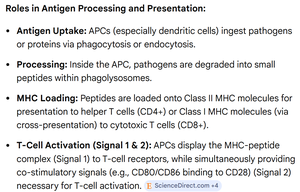
Antigen-presenting cells (APCs) play a crucial role in linking innate and adaptive immunity by processing and presenting antigens to T cells.
Antigen Uptake: APCs (e.g., dendritic cells) ingest pathogens via phagocytosis or endocytosis.
Processing: Pathogens are degraded into peptides within phagolysosomes.
MHC Loading: Peptides are loaded onto MHC molecules for presentation to T cells (Class II MHC for CD4+; Class I MHC for CD8+).
T-Cell Activation: APCs display the MHC-peptide complex to T-cell receptors and provide co-stimulatory signals necessary for activation.
Summary Table: Key Terms and Concepts
Term | Definition | Key Features |
|---|---|---|
Antigen | Substance that provokes an immune response | Recognized by antibodies or TCRs; may not always induce a response |
Immunogen | Antigen that induces an immune response | All immunogens are antigens; not all antigens are immunogens |
Epitope | Specific region of antigen recognized by lymphocyte | Primary signal for immune recognition |
APC | Antigen-presenting cell | Processes and presents antigens to T cells via MHC |
