 Back
BackAdaptive Immune System: Structure, Function, and Mechanisms
Study Guide - Smart Notes
 Tailored notes based on your materials, expanded with key definitions, examples, and context.
Adaptive Immune System
Introduction to Adaptive Immunity
The adaptive immune system is a highly specialized defense mechanism that enables the body to recognize and eliminate specific pathogens and their products. Unlike the innate immune system, adaptive immunity is characterized by specificity, memory, and the ability to distinguish self from non-self.
Purpose: To provide targeted, long-lasting protection against pathogens.
Key Attributes: Specificity, inducibility, clonality, unresponsiveness to self, and memory.
Key Characteristics of Adaptive Immunity
Specificity: Targets unique molecular structures (epitopes) on antigens.
Tolerance to Self: Normally does not react to the body’s own antigens; failure leads to autoimmune diseases.
Minimal Self-Damage: Designed to minimize collateral damage to host tissues, though excessive responses can cause pathology (e.g., anaphylaxis).
Immunological Memory: Enables faster and stronger responses upon re-exposure to the same antigen.
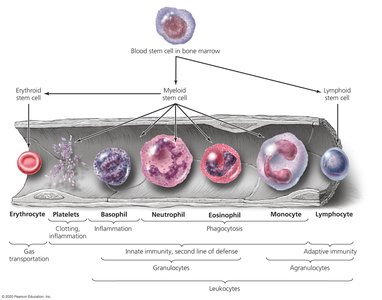
Cells of the Adaptive Immune System
Leukocytes and Lymphocytes
Leukocytes are white blood cells essential for immune responses. Lymphocytes are a subset of leukocytes that play central roles in adaptive immunity.
B cells: Mature in bone marrow; produce antibodies that bind specific antigens.
T cells: Mature in the thymus; include helper T cells (CD4+) and cytotoxic T cells (CD8+).
Natural Killer (NK) cells: Part of innate immunity; kill infected or cancerous cells without antigen specificity.
Dendritic Cells
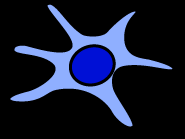
Dendritic cells are professional antigen-presenting cells (APCs) found in tissues. They capture antigens, migrate to lymph nodes, and initiate adaptive immune responses by presenting antigens to naïve lymphocytes, thus bridging innate and adaptive immunity.
Organization of the Adaptive Immune Response
Primary and Secondary Lymphoid Organs
Primary lymphoid organs: Sites of lymphocyte development (bone marrow and thymus).
Secondary lymphoid organs: Sites where adaptive immune responses are initiated (lymph nodes, spleen, Peyer’s patches).
Activation and Clonal Selection
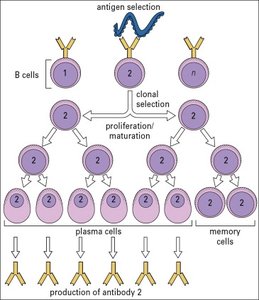
Adaptive immune responses are initiated when antigen-presenting cells (APCs) present antigens to naïve lymphocytes in secondary lymphoid organs. The high specificity of the adaptive immune system is due to unique antigen receptors on each B and T cell. Only those cells whose receptors recognize the antigen are activated, proliferate, and differentiate—a process known as clonal selection.
Clonal Selection: The process by which specific lymphocyte clones are selected for expansion and differentiation upon encountering their specific antigen.

Effector Mechanisms of Adaptive Immunity
T Cells
Helper T cells (CD4+): Direct immune responses by secreting cytokines. Subtypes include Th1 (cell-mediated immunity), Th2 (humoral immunity), and Th17 (inflammation and defense against fungi and extracellular bacteria).
Cytotoxic T cells (CD8+): Kill infected or abnormal cells via the perforin-granzyme pathway or the CD95 pathway.
B Cells and Antibodies
B cells differentiate into plasma cells that secrete antibodies. Antibodies bind to specific epitopes on antigens and mediate several functions:
Neutralization: Block pathogen binding to host cells.
Opsonization: Enhance phagocytosis by marking pathogens for destruction.
Agglutination: Clump pathogens together for easier clearance.
Complement activation: Trigger the complement cascade to lyse pathogens.
Antibody-dependent cellular cytotoxicity (ADCC): Recruit NK cells to destroy antibody-coated cells.
Classes of Antibodies
There are five main classes of antibodies (immunoglobulins): IgG, IgM, IgA, IgE, and IgD. Each class has distinct structures and functions.
Class | Structure | Main Functions | Location |
|---|---|---|---|
IgG | Monomer | Complement activation, opsonization, neutralization, crosses placenta | Blood, extracellular fluid |
IgM | Pentamer | First antibody produced, agglutination, complement activation | Blood |
IgA | Dimer (secretory) | Mucosal immunity, neutralization | Mucus, saliva, tears, breast milk |
IgE | Monomer | Allergic responses, defense against parasites | Bound to mast cells, basophils |
IgD | Monomer | B cell receptor | B cell surface |
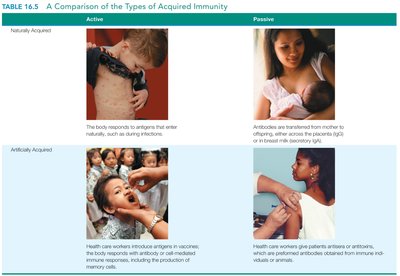
Types of Acquired Immunity
Active vs. Passive Immunity
Acquired immunity can be classified based on how it is obtained:
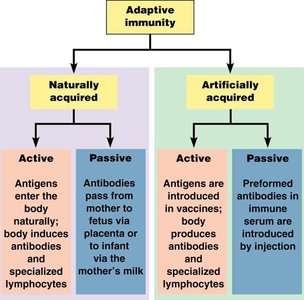
Active immunity: The body produces its own antibodies after exposure to antigens (naturally by infection or artificially by vaccination).
Passive immunity: The body receives preformed antibodies (naturally from mother to fetus/infant or artificially by injection of immune serum).
Immunological Memory
Primary and Secondary Immune Responses
Upon first exposure to an antigen, the primary immune response is slow and produces limited antibodies. Subsequent exposures elicit a secondary immune response that is faster and more robust due to the presence of memory cells.
Memory B cells: Long-lived cells that quickly produce antibodies upon re-exposure to the antigen.
Memory T cells: Rapidly respond to previously encountered antigens.
Immune Pathology and Autoimmunity
Immune Pathology
While the adaptive immune system is essential for defense, inappropriate or excessive responses can cause tissue damage and contribute to diseases such as autoimmune disorders (e.g., Type I diabetes, rheumatoid arthritis, lupus).
Autoimmunity: Immune responses against self-antigens.
Immune pathology: Damage caused by immune responses, sometimes more severe than the original infection.
Summary Table: Types of Acquired Immunity
Active | Passive | |
|---|---|---|
Naturally Acquired | Antigens enter the body naturally; body induces antibodies and specialized lymphocytes. | Antibodies pass from mother to fetus via placenta or to infant via mother’s milk. |
Artificially Acquired | Antigens are introduced in vaccines; body produces antibodies and specialized lymphocytes. | Preformed antibodies in immune serum are introduced by injection. |
