 Back
BackChapter 16
Study Guide - Smart Notes
 Tailored notes based on your materials, expanded with key definitions, examples, and context.
Adaptive Immune System
Overview and Purpose
The adaptive immune system is a highly specialized defense mechanism that enables the body to recognize and eliminate specific pathogens and their products. It builds upon the innate immune response and is characterized by its ability to target distinct invaders with precision.
Specificity: Targets unique molecular structures (antigens) on pathogens.
Inducibility: Activated only in response to specific antigens.
Clonality: Generates clones of lymphocytes specific to the antigen.
Unresponsiveness to self: Prevents attack on the body's own cells.
Memory: Remembers previous encounters for faster future responses.
Key Characteristics of Adaptive Immunity
Adaptive immunity is defined by four main features:
Specificity: Recognizes and responds to specific epitopes on antigens.
Tolerance to self: Avoids attacking self-antigens, preventing autoimmune disorders.
Minimal self-damage: Immune responses are regulated to minimize harm to host tissues.
Immunological memory: Enables rapid and robust responses upon re-exposure to the same antigen.
Cellular Components of Adaptive Immunity
Leukocytes and Lymphocytes
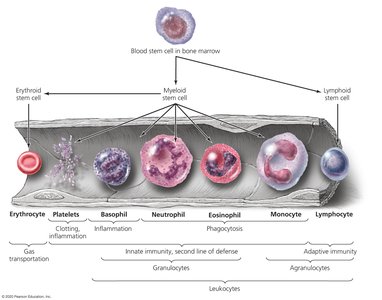
Leukocytes, or white blood cells, are central to immune function. Among them, lymphocytes are the primary cells involved in adaptive immunity.
B cells: Mature in bone marrow; produce antibodies (immunoglobulins) that bind to antigens.
T cells: Mature in thymus; include helper (CD4+) T cells (direct immune response via cytokines) and cytotoxic (CD8+) T cells (kill infected or cancerous cells).
Natural Killer (NK) cells: Kill infected or cancerous cells as part of the innate response.
Dendritic Cells: Antigen Presenting Cells
Dendritic cells are professional antigen-presenting cells found in tissues. They capture antigens, migrate to lymph nodes, and initiate adaptive immune responses, serving as a bridge between innate and adaptive immunity. 
Organization of the Adaptive Immune Response
Secondary Lymphoid Organs
Adaptive immune responses are initiated in secondary lymphoid organs such as lymph nodes, spleen, and Peyer's patches. These sites facilitate interactions between antigen-presenting cells and naïve lymphocytes. 
Antigen Recognition and Clonal Selection
The high specificity of the adaptive immune system is due to antigen-specific receptors on B cells (immunoglobulins) and T cells (T cell receptors). Each lymphocyte expresses a unique receptor, conferring one specificity per cell.
Clonal selection: Upon antigen encounter, only lymphocytes with receptors specific to the antigen are activated, proliferate, and differentiate into effector and memory cells.
Mechanisms of Adaptive Immune Response
Helper T Cells (CD4+)
Helper T cells are programmed during priming to produce specific cytokines, tailoring the immune response to the pathogen type.
Th1 cells: Produce INFγ, activate macrophages for intracellular microbes (cell-mediated immunity).
Th2 cells: Produce IL-4 and IL-5, stimulate antibody production and anti-parasite responses (humoral immunity).
Th17 cells: Produce IL-17, stimulate neutrophil responses for extracellular bacteria and fungi.

Cytotoxic T Cells (CD8+)
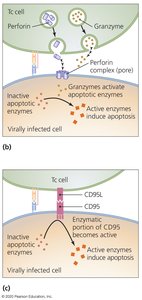
Cytotoxic T cells kill infected or abnormal cells via two main pathways:
Perforin-granzyme pathway: Releases proteins that induce apoptosis in target cells.
CD95 pathway: Activates apoptotic enzymes through cell surface glycoproteins.
B Cells and Antibody Production
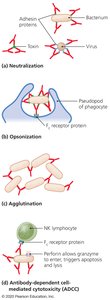
B cells produce antibodies that bind to specific epitopes on antigens. Antibodies function in several ways:
Activation of complement and inflammation
Neutralization
Opsonization
Agglutination
Antibody-dependent cellular cytotoxicity (ADCC)
Antibody Classes
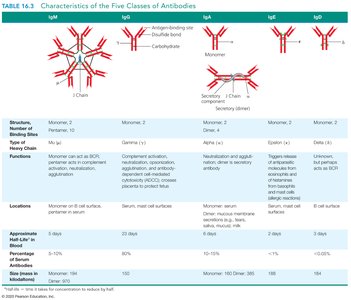
There are five main classes of antibodies, each with distinct structures and functions.
Class | Structure | Function | Location |
|---|---|---|---|
IgG | Monomer | Complement activation, opsonization, neutralization | Blood, extracellular fluid |
IgM | Pentamer | Primary response, agglutination | Blood |
IgA | Dimer | Secretory immunity | Mucosal surfaces |
IgE | Monomer | Allergic responses, anti-parasite | Bound to mast cells |
IgD | Monomer | B cell receptor | B cell surface |
Inducement of T-Dependent Antibody Immunity
Steps in T-Dependent Antibody Response
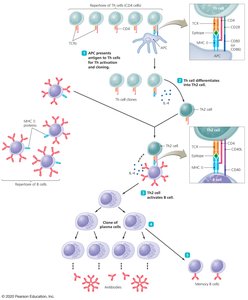
The T-dependent antibody response involves four main steps:
Antigen presentation for helper T cell activation and proliferation
Differentiation of helper T cells into Th2 cells
Activation of B cells
Proliferation and differentiation of B cells into plasma and memory cells
Immunological Memory
Memory Cells and Secondary Response
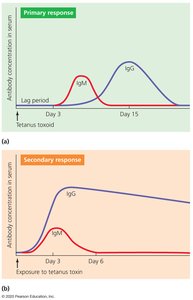
Memory cells are produced during the primary immune response and persist in lymphoid tissues. They enable a much faster and more robust response upon subsequent exposure to the same antigen.
Primary response: Slow, produces small amounts of antibodies.
Secondary response: Rapid, produces large amounts of antibodies.
Types of Acquired Immunity
Active vs Passive Immunity
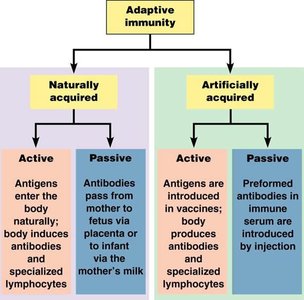
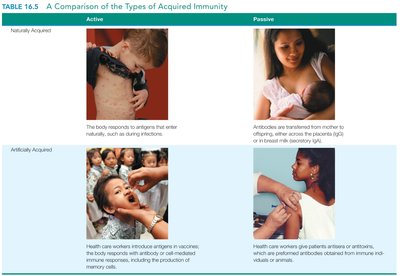
Acquired immunity can be classified as naturally or artificially acquired, and as active or passive.
Active | Passive | |
|---|---|---|
Naturally Acquired | Body responds to antigens that enter naturally (e.g., infection) | Antibodies transferred from mother to offspring (placenta, breast milk) |
Artificially Acquired | Antigens introduced in vaccines; body produces antibodies | Preformed antibodies introduced by injection |
Immune Pathology and Tolerance
Immune Pathology
Immune responses can sometimes cause pathology, especially in autoimmune diseases. Examples include atherosclerosis, type I diabetes, rheumatoid arthritis, multiple sclerosis, lupus, asthma, inflammatory bowel disease, and possibly Alzheimer's disease.
Immune pathology is often observed without clear understanding of initiation or antigen specificity.
Lymphocyte Development and Tolerance
Lymphocyte development occurs in bone marrow (B cells) and thymus (T cells). Tolerance mechanisms prevent immune responses against self-antigens, maintaining homeostasis and preventing autoimmunity.
Summary Table: Steps in Adaptive Immune Response
Step | Description |
|---|---|
Recognition | Detection of antigen by dendritic cells and lymphocytes |
Alarm | Activation signals sent to recruit immune cells |
Inflammation | Local response to infection or injury |
Innate cell recruitment | Mobilization of innate immune cells |
Innate effector function | Initial defense mechanisms |
Adaptive response | Activation, proliferation, and differentiation of antigen-specific lymphocytes |
Conclusion
The adaptive immune system is a complex, highly regulated network that provides specific, inducible, and long-lasting protection against pathogens. Its ability to distinguish self from non-self, generate memory, and tailor responses to different types of invaders is fundamental to health and disease prevention.
Additional info:
Some diagrams and tables were inferred and expanded for clarity and completeness based on standard immunology textbook content.
