 Back
BackAdaptive Immunity and Immunization: Mechanisms, Antibodies, and Vaccines
Study Guide - Smart Notes
 Tailored notes based on your materials, expanded with key definitions, examples, and context.
Chapter 16: Adaptive Immunity (Specific Immunity)
Overview of Adaptive Immunity
Adaptive immunity is the body's specific defense mechanism against particular pathogens and foreign molecules known as antigens. Unlike innate immunity, adaptive immunity has memory, allowing for a more rapid and effective response upon subsequent exposures to the same antigen. This system is acquired over time and involves specialized cells and organs.
Key Components: B cells, T cells, lymphatic system, bone marrow, thymus
Memory: Remembers prior exposure to pathogens, enabling a faster secondary response
Types of Immune Responses
Humoral Response: Involves the production of antibodies (immunoglobulins) by B cells. Antibodies bind to antigens, tagging them for destruction.
Cell-Mediated Response: T cells recognize antigens presented on foreign cells and destroy these cells. Dysregulation can lead to autoimmune disorders.
Antigens and Their Properties
Antigens are molecules recognized as foreign by the immune system, provoking a specific immune response. They are typically large macromolecules such as proteins from bacteria, viruses, fungi, and protozoa, but can also include food and dust particles.
Epitope: The specific three-dimensional region of an antigen recognized by immune cells.
Types of Antigens:
Exogenous antigens: Toxins and components of microbial cell walls, membranes, flagella, and pili.
Endogenous antigens: Produced by microbes that reproduce inside body cells.
Autoantigens: Derived from normal cellular processes.
Major Histocompatibility Complex (MHC) and Antigen Presentation
The MHC is a group of glycoproteins found on the membranes of most vertebrate cells. They play a crucial role in presenting antigenic epitopes to immune cells and are important in tissue compatibility for grafting.
MHC Class I: Present on all nucleated cells; present endogenous antigens.
MHC Class II: Present on antigen-presenting cells (APCs); present exogenous antigens.
B Lymphocytes (B Cells) and Antibodies
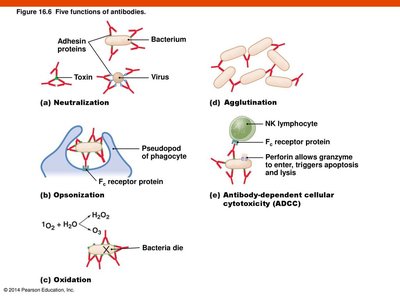
B cells produce antibodies with antigen-binding sites complementary to specific epitopes. Antibodies mediate several immune functions:
Neutralization: Block pathogen attachment and toxin activity.
Opsonization: Enhance phagocytosis by marking antigens for ingestion.
Oxidation: Trigger production of reactive oxygen species to kill pathogens.
Agglutination: Clump antigens together, facilitating removal.
Antibody-Dependent Cellular Cytotoxicity (ADCC): Recruit NK cells to destroy antibody-coated cells.
Classes of Antibodies (Immunoglobulins)
IgM: First antibody produced during the primary response.
IgG: Most common and longest-lasting antibody; provides the majority of antibody-based immunity.
IgA: Associated with body secretions (e.g., saliva, tears, mucous).
IgE: Involved in responses to parasitic infections and allergies.
IgD: Function not fully understood.
Primary and Memory Immune Responses
The primary immune response occurs upon first exposure to an antigen, with B cells producing antibodies and memory cells. The secondary (memory) response is faster and more robust due to the presence of memory cells.
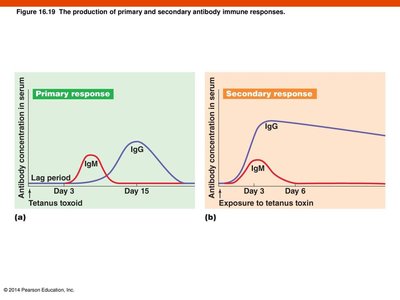
Primary Response: Lag period before antibody production; IgM produced first, followed by IgG.
Secondary Response: Rapid and greater production of IgG upon re-exposure to the same antigen.
Types of Acquired Immunity
Naturally Acquired Immunity: Response to antigens encountered in daily life (e.g., infection).
Artificially Acquired Immunity: Response to antigens introduced via vaccination.
Active Immunity: Patient's own B cells produce antibodies (can be natural or artificial).
Passive Immunity: Patient receives antibodies from another individual (e.g., maternal antibodies, antiserum).
Chapter 17: Immunization and Immune Testing
Principles of Immunization
Immunization induces a specific immune response, providing protection against infectious diseases. There are two main approaches:
Active Immunization (Vaccination): Patient mounts their own immune response.
Passive Immunization: Transfer of antibodies from another source; provides immediate but temporary protection.
Main Types of Vaccines
Attenuated (Live, Modified) Vaccines:
Contain live pathogens with reduced virulence; can replicate and induce strong, long-lasting immunity.
May provide herd immunity but can cause disease in immunosuppressed individuals or revert to virulent form.
Examples: Oral polio vaccine, some flu vaccines.
Killed (Inactivated) Vaccines:
Contain killed microbes or fragments; cannot replicate, making them safer but less immunogenic.
Do not provide herd immunity; may cause inflammatory responses due to endotoxins.
Examples: Injectable polio vaccine, some flu vaccines.
Toxoid Vaccines:
Contain inactivated toxins; require multiple doses for effective immunity.
Examples: Tetanus vaccine, DTaP vaccine.
mRNA Vaccines:
Contain mRNA encoding the antigen, encapsulated in lipid nanoparticles; must enter cells for translation.
Can be synthesized in vitro; require boosters; do not generate herd immunity.
Examples: Moderna and Pfizer COVID-19 vaccines.
Risks and Benefits of Routine Vaccination
Benefits: Reduces prevalence of infectious diseases, prevents outbreaks, and protects vulnerable populations.
Risks: Mild pain at injection site, rare cases of malaise or fever, extremely rare risk of anaphylactic shock.
Research has disproven links between vaccines and autism, diabetes, or asthma.
Famous Contributors to Vaccine Development
Jonas Salk: Developed the first injectable, killed polio vaccine (1955), significantly reducing polio cases.
Albert Sabin: Developed the oral, live attenuated polio vaccine (1961), further reducing polio worldwide.
Progression of Clinical Trials for Vaccines
Preclinical: Tested on cultured cells and animals for immune response.
Phase I: Small group of humans; assesses safety and immune stimulation.
Phase II: Hundreds of humans; evaluates safety across different demographics.
Phase III: Thousands of participants; determines efficacy and detects rare adverse effects.
Approval and Distribution: Regulatory review, licensing, and public distribution.
COVID-19 Vaccines in the US
AstraZeneca (AZD1222): Attenuated adenovirus vector expressing COVID-19 spike protein.
Johnson & Johnson: Attenuated adenovirus vector expressing COVID-19 spike protein.
Moderna (mRNA-1273): mRNA vaccine encoding spike protein in lipid nanoparticle.
Pfizer/BioNTech (BNT162b2): mRNA vaccine encoding spike protein in lipid nanoparticle.
Passive Immunization
Administration of antibodies (antiserum or antivenom) from human or animal donors.
Used for immediate protection; antibodies are short-lived and may trigger allergic reactions, especially if from a different species.
Vaccine Safety and Public Health
Vaccine safety is rigorously monitored; serious adverse effects are extremely rare.
False claims linking vaccines to autism have been thoroughly debunked; failure to vaccinate has led to outbreaks of preventable diseases.
Table: Comparison of Types of Acquired Immunity
Type | How Immunity is Acquired | Example |
|---|---|---|
Naturally Acquired Active | Exposure to pathogens in daily life; body produces antibodies | Recovery from chickenpox |
Naturally Acquired Passive | Transfer of antibodies from mother to child | Maternal antibodies via placenta or breast milk |
Artificially Acquired Active | Vaccination; body produces antibodies | MMR vaccine |
Artificially Acquired Passive | Injection of antibodies from another source | Antivenom for snakebite |
