 Back
BackAdaptive Immunity and the Lymphatic System: Study Notes
Study Guide - Smart Notes
 Tailored notes based on your materials, expanded with key definitions, examples, and context.
Adaptive Immunity
Overview of Adaptive Immunity
Adaptive immunity is a specialized defense mechanism that enables the body to recognize and respond to specific pathogens and their products. Unlike innate immunity, adaptive immunity is highly specific and can remember previous encounters with pathogens, providing enhanced protection upon subsequent exposures.
Specificity: Targets particular antigens unique to each pathogen.
Inducibility: Activated only in response to specific antigens.
Clonality: Generates clones of lymphocytes specific to the antigen.
Unresponsive to self: Does not attack the body's own cells.
Immunological Memory: Remembers past infections for faster future responses.
Types of Lymphocytes and Adaptive Defense
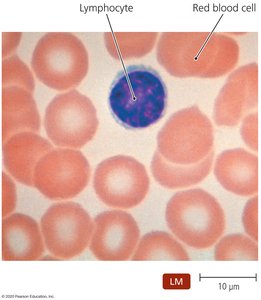
Adaptive immunity is mediated by lymphocytes, which are white blood cells specialized for immune responses. There are two main types of lymphocytes:
B lymphocytes (B cells): Mature in the bone marrow and are responsible for antibody (humoral) immune responses.
T lymphocytes (T cells): Mature in the thymus and are responsible for cell-mediated immune responses.
Adaptive immunity is divided into two main types:
Cell-mediated responses: Involve T cells attacking infected or abnormal cells.
Antibody (humoral) responses: Involve B cells producing antibodies that neutralize pathogens.
Tissues and Organs of the Lymphatic System
Components of the Lymphatic System
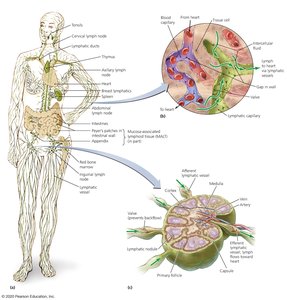
The lymphatic system is a network of tissues, organs, and vessels that play a crucial role in immune surveillance and defense. It screens the tissues of the body for foreign molecules and helps maintain fluid balance.
Lymphoid cells: Include lymphocytes and other immune cells.
Lymphatic vessels: One-way system that conducts lymph from tissues and returns it to the circulatory system.
Lymph: A fluid similar in composition to blood, arising from fluid leaked from blood vessels into surrounding tissue.
Lymphoid Organs
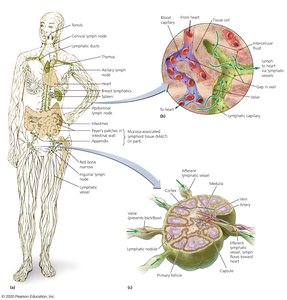
Lymphoid organs are classified as primary or secondary based on their function in lymphocyte development and immune responses.
Primary lymphoid organs: Sites of lymphocyte maturation. Includes the red bone marrow (B cell maturation) and thymus (T cell maturation).
Secondary lymphoid organs: Sites where immune responses are initiated. Includes lymph nodes, spleen, tonsils, and mucosa-associated lymph tissue (MALT).
Quiz Example: Classification of Lymphoid Organs
Which of the following is NOT a secondary lymphoid organ?
A. Tonsils
B. Spleen
C. Thymus
D. Lymph nodes
Correct answer: C. Thymus (The thymus is a primary lymphoid organ.)
Summary Table: Lymphoid Organs
Organ | Type | Function |
|---|---|---|
Red bone marrow | Primary | B cell maturation |
Thymus | Primary | T cell maturation |
Lymph nodes | Secondary | Immune response initiation |
Spleen | Secondary | Filters blood, immune response |
Tonsils | Secondary | Immune surveillance |
MALT | Secondary | Immune response in mucosal tissues |
Key Terms and Definitions
Antigen: Any substance that can trigger an immune response.
Lymphocyte: A type of white blood cell involved in adaptive immunity.
Immunological memory: The ability of the immune system to remember previous encounters with pathogens.
Humoral immunity: Immunity mediated by antibodies produced by B cells.
Cell-mediated immunity: Immunity mediated by T cells.
Additional info:
Adaptive immunity is essential for long-term protection against infectious diseases and is the basis for immunization strategies.
Failure of self-tolerance can lead to autoimmune diseases, where the immune system attacks the body's own tissues.
