 Back
Adaptive Immunity: Mechanisms and Components
Study Guide - Smart Notes
 Tailored notes based on your materials, expanded with key definitions, examples, and context.
Adaptive Immunity
Overview of Adaptive Immunity
Adaptive immunity is the body's highly specific defense mechanism against particular pathogens and their products. It is characterized by the activity of specialized lymphocytes and the ability to remember previous encounters with antigens, leading to a more effective response upon re-exposure.
Humoral immune responses: Mediated by B lymphocytes (B cells), which mature in the bone marrow and produce antibodies.
Cell-mediated immune responses: Mediated by T lymphocytes (T cells), which mature in the thymus and act directly on infected or abnormal cells.
Characteristics of Adaptive Immune Responses
Specificity: Each response targets a specific antigen.
Memory: The immune system responds more rapidly and effectively to previously encountered antigens.
Tolerance: Normally does not react to self-antigens, preventing autoimmunity.
Inducibility: Activated only in response to specific pathogens.
Clonality: Once activated, lymphocytes proliferate to form clones specific to the antigen.
Organization of the Immune System
Elements of Adaptive Immunity
The adaptive immune system is organized into primary and secondary lymphoid organs, and involves various cells, antigens, antibodies, and signaling molecules.
Stem Cells: Give rise to all immune cells.
Primary Lymphoid Organs: Sites where lymphocytes mature (bone marrow for B cells, thymus for T cells).
Secondary Lymphoid Organs: Sites where immune responses are initiated (lymph nodes, spleen, mucosal-associated lymphoid tissue).
Primary Lymphoid Organs
Thymus: Site of T cell maturation.
Bone Marrow: Site of B cell maturation.
Secondary Lymphoid Organs
Lymph Nodes: Filter lymph and house lymphocytes.
Lymphoid Tissue: Scattered immune cells in mucosal surfaces.
Lymphatic Vessels: Transport lymph fluid back to the circulatory system.
Lymph: Fluid similar to plasma, derived from tissue fluid.
Edema: Accumulation of excess fluid in tissues.
Antigens
Definition and Properties
Antigen (Ag): Any foreign substance that stimulates an immune response. Antigens contain specific regions called epitopes where antibodies bind. The immunogenicity of an antigen depends on its molecular complexity and structure.
Poorly immunogenic: Simple polysaccharides and lipids.
Highly immunogenic: Proteins and complex polysaccharides (e.g., LPS).
Types of Antigens
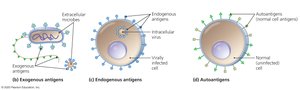
Exogenous antigens: Toxins and components of microbial cell walls, membranes, flagella, and pili.
Endogenous antigens: Produced by microbes that replicate inside host cells.
Autoantigens: Derived from normal cellular processes (self-antigens).
Major Histocompatibility Complex (MHC)
Role in Self/Non-Self Recognition
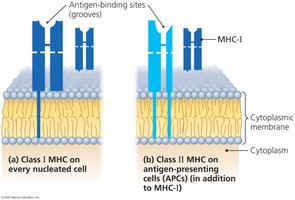
The Major Histocompatibility Complex (MHC) is a group of genes encoding cell surface proteins that present antigenic peptides to T cells, allowing the immune system to distinguish self from non-self.
Class I MHC: Present on all nucleated cells except red blood cells; present endogenous antigens to cytotoxic T cells.
Class II MHC: Present only on antigen-presenting cells (APCs) such as macrophages, dendritic cells, and B cells; present exogenous antigens to helper T cells.
T Lymphocytes (T Cells)
Development and Function
T cells are produced in the bone marrow and mature in the thymus. Each T cell expresses a unique T cell receptor (TCR) specific for a single antigen. T cells are central to cell-mediated immunity and act directly on infected or abnormal host cells.
Cytotoxic T cells (Tc): Express CD8; kill virus-infected and cancer cells.
Helper T cells (Th): Express CD4; regulate B cells and cytotoxic T cells. Th1 cells help produce Tc cells; Th2 cells help B cells produce antibodies.
Regulatory T cells (Treg): Suppress and regulate immune responses to prevent excessive reactions.
B Lymphocytes (B Cells) and Antibodies
B Cell Receptors (BCRs)
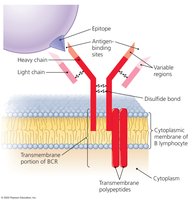
B cells are primarily found in the spleen and lymph nodes, with a small fraction circulating in the blood. Each B cell expresses B cell receptors (BCRs) on its surface, which are membrane-bound antibodies specific to a single epitope.
Each B cell has multiple identical BCRs.
The variable regions of the BCR form the antigen-binding sites.
The diversity of BCRs allows recognition of millions of different epitopes.
Antibody Structure
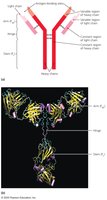
Antibodies (Immunoglobulins, Ig): Glycoproteins secreted by plasma cells that bind specifically to antigens. Each antibody consists of two identical heavy chains and two identical light chains, with variable regions forming the antigen-binding sites.
Fab (fragment, antigen-binding): The arms of the antibody that bind antigen.
Fc (fragment, crystallizable): The stem of the antibody, mediating effector functions.
Antibody Functions
Activation of Complement and Inflammation: Antibody binding can trigger the complement cascade and inflammatory responses.
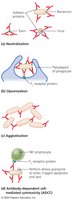
Neutralization: Antibodies block the activity of toxins and prevent pathogen attachment.
Opsonization: Antibodies enhance phagocytosis by marking pathogens for ingestion.
Agglutination: Antibodies cause clumping of antigens, facilitating clearance.
Antibody-Dependent Cell-Mediated Cytotoxicity (ADCC): Antibodies recruit natural killer (NK) cells to destroy target cells.
Classes of Antibodies
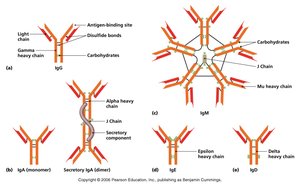
There are five main classes of antibodies, each with distinct functions and structures:
Class | Structure | Main Functions |
|---|---|---|
IgM | Pentamer | First antibody produced; effective in agglutination and complement activation |
IgG | Monomer | Most abundant; crosses placenta; long-lived; all major functions |
IgA | Dimer (secretory form) | Found in secretions (e.g., saliva, breast milk); protects mucosal surfaces |
IgE | Monomer | Involved in allergic responses and defense against parasites |
IgD | Monomer | Membrane-bound; function not well understood |
Cytokines
Types and Functions
Cytokines are soluble regulatory proteins that mediate communication between immune cells. They include:
Interleukins (ILs): Signal among leukocytes.
Interferons (IFNs): Antiviral proteins that also act as cytokines.
Growth factors: Stimulate stem cell division.
Tumor necrosis factor (TNF): Kills tumor cells and regulates immune responses.
Chemokines: Attract leukocytes to sites of infection.
Cell-Mediated Immune Responses
Activation of Cytotoxic T Cells
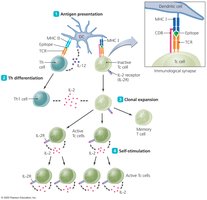
Cytotoxic T cells (Tc) respond to intracellular pathogens and abnormal cells. Their activation involves several steps:
Antigen presentation: Infected cells display pathogen epitopes on MHC I molecules to Tc cells.
Helper T cell differentiation: APCs present epitopes on MHC II to helper T cells, which differentiate into Th1 cells and secrete cytokines to activate Tc cells.
Clonal expansion: Activated Tc cells proliferate.
Self-stimulation: Daughter Tc cells become self-stimulating.
Antibody Immune Responses
B Cell Activation and Proliferation
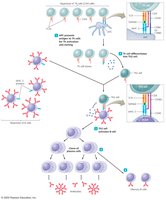
Activation of T-dependent antibody immunity requires the assistance of Th2 cells. The process involves:
Antigen presentation by APCs to Th cells (MHC II).
Differentiation of Th cells into Th2 cells.
Activation of B cells by Th2 cells via cytokines.
Proliferation and differentiation of B cells into plasma cells (antibody-secreting) and memory B cells.
Types of B Cells
Plasma cells: Short-lived cells that secrete antibodies specific to the antigen.
Memory B cells: Long-lived cells that do not secrete antibodies but can rapidly respond upon re-exposure to the antigen.
Primary and Secondary Immune Responses
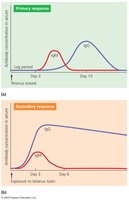
The primary immune response produces small amounts of antibody and is relatively slow. The secondary response, mediated by memory cells, is much faster and produces higher levels of antibody.
Natural Killer (NK) Lymphocytes
Functions
NK cells are lymphocytes that do not require prior exposure to antigen to kill target cells. They are important in the early defense against virus-infected and cancer cells.
Kill virus-infected cells.
Kill cancer cells.
Types of Acquired Immunity
Type | How Acquired | Example |
|---|---|---|
Natural Acquired Active | Exposure to antigen; immune response | Infection |
Naturally Acquired Passive | Transfer of antibodies | Maternal IgG via placenta, IgA via breast milk |
Artificial Acquired Active | Vaccination | Immunization with vaccine |
Artificially Acquired Passive | Administration of antibodies | Antiserum therapy |
