 Back
Adaptive Immunity: Mechanisms and Responses
Study Guide - Smart Notes
 Tailored notes based on your materials, expanded with key definitions, examples, and context.
Adaptive Immune Response
Strategy of Adaptive Immune Response
The adaptive immune response is a highly specific defense mechanism that is activated upon exposure to a particular antigen. The first encounter with an antigen triggers the primary response, which may take a week or more to develop. Upon subsequent exposures, the immune system mounts a faster and more effective secondary response due to immunological memory. Adaptive immunity is divided into two main branches:
Humoral immunity: Eliminates extracellular pathogens via B lymphocytes.
Cellular immunity: Eliminates intracellular pathogens via T lymphocytes.
Humoral Immunity
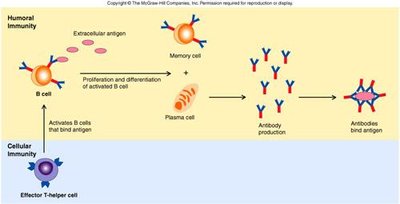
Humoral immunity is mediated by B lymphocytes (B cells), which develop in the bone marrow. Upon activation by antigen binding, B cells proliferate and differentiate into plasma cells that produce antibodies. Some B cells become memory cells, providing long-term immunity.
B cell activation: Triggered by antigen binding to B cell receptor.
Plasma cells: Produce antibodies specific to the antigen.
Memory B cells: Enable rapid response upon re-exposure.
Cellular Immunity
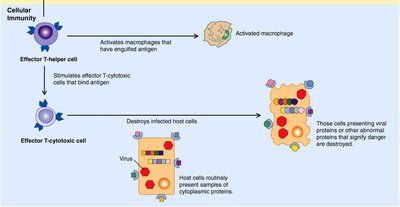
Cellular immunity is mediated by T lymphocytes (T cells), which mature in the thymus. T cells are divided into two subsets:
Cytotoxic T cells (Tc): Destroy infected or cancerous cells.
Helper T cells (Th): Activate B cells and macrophages, orchestrating the immune response.
Anatomy of the Lymphoid System
Lymphoid System Overview
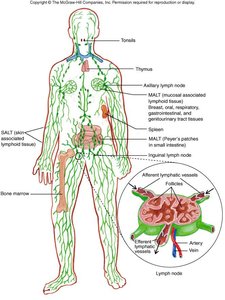
The lymphoid system is a network of tissues and organs that facilitate encounters between B and T cells and antigens. It is essential for mounting an appropriate immune response.
Lymphatic vessels: Transport lymph throughout the body.
Secondary lymphoid organs: Sites where lymphocytes gather and encounter antigens (e.g., lymph nodes, spleen, tonsils, adenoids, appendix).
Primary lymphoid organs: Bone marrow and thymus, where B and T cells mature.
Nature of Antigens
Definition and Properties
An antigen is any compound that elicits an immune response, typically by stimulating antibody production. Antigens that cause an immune response are termed immunogens. Proteins and polysaccharides are strong immunogens, while lipids and nucleic acids are less effective. The immune system recognizes antigens at specific sites called epitopes or antigenic determinants.
Nature of Antibody
Structure of Antibodies
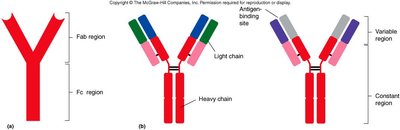
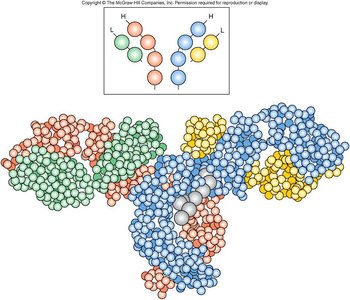
The basic unit of an antibody (Ab) is a monomer composed of four chains of amino acids held together by disulfide bonds: two heavy chains and two light chains. Each chain has a constant region (Fc) and a variable region (Fab), the latter being unique to each antibody and responsible for antigen binding.
Fc region: Constant region, determines antibody class.
Fab region: Variable region, binds specific antigen.
Protective Outcomes of Antibody-Antigen Binding
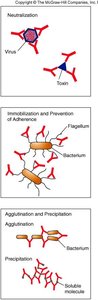
Antibody binding to antigens leads to several protective outcomes:
Neutralization: Prevents toxins or viruses from interacting with cells.
Immobilization and prevention of adherence: Antibodies bind to cellular structures, interfering with function.
Agglutination and precipitation: Clumping of bacterial cells, facilitating phagocytosis.
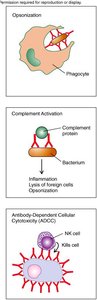
Opsonization: Coating of bacteria to enhance phagocytosis.
Complement activation: Triggers classical pathway, leading to inflammation and lysis.
Antibody-dependent cellular cytotoxicity (ADCC): Targets cells for destruction by certain immune cells.
Classes of Antibodies
Antibodies are divided into five classes based on their constant region:
IgM: First antibody to respond to infection; pentamer structure; only antibody formed by fetus.
IgG: Dominant antibody in circulation; monomer; only antibody that crosses the placenta; antibody of memory.
IgA: Found in secretions (e.g., breast milk, mucous, tears, saliva); monomer in serum, dimer in secretions.
IgD: Less than 1% of total antibody; monomer; involved in maturation of antibody response.
IgE: Barely detectable in circulation; monomer; active in allergic reactions.
Clonal Selection of Lymphocytes
Mechanism of Clonal Selection
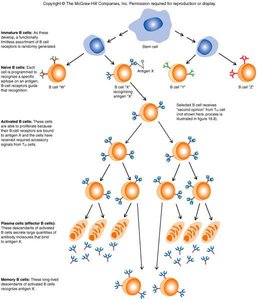
When an antigen enters the body, only the appropriate antibody binds, initiating multiplication of specific lymphocytes. This process is called clonal selection, and repeated cycles of cell division generate a population of identical cells (clonal expansion). Without sustained stimulation, cells undergo apoptosis.
Lymphocyte Characteristics
Naive: Have antigen receptor but have not encountered antigen.
Activated: Able to proliferate after binding antigen.
Effectors: Descendants of activated lymphocytes; produce cytokines (e.g., plasma cells, T helper, cytotoxic T cells).
Memory lymphocytes: Long-lived descendants; responsible for rapid secondary response.
B Lymphocyte and Antibody Response
Activation and Response
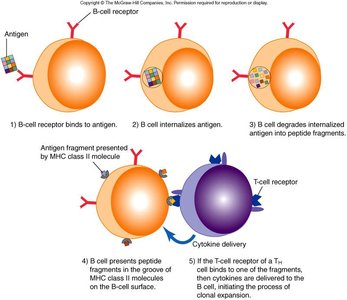
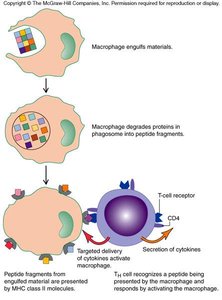
B cells are activated when antigen binds to their receptor. Often, confirmation from helper T cells is required. Antigen is processed by macrophages (antigen-presenting cells, APCs), which present antigen fragments on their surface alongside self-antigen.
Primary Response Characteristics
Lag period: 10-12 days before antibody detection in blood.
Proliferation and differentiation: Activated B cells become plasma cells and memory cells.
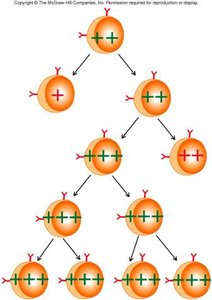
Affinity maturation: B cell receptors become more specific to antigen.
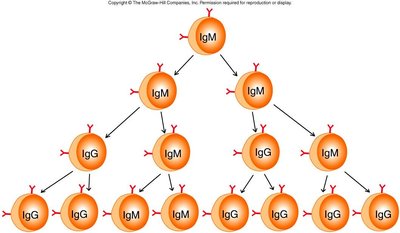
Class switching: B cells switch from producing IgM to other antibody classes (commonly IgG).
Secondary Response Characteristics
Memory cells: Enable swift and effective response, often eliminating invaders before harm occurs.
Vaccines: Exploit immunologic memory for protection.
Rapid antibody production: Memory B cells differentiate into plasma cells quickly.
T-Independent Antigens
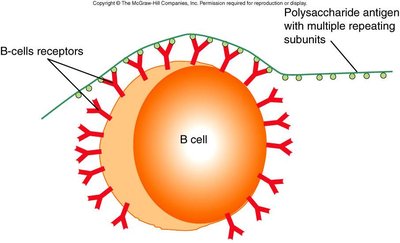
Some antigens can stimulate antibody response without helper T cells. These are called T-independent antigens, often polysaccharides or lipopolysaccharides with multiple repeating subunits.
T Lymphocytes: Antigen Recognition and Response
General Characteristics
T cells have multiple copies of T cell receptors with variable antigen binding sites. Unlike B cells, T cells do not produce antibodies but interact directly with antigens presented by APCs.
Major Histocompatibility Complex (MHC)
Antigen presentation occurs via MHC molecules:
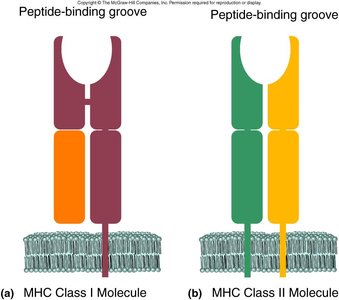
MHC class I: Binds endogenous antigens; recognized by cytotoxic T cells (CD8).
MHC class II: Binds exogenous antigens; recognized by helper T cells (CD4).
Functions of T Cell Subsets
Cytotoxic T cells (Tc, CD8): Induce apoptosis in infected or cancerous cells; recognize MHC class I.
Helper T cells (Th, CD4): Activate B cells and macrophages; recognize MHC class II; orchestrate immune response.
Role of Th Cells in B Cell and Macrophage Activation
B cell activation: Th cells produce cytokines upon recognizing peptide:MHC class II complex on B cells, driving proliferation, class switching, and memory formation.
Macrophage activation: Th cells deliver cytokines to macrophages, enhancing their destructive mechanisms against resistant microbes.
Natural Killer Cells
Characteristics and Functions
Natural killer (NK) cells descend from lymphoid stem cells but lack antigen specificity. They recognize antigens via the Fc portion of IgG antibodies and are important in antibody-dependent cellular cytotoxicity (ADCC) and killing host cells lacking MHC class I molecules, especially during viral infections.
Lymphocyte Development
B and T Cell Maturation
B and T cells acquire the ability to recognize distinct epitopes during development. B cells mature in the bone marrow, while T cells mature in the thymus. Proper function is ensured through developmental checkpoints.
Antibody Class | Structure | Function | Location |
|---|---|---|---|
IgM | Pentamer | First response, fetal antibody | Blood, B cell surface |
IgG | Monomer | Memory, crosses placenta | Blood, tissues |
IgA | Dimer (secretions), Monomer (serum) | Mucosal immunity | Secretions, serum |
IgD | Monomer | B cell maturation | B cell surface |
IgE | Monomer | Allergic response | Tissues |
Additional info: The notes have been expanded to provide academic context and self-contained explanations suitable for exam preparation in a college-level Microbiology course.
