 Back
BackAdaptive Immunity: Principles and Mechanisms
Study Guide - Smart Notes
 Tailored notes based on your materials, expanded with key definitions, examples, and context.
Adaptive Immunity
Overview of Adaptive Immunity
The adaptive immune system is the third and final line of defense in the human body, providing a highly specific response to pathogens. Unlike innate immunity, adaptive immunity takes longer to mount but offers specificity and immunological memory, allowing for a rapid and effective response upon re-exposure to the same antigen.
Specificity: Adaptive immunity targets specific antigens through specialized lymphocytes (T and B cells).
Memory: Upon secondary exposure to the same antigen, the response is faster and more robust due to memory cells.
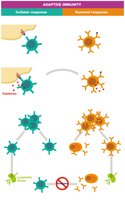
Branches: Includes the cellular response (T cell-mediated) and humoral response (antibody-mediated).
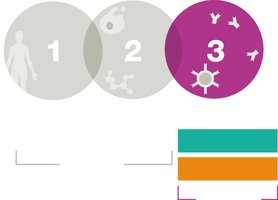
Comparison: Innate vs. Adaptive Immunity
Innate Immunity: Immediate, non-specific, no memory, includes barriers and phagocytic cells.
Adaptive Immunity: Delayed, highly specific, forms memory, involves lymphocytes and antibodies.
Cells of Adaptive Immunity
T Cells and B Cells
T and B lymphocytes are central to adaptive immunity. Both originate in the bone marrow, but T cells mature in the thymus while B cells mature in the bone marrow. Each cell type has unique roles and mechanisms for antigen recognition.
T Cells: Mediate cellular immunity; require antigen presentation via MHC molecules for activation.
B Cells: Mediate humoral immunity; can recognize antigens directly and differentiate into plasma cells that secrete antibodies.
T Helper Cells vs. T Cytotoxic Cells
T Helper Cells (CD4+): Coordinate immune responses by releasing cytokines, activating B cells and T cytotoxic cells.
T Cytotoxic Cells (CD8+): Directly destroy infected, cancerous, or foreign cells by inducing apoptosis.
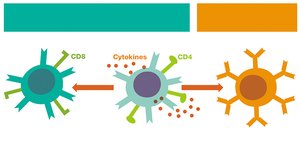
Self-Tolerance and Lymphocyte Screening
Self-tolerance is the ability of the immune system to avoid attacking the body's own tissues. Immature T and B cells are screened for self-reactivity during development. Cells that react strongly to self-antigens undergo apoptosis, preventing autoimmune responses.
T Cells: Screened in the thymus.
B Cells: Screened in the bone marrow.
Stages of the Adaptive Immune Response
1. Antigen Presentation
Antigen-presenting cells (APCs), such as dendritic cells, process and present antigens to T cells using major histocompatibility complex (MHC) molecules. B cells can recognize antigens directly without APCs.
2. Lymphocyte Activation
Upon antigen recognition, lymphocytes are activated by cytokines. Activated T cells can further stimulate B cell activation.
3. Lymphocyte Proliferation and Differentiation
Activated lymphocytes undergo clonal expansion, producing effector cells (which combat the antigen) and memory cells (which persist for rapid future responses).
4. Antigen Elimination and Memory
Effector cells eliminate the antigen. After the threat is cleared, most effector cells die, but memory cells remain in lymphatic tissues, enabling a faster response upon re-exposure.
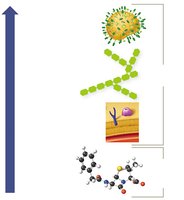
Antigens and Immunogenicity
Antigen Structure and Epitopes
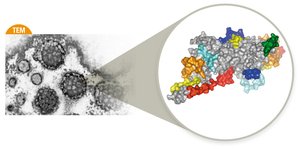
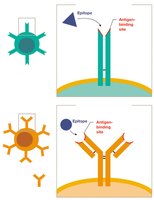
An antigen is any molecule capable of inducing an immune response. The specific part of an antigen recognized by lymphocytes is called an epitope. The immunogenicity of an antigen depends on its biochemical nature, with proteins being the most immunogenic, followed by polysaccharides, lipids, and small molecules.
Epitope: The precise molecular structure recognized by B or T cell receptors.
Antigen Recognition: TCRs and BCRs
T cell receptors (TCRs) and B cell receptors (BCRs) are highly variable, allowing the immune system to recognize a vast array of antigens. BCRs can be secreted as antibodies after B cell activation.
Antibodies (Immunoglobulins)
Structure and Function
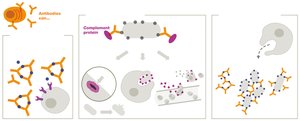
Antibodies are Y-shaped proteins produced by plasma cells (activated B cells). They bind to specific antigens, neutralizing them, activating complement, and enhancing phagocytosis through opsonization, agglutination, and precipitation.
Neutralization: Block toxins or pathogens from interacting with host cells.
Complement Activation: Trigger the complement cascade, leading to pathogen lysis.
Opsonization: Tag pathogens for enhanced phagocytosis.
Agglutination/Precipitation: Clump antigens together for easier clearance.
Antibody Isotypes
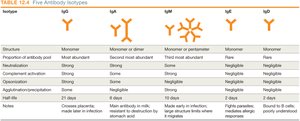
There are five main antibody isotypes, each with distinct structures and functions. B cells can undergo isotype switching to produce different classes of antibodies against the same antigen.
Isotype | Structure | Prevalence | Complement Activation | Opsonization | Agglutination/Precipitation | Notes |
|---|---|---|---|---|---|---|
IgG | Monomer | Most abundant | Strong | Strong | Strong | Crosses placenta; made later in infection |
IgA | Monomer or dimer | Second most abundant | Some | Strong | Some | In secretions; mucosal immunity |
IgM | Monomer or pentamer | Third most abundant | Strong | Negligible | Strong | Made early in infection; strong agglutination |
IgE | Monomer | Rare | Negligible | Negligible | Negligible | Fights parasites; mediates allergic responses |
IgD | Monomer | Rare | Negligible | Negligible | Negligible | Bound to B cells; poorly understood |
Immunological Memory
Primary vs. Secondary Immune Response
Upon first exposure to an antigen (primary response), IgM is produced first, followed by IgG. Secondary exposure triggers a rapid and robust production of IgG due to memory B and T cells, often preventing disease symptoms.
Categories of Adaptive Immunity
Types of Acquired Immunity
Naturally Acquired Active Immunity: Results from infection; long-term protection due to memory cell formation.
Artificially Acquired Active Immunity: Results from vaccination; also confers long-term protection.
Naturally Acquired Passive Immunity: Transfer of antibodies (e.g., maternal antibodies); temporary protection, no memory cells formed.
Artificially Acquired Passive Immunity: Administration of antibodies (e.g., antivenom); temporary protection, no memory cells formed.
Summary Table: Key Cells of Adaptive Immunity
Cell Type | Main Function | Activation Requirement | Effector Mechanism |
|---|---|---|---|
T Helper Cell (CD4+) | Coordinate immune response | Antigen presentation via MHC II | Release cytokines, activate B and T cells |
T Cytotoxic Cell (CD8+) | Destroy infected/cancerous cells | Antigen presentation via MHC I | Induce apoptosis |
B Cell | Produce antibodies | Direct antigen binding or T cell help | Differentiate into plasma cells |
Plasma Cell | Secrete antibodies | B cell activation | Antibody production |
Memory Cell | Long-term immunity | Formed after activation | Rapid response upon re-exposure |
Additional info: The above notes are based on selected readings and slides from Chapter 12, "Adaptive Immunity," and are intended for exam preparation in a college-level microbiology course.
