 Back
BackAdaptive Immunity: Specific Defenses of the Host
Study Guide - Smart Notes
 Tailored notes based on your materials, expanded with key definitions, examples, and context.
Adaptive Immunity: Specific Defenses of the Host
Dual Nature of the Adaptive Immune System
The adaptive immune system is characterized by its ability to specifically recognize and respond to foreign substances, known as antigens. It consists of two main branches: humoral immunity and cellular immunity, each with distinct mechanisms and roles in host defense.
Humoral Immunity: Mediated by B lymphocytes (B cells), which produce antibodies that target extracellular pathogens and toxins.
Cellular Immunity: Mediated by T lymphocytes (T cells), which recognize antigenic peptides presented by phagocytic cells and are effective against intracellular pathogens such as viruses and certain bacteria.
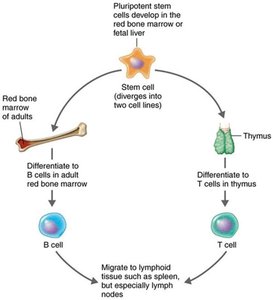
B cells are created and mature in the red bone marrow, while T cells mature in the thymus. Both cell types migrate to lymphoid tissues, where they participate in immune responses.
Comparison of Humoral and Cellular Immunity
Humoral immunity combats threats outside cells, such as extracellular bacteria and toxins, while cellular immunity targets antigens that have already entered cells, including viruses and intracellular bacteria.
Humoral Immunity: Effective against pathogens in body fluids.
Cellular Immunity: Effective against pathogens within host cells.
Cytokines: Chemical Messengers of Immune Cells
Cytokines are protein messengers produced by immune cells in response to stimuli. They regulate the intensity and duration of immune responses by acting on various target cells.
Interleukins (ILs): Facilitate communication between leukocytes.
Chemokines: Induce migration (chemotaxis) of leukocytes.
Interferons (IFNs): Interfere with viral infections of host cells.
Tumor Necrosis Factor alpha (TNF-α): Involved in inflammation and autoimmune diseases.
Hematopoietic cytokines: Control development of red and white blood cells.
Overproduction of cytokines can result in a cytokine storm, which is harmful to the host.
Key Cytokines and Their Roles
Cytokine | Effect | Target Cell(s) | Source |
|---|---|---|---|
IL-4 | Proliferate TH2 cells; class switching to IgE | Naïve TH; B cells | TH2 |
IL-12 | Stimulates growth/function of TH1 cells; stimulates IFN-γ and TNF-α | Naïve TH; NK cells | Dendritic cells, macrophages, neutrophils |
IL-17 | Inflammation | Neutrophils | TH17 |
IL-22 | Stimulates epithelial cells to make antimicrobial proteins | Epithelial cells | TH17 |
IFN-γ | Promote phagocytosis; activate macrophages and humoral response | CTL, macrophages | TH1 |
Chemokines | Chemotaxis | Neutrophils | Varies; macrophages, epithelial cells |
TNF-α | Inflammation | Tumor cells | Macrophages, TH, NK cells |
GM-CSF | Increase macrophages and granulocytes | Myeloid stem cells | Macrophages, T cells, NK cells |
Antigens and Epitopes
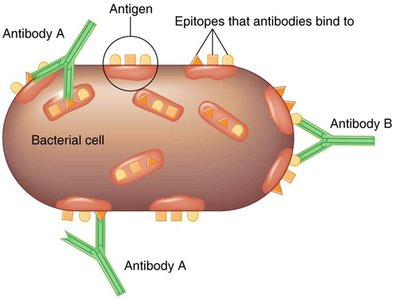
Antigens are substances that provoke an immune response, typically by stimulating the production of antibodies. They are usually components of invading microbes, such as capsules, cell walls, flagella, fimbriae, toxins, viral capsids, and spikes. Nonmicrobial antigens include egg white, pollen, and cell surface molecules.
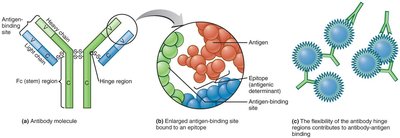
Epitopes (Antigenic Determinants): Specific regions on an antigen that antibodies recognize and bind to.
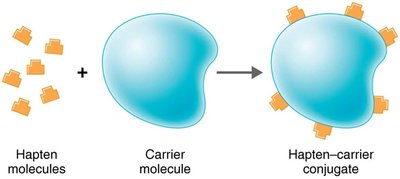
Haptens: Small molecules that are not antigenic by themselves but can provoke an immune response when attached to carrier molecules.
Humoral Immunity: Antibodies (Immunoglobulins)
Antibodies are compact, soluble proteins called immunoglobulins (Ig) that specifically recognize and bind to antigens, targeting them for destruction. Each antibody has a valence, which is the number of antigen-binding sites.
Structure: Four protein chains form a Y shape—two identical light chains and two identical heavy chains joined by disulfide links.
Variable (V) regions: Located at the ends of the arms; bind epitopes.
Constant (Fc) region: The stem, identical for a particular Ig class.
Classes: IgG, IgM, IgA, IgD, IgE.
Immunoglobulin Classes
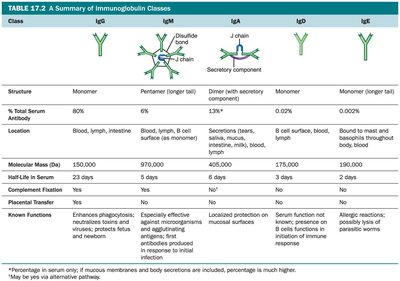
There are five main classes of immunoglobulins, each with distinct structures and functions:
Class | Structure | % Total Serum Antibody | Location | Known Functions |
|---|---|---|---|---|
IgG | Monomer | 80% | Blood, lymph, intestine | Enhances phagocytosis, neutralizes toxins/viruses, protects fetus |
IgM | Pentamer (with J chain) | 6% | Blood, lymph, B cell surface | First response, agglutination, complement activation |
IgA | Dimer (with secretory component) | 13% | Secretions (tears, saliva, mucous, milk) | Local protection in mucous membranes |
IgD | Monomer | 0.02% | B cell surface, blood, lymph | Initiates immune response on B cells |
IgE | Monomer | 0.002% | Bound to mast cells, basophils, blood | Allergic reactions, lysis of parasitic worms |
Types of Adaptive Immunity
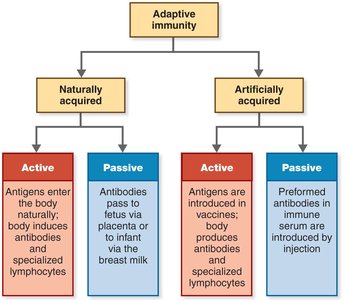
Adaptive immunity can be acquired naturally or artificially, and can be active or passive:
Naturally acquired active immunity: Results from infection; the body produces its own antibodies.
Naturally acquired passive immunity: Antibodies are transferred from mother to fetus via placenta or to infant via breast milk.
Artificially acquired active immunity: Results from vaccination; the body produces antibodies in response to introduced antigens.
Artificially acquired passive immunity: Injection of preformed antibodies.
Summary Table: Types of Adaptive Immunity
Type | How Acquired | Key Features |
|---|---|---|
Naturally Acquired Active | Infection | Body produces antibodies and lymphocytes |
Naturally Acquired Passive | Placenta, breast milk | Antibodies transferred from mother |
Artificially Acquired Active | Vaccination | Body produces antibodies in response to vaccine |
Artificially Acquired Passive | Injection | Preformed antibodies introduced |
Additional info:
Adaptive immunity is highly specific and involves memory, allowing for a more rapid and effective response upon subsequent exposure to the same antigen. The dual nature of the system ensures comprehensive protection against a wide variety of pathogens.
