 Back
BackAdaptive Immunity: Structure, Function, and Cellular Mechanisms
Study Guide - Smart Notes
 Tailored notes based on your materials, expanded with key definitions, examples, and context.
Adaptive Immunity
Overview of Antigens
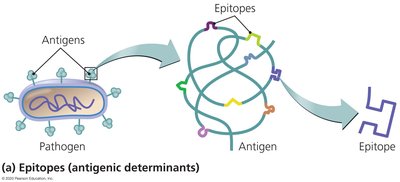
Adaptive immunity is the branch of the immune system that specifically recognizes and responds to foreign molecules, known as antigens. These molecules are typically large macromolecules from pathogens, but can also include particles from food and dust. The immune system identifies antigens by their unique three-dimensional regions called epitopes.
Antigens: Substances recognized as foreign and targeted by the immune system.
Epitope: The specific region of an antigen recognized by immune cells.
Best antigens: Large, complex macromolecules such as proteins.
Sources: Bacterial components, viral proteins, fungal and protozoan molecules, as well as environmental particles.
Recognition: Immune cells detect epitopes on antigens for targeted response.
Types of Antigens
Antigens are classified based on their origin and location within the body. Understanding these types is crucial for comprehending immune responses.
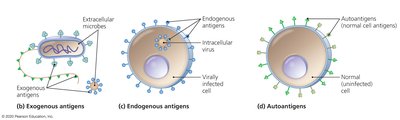
Exogenous antigens: Originate outside the host cells, including toxins and components of microbial cell walls, membranes, flagella, and pili.
Endogenous antigens: Produced by microbes that reproduce inside host cells, such as viruses.
Autoantigens (self antigens): Derived from normal cellular processes; usually ignored by the immune system unless autoimmunity occurs.
Preparation for an Adaptive Immune Response
Major Histocompatibility Complex (MHC) and Antigen-Presenting Cells (APCs)
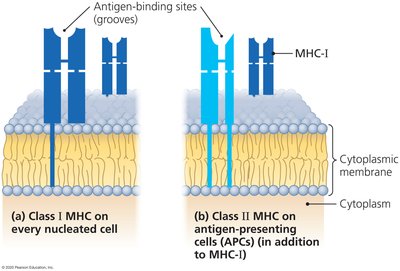
The major histocompatibility complex (MHC) is a set of glycoproteins found in the membranes of most vertebrate cells. MHC molecules hold and present antigenic epitopes to immune cells, facilitating recognition and response.
MHC Class I: Present on all nucleated cells except red blood cells; display endogenous antigens.
MHC Class II: Present only on professional antigen-presenting cells (APCs) such as macrophages, B cells, and dendritic cells; display exogenous antigens.
Antigen-binding groove: Region of MHC molecule where antigens are held for presentation.
Antigen-Presenting Cells (APCs)
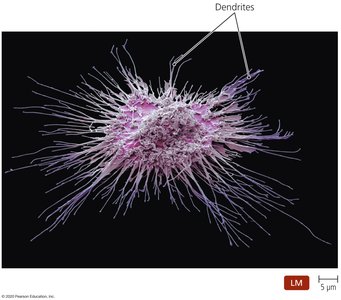
APCs are specialized cells that process and present antigens to T cells, initiating adaptive immune responses. Examples include dendritic cells, macrophages, and B cells.
Dendritic cells: Highly effective APCs with dendrites for capturing antigens.
Macrophages: Engulf pathogens and present antigens via MHC II.
B cells: Present antigens and produce antibodies.
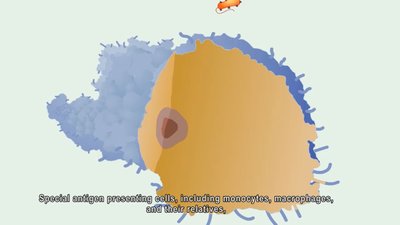
Antigen Processing
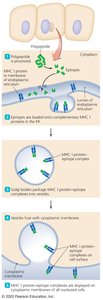
Antigen processing is the mechanism by which antigens are broken down and loaded onto MHC molecules for presentation to T cells. The process differs for endogenous and exogenous antigens.
Endogenous antigen processing: Antigens from intracellular pathogens are processed and presented by MHC I.
Exogenous antigen processing: Antigens from extracellular pathogens are processed and presented by MHC II.
T Lymphocytes (T Cells)
Structure and Function
T cells are a type of lymphocyte that play a central role in cell-mediated immunity. They are produced in the red bone marrow and mature in the thymus, then circulate in the lymph and blood, migrating to lymph nodes, spleen, and Peyer's patches.
Intracellular pathogens: T cells target cells infected with viruses or other intracellular microbes.
Abnormal cell-surface proteins: Some T cells recognize and respond to abnormal proteins on body cells.
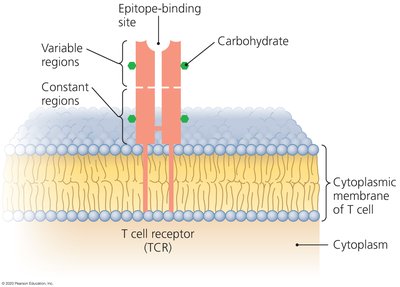
T cell receptors (TCRs): Located on the cytoplasmic membrane, these receptors are specific for particular epitopes presented by MHC molecules.
Types of T Lymphocytes
T cells are classified based on their surface glycoproteins and functions:
Cytotoxic T lymphocytes (CD8 cells): Directly kill infected or abnormal cells by secreting perforins and granzymes.
Helper T lymphocytes (CD4 cells): Regulate B cells and cytotoxic T cells; subdivided into Type 1 (secrete IL-2, gamma interferon) and Type 2 (secrete IL-4, IL-5).
Regulatory T lymphocytes (Tr cells): Suppress adaptive immune responses by secreting IL-10.
Clonal Deletion of T Cells
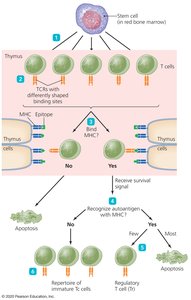
Clonal deletion is a critical process that ensures immune responses are not directed against self-antigens (autoantigens). Immature T cells undergo selection in the thymus, resulting in the elimination of self-reactive cells.
Apoptosis: Self-reactive T cells are eliminated by programmed cell death.
Regulatory T cells: Some self-recognizing T cells become regulatory T cells to help maintain tolerance.
Protective T cells: T cells that recognize MHC and foreign epitopes survive and form the repertoire of functional T cells.
Review Questions
Class II MHC Location
Class II MHC: Found exclusively on professional antigen-presenting cells (APCs), not on skin, red blood cells, or all nucleated cells.
Cell-Mediated Immunity
T lymphocytes: The primary cells responsible for cell-mediated immunity, not NK cells, B lymphocytes, or dendritic cells.
Additional info: Expanded explanations and definitions were added for clarity and completeness. All images included are directly relevant to the adjacent content and reinforce key concepts in adaptive immunity.
