 Back
BackAlgae, Protozoa, Helminths, and Arthropod Vectors: Key Concepts in Medical Microbiology
Study Guide - Smart Notes
 Tailored notes based on your materials, expanded with key definitions, examples, and context.
Algae
Defining Characteristics of Algae
Algae are a diverse group of mostly aquatic, photosynthetic organisms that are not classified as plants. They play essential roles in aquatic ecosystems and have both beneficial and harmful impacts on humans and the environment.
Not a taxonomic group: Algae are classified based on their characteristics, not taxonomy.
Structure: Unicellular or filamentous photoautotrophs; lack true roots, stems, and leaves.
Habitat: Mostly aquatic; require water for growth and reproduction.
Vegetative structures: The thallus is the body of multicellular algae, consisting of holdfasts (attachment), stipes (stem-like), and blades (leaf-like). Some have pneumocysts (gas-filled bladders) for buoyancy.
Nutrition: Most are photosynthetic, using chlorophyll a and accessory pigments.
Reproduction: All can reproduce asexually; multicellular forms may also reproduce sexually via alternation of generations.
Major Phyla of Algae
Brown algae (kelp): Multicellular, macroscopic, with cellulose and alginic acid cell walls. Produce algin, a food thickener.
Red algae: Mostly multicellular, can live at greater depths, harvested for agar and carrageenan. Some produce toxins.
Green algae: Unicellular or multicellular, with cellulose cell walls, chlorophyll a and b, and starch storage. Ancestors of terrestrial plants.
Dinoflagellates: Unicellular, cellulose in plasma membrane, component of plankton. Some produce neurotoxins (saxitoxins) causing paralytic shellfish poisoning.
Beneficial and Harmful Effects of Algae
Beneficial: Produce oxygen via photosynthesis; used in food and industry (e.g., agar, algin).
Harmful: Some produce toxins harmful to humans and animals; algal blooms can disrupt aquatic ecosystems.
Protozoa
Defining Characteristics of Protozoa
Protozoa are unicellular eukaryotes found in water and soil. They exhibit animal-like nutrition and complex life cycles, with some species causing significant human diseases.
Structure: Unicellular, eukaryotic, often with specialized feeding and locomotion structures.
Nutrition: Animal-like; ingest or absorb nutrients.
Life cycle: Feeding/growing form is the trophozoite. Reproduce asexually (fission, budding, schizogony) and sexually (conjugation). Many form cysts for survival.
Habitat: Require abundant water; some are normal microbiota, others are pathogens.
Major Groups of Protozoa and Examples
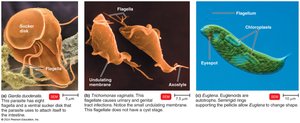
Excavata: Spindle-shaped, flagellated. Includes Giardia intestinalis (intestinal parasite, cyst-forming, fecal-oral transmission) and Trichomonas vaginalis (no cyst stage, human pathogen).
Euglenozoa: Disc-shaped mitochondria; most are photoautotrophs, but hemoflagellates (e.g., Trypanosoma) are blood parasites transmitted by insects.
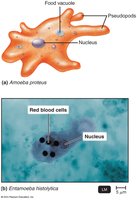
Amoebozoa: Move by pseudopods. Includes Entamoeba histolytica (causes amebic dysentery), Acanthamoeba (corneal infections), and Balamuthia (encephalitis).
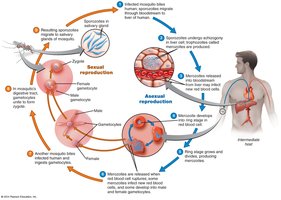
Apicomplexa: Nonmotile, obligate intracellular parasites with complex life cycles. Includes Plasmodium (malaria), Toxoplasma gondii (toxoplasmosis), and Cryptosporidium (waterborne illness).
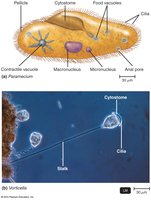
Ciliates: Move by cilia; only human parasite is Balantidium coli (dysentery).
Hosts in Protozoan Life Cycles
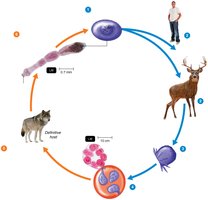
Definitive host: Where sexual reproduction occurs.
Intermediate host: Where asexual reproduction or development occurs.
Example: In malaria, the mosquito is the definitive host, and humans are the intermediate host.
Helminths
Distinguishing Characteristics of Parasitic Helminths
Helminths are multicellular, eukaryotic animals specialized for parasitism. They often have complex life cycles involving multiple hosts.
Structure: May lack digestive system, have reduced nervous and locomotor systems, and possess complex reproductive organs.
Reproduction: Can be dioecious (separate sexes) or monoecious (hermaphroditic).
Major Groups of Parasitic Helminths
Platyhelminthes (flatworms): Includes trematodes (flukes) and cestodes (tapeworms).
Nematoda (roundworms): Cylindrical, complete digestive system, sexual dimorphism.
Trematodes (Flukes)
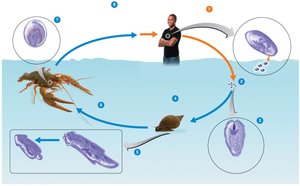
Structure: Flat, leaf-shaped, with oral and ventral suckers.
Examples: Paragonimus (lung fluke), Schistosoma (blood fluke).
Transmission: Involves intermediate hosts (e.g., snails, crayfish) and definitive hosts (humans).
Cestodes (Tapeworms)
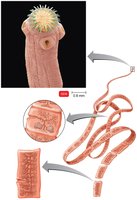
Structure: Scolex (head with suckers), proglottids (body segments with reproductive organs).
Examples: Taenia solium (pork tapeworm), Echinococcus granulosus (hydatid disease).
Life cycle: Humans can be definitive or intermediate hosts, depending on the species and transmission route.
Nematodes (Roundworms)
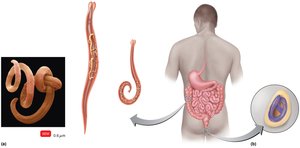
Structure: Cylindrical, complete digestive system, sexual dimorphism (males and females differ in size/structure).
Transmission: Divided into those with eggs infective to humans and those with larvae infective to humans.
Examples (eggs infective): Ascaris lumbricoides (intestinal roundworm), Enterobius vermicularis (pinworm).
Examples (larvae infective): Necator americanus (hookworm), Dirofilaria immitis (heartworm, spread by mosquitoes).
Arthropods as Vectors
Role of Arthropods in Disease Transmission
Arthropods are animals with segmented bodies, jointed legs, and hard exoskeletons. Many serve as vectors, transmitting pathogenic microorganisms to humans.
Major classes: Arachnida (mites, ticks), Crustacea (crabs, crayfish), Insecta (lice, fleas, flies, mosquitoes, bugs).
Transmission types: Mechanical (passive transfer) and biological (pathogen multiplies in vector).
Definitive host: The vector in which the pathogen undergoes sexual reproduction.
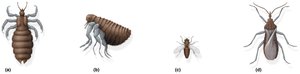
Important Arthropod Vectors of Human Diseases
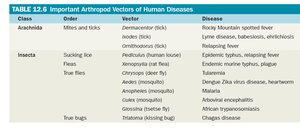
The following table summarizes key arthropod vectors, their associated diseases, and the pathogens they transmit.
Class | Order | Vector | Disease |
|---|---|---|---|
Arachnida | Mites and ticks | Dermacentor (tick), Ixodes (tick), Ornithodoros (tick) | Rocky Mountain spotted fever, Lyme disease, relapsing fever, tularemia, babesiosis, ehrlichiosis |
Insecta | Sucking lice | Pediculus (human louse) | Epidemic typhus, relapsing fever |
Insecta | Fleas | Xenopsylla (rat flea) | Endemic murine typhus, plague |
Insecta | True flies | Chrysops (deer fly), Anopheles (mosquito), Aedes (mosquito), Culex (mosquito), Glossina (tsetse fly), Triatoma (kissing bug) | Tularemia, malaria, dengue, Zika virus, yellow fever, heartworm, African trypanosomiasis, arboviral encephalopathies, Chagas disease |
Additional info: This guide expands on the provided notes with definitions, examples, and context to ensure clarity and completeness for microbiology students. All images included are directly relevant to the adjacent content and reinforce key concepts.
