 Back
Alkanes and Cycloalkanes: Structure, Nomenclature, Properties, and Isomerism
Study Guide - Smart Notes
 Tailored notes based on your materials, expanded with key definitions, examples, and context.
Hydrocarbons: Classification and Structure
Types of Hydrocarbons
Hydrocarbons are organic molecules composed solely of hydrogen and carbon. They are classified based on the types of carbon-carbon bonds present: saturated (alkanes) and unsaturated (alkenes, alkynes, arenes).
Saturated hydrocarbons (Alkanes): Only carbon-carbon single bonds.
Unsaturated hydrocarbons: Contain double bonds (alkenes), triple bonds (alkynes), or benzene-like rings (arenes).
Example: Ethane (alkane), Ethene (alkene), Acetylene (alkyne), Benzene (arene). 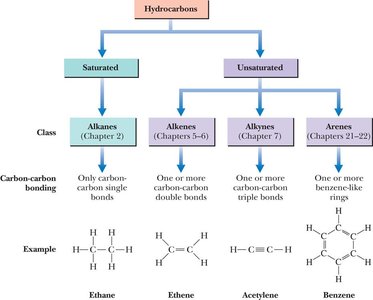
Structure of Alkanes
Bonding and Molecular Geometry
Alkanes are characterized by tetrahedral geometry around each carbon atom, with bond angles of 109.5°. Their general formula is , where x is the number of carbon atoms.
Line-Angle Formula: A simplified structural representation where vertices and line ends denote carbon atoms.
Ball-and-Stick Model: Visualizes the three-dimensional arrangement of atoms.
Example: Propane, Butane, and Pentane. 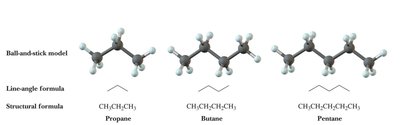
Constitutional Isomerism in Alkanes
Definition and Examples
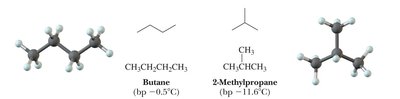
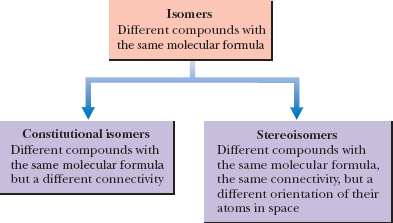
Constitutional isomers are compounds with the same molecular formula but different connectivity of atoms.
Example: C4H10 (butane and 2-methylpropane).
Isomers differ in the arrangement of carbon chains and branching.
Nomenclature of Alkanes and the IUPAC System
Rules for Naming Alkanes
The IUPAC system provides a systematic method for naming alkanes:
Identify the longest carbon chain (parent chain).
Name substituent groups attached to the parent chain.
Number the chain to give substituents the lowest possible numbers.
Use prefixes (di-, tri-, tetra-) for multiple identical substituents.
List substituents alphabetically (ignoring numerical prefixes).
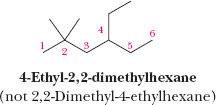
Example: 4-Methyloctane. 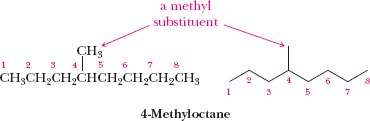 Example: 4-Ethyl-2,2-dimethylhexane.
Prefixes for Carbon Chain Length
The prefixes for the number of carbon atoms in the parent chain are standardized. 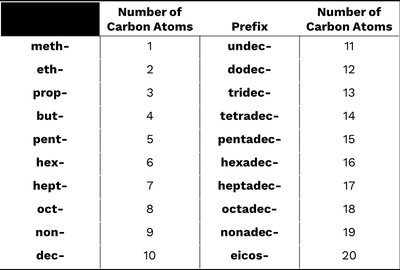
Common Names and Alkyl Groups
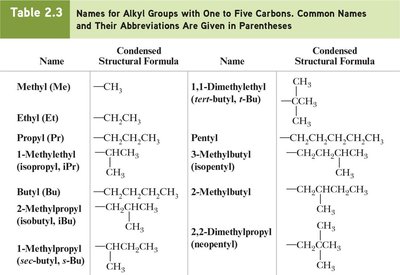
Alkyl groups are derived from alkanes by removing a hydrogen atom.
Methyl (CH3-), Ethyl (CH3CH2-), Propyl (CH3CH2CH2-)
Common names often use prefixes like n-, iso-, and neo- to indicate branching.
Classification of Carbon and Hydrogen Atoms
Primary, Secondary, Tertiary, and Quaternary
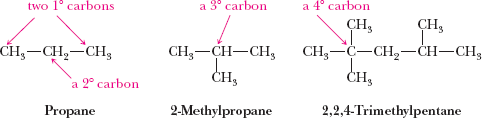
Carbon atoms are classified based on the number of other carbons to which they are attached:
Primary (1°): Attached to one other carbon.
Secondary (2°): Attached to two other carbons.
Tertiary (3°): Attached to three other carbons.
Quaternary (4°): Attached to four other carbons.
Cycloalkanes: Structure and Nomenclature
Cyclic Hydrocarbons
Cycloalkanes are saturated ring structures with the general formula .
Most common are five- and six-membered rings.
Naming begins with "cyclo-" and follows similar substituent rules as alkanes.

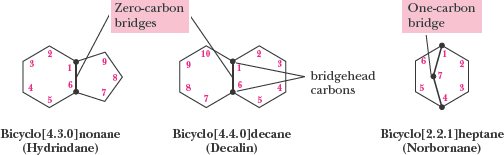
Bicycloalkanes
Structure and Formula
Bicycloalkanes contain two rings sharing two carbon atoms (bridgehead carbons). Their formula is .
Examples: Hydrindane (9C), Decalin (10C), Norbornane (7C).
Conformations of Alkanes and Cycloalkanes
Strain and Molecular Models
Alkanes and cycloalkanes can adopt different conformations due to rotation about single bonds.
Torsional strain: Caused by eclipsed interactions.
Steric strain: Caused by atoms being forced closer than their radii allow.
Angle strain: Caused by bond angles deviating from the ideal tetrahedral value.
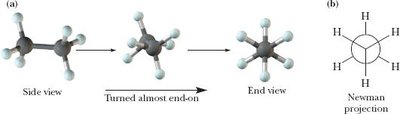
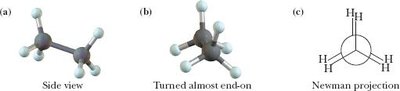
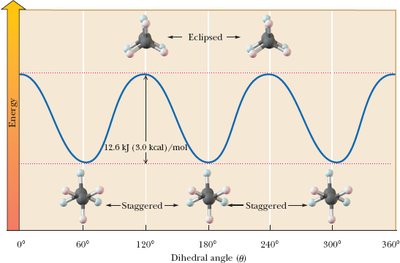
Energy Profile of Ethane Conformations
The staggered conformation is most stable, while eclipsed is least stable.
Energy barrier between conformations is about 12.6 kJ/mol.
Cycloalkane Conformations
Ring Strain and Stability
Cycloalkanes adopt nonplanar conformations to minimize strain.
Cyclopropane: Significant angle and torsional strain.
Cyclobutane: Puckered to reduce torsional strain.
Cyclopentane: Envelope conformation relieves strain.
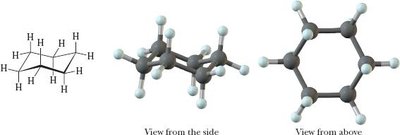
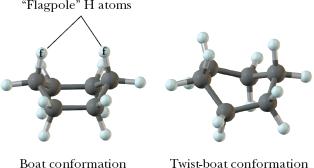
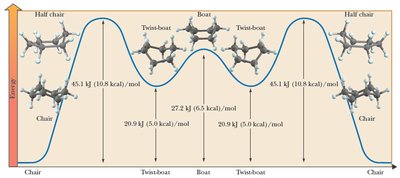
Cyclohexane: Chair conformation is most stable; boat and twist-boat are less stable.
Axial and Equatorial Bonds
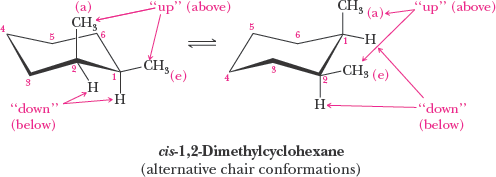
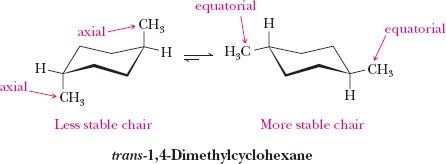
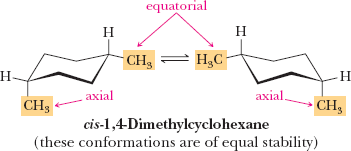
In the chair conformation, bonds are either axial (parallel to ring axis) or equatorial (around ring equator).
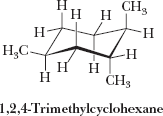
Substituents prefer equatorial positions to minimize steric strain.
Diaxial interactions cause additional strain.
Cis, Trans Isomerism in Cycloalkanes and Bicycloalkanes
Stereoisomerism
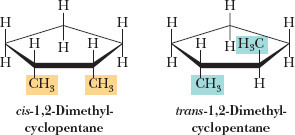
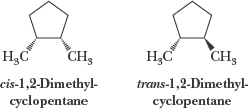
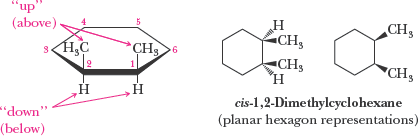
Stereoisomers have the same connectivity but differ in spatial arrangement.
Cis isomer: Substituents on the same side of the ring.
Trans isomer: Substituents on opposite sides.
Trans isomers are generally more stable due to reduced steric strain.
Physical Properties of Alkanes and Cycloalkanes
Polarity and Intermolecular Forces
Alkanes and cycloalkanes are nonpolar, exhibiting only weak dispersion forces.
Melting and boiling points increase with molecular weight.
Branching decreases surface area and boiling point.

Heats of Combustion and Stability
Combustion Reactions
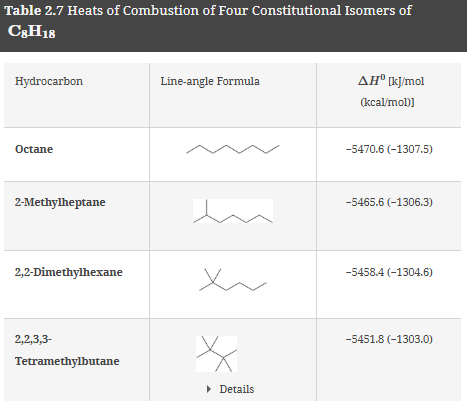
Alkanes undergo combustion to produce CO2 and H2O, releasing energy as heat.
Heat of combustion () is a measure of stability; more branching increases stability.
Cyclopropane releases more energy due to ring strain.
Summary Table: Alkane and Cycloalkane Properties
Property | Alkanes | Cycloalkanes |
|---|---|---|
General Formula | CxH2x+2 | CxH2x |
Bond Angles | 109.5° | Varies (60°–110.9°) |
Isomerism | Constitutional, Stereoisomerism | Cis/trans, Stereoisomerism |
Physical Properties | Nonpolar, weak dispersion forces | Nonpolar, ring strain affects properties |
Combustion | Releases CO2 and H2O | Releases CO2 and H2O, ring strain increases energy |
Key Equations
General Formula for Alkanes
General Formula for Cycloalkanes
Combustion Reaction Example
Heat of Combustion
Conclusion
Alkanes and cycloalkanes are fundamental classes of hydrocarbons with distinct structural, physical, and chemical properties. Understanding their nomenclature, isomerism, conformations, and reactions is essential for further study in organic chemistry and biochemistry. Additional info: These concepts are foundational for understanding the molecular basis of biological lipids and membrane structures, which are relevant to microbiology.
