Back
Antimicrobial Drugs: Mechanisms, Clinical Use, and Resistance
Study Guide - Smart Notes
 Tailored notes based on your materials, expanded with key definitions, examples, and context.
History and Types of Antimicrobial Agents
Development of Antimicrobial Therapy
The discovery and development of antimicrobial agents revolutionized the treatment of infectious diseases. These agents are classified based on their origin and method of production.
Chemotherapeutic agents: Chemicals that affect physiology in any manner, including drugs that act against diseases.
Antimicrobial agents: Drugs specifically used to treat infections caused by microorganisms.
Key historical figures:
Paul Ehrlich: Developed "magic bullets" (arsenic compounds) targeting microbes.
Alexander Fleming: Discovered penicillin from Penicillium fungus.
Gerhard Domagk: Discovered sulfanilamide, the first widely used antimicrobial.
Selman Waksman: Coined the term "antibiotics" for naturally produced antimicrobial agents.
Semi-synthetics: Chemically altered antibiotics for improved efficacy.
Synthetics: Completely synthesized antimicrobials in the laboratory.
Mechanisms of Antimicrobial Action
Selective Toxicity and Drug Targets
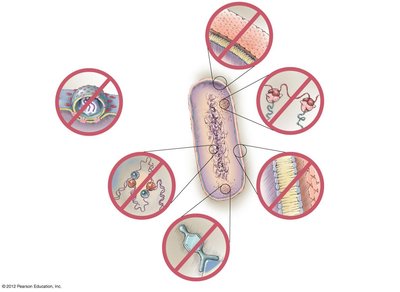
Antimicrobial drugs exploit differences between microbial and host cells to achieve selective toxicity. The largest number of drugs target bacteria, with fewer options for eukaryotic pathogens and viruses.
Selective toxicity: Drugs are designed to harm pathogens without damaging the host.
Major mechanisms:
Inhibition of cell wall synthesis
Inhibition of protein synthesis
Disruption of cytoplasmic membranes
Inhibition of metabolic pathways
Inhibition of nucleic acid synthesis
Inhibition of pathogen attachment or entry
Inhibition of Cell Wall Synthesis
Peptidoglycan Synthesis and Beta-Lactam Drugs
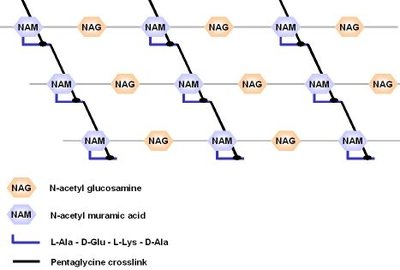
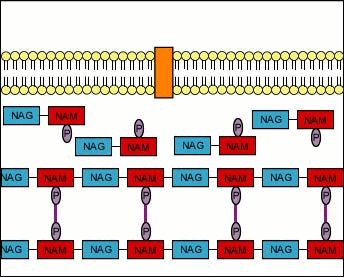
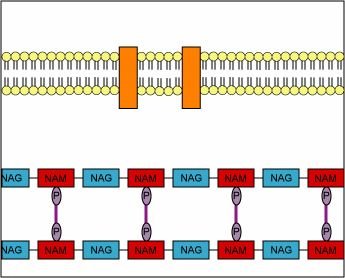
Bacterial cell walls are composed of peptidoglycan, a polymer of N-acetylglucosamine (NAG) and N-acetylmuramic acid (NAM) cross-linked by peptide bridges. Drugs targeting cell wall synthesis are most effective against actively growing bacteria.
Beta-lactams (e.g., penicillins, cephalosporins): Bind to enzymes that cross-link NAM subunits, weakening the cell wall and causing lysis.
Semi-synthetic beta-lactams: More stable, better absorbed, and active against resistant bacteria.
Other agents:
Vancomycin, cycloserine: Interfere with peptide bridges in Gram-positive bacteria.
Bacitracin: Blocks secretion of NAG and NAM from the cytoplasm.
Isoniazid, ethambutol: Disrupt mycolic acid synthesis in mycobacteria (e.g., tuberculosis).
Inhibition of Protein Synthesis
Targeting Ribosomes
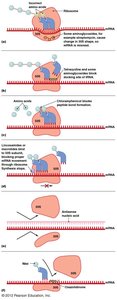
Prokaryotic ribosomes (70S) differ from eukaryotic ribosomes (80S), allowing selective inhibition of bacterial protein synthesis. However, mitochondrial ribosomes in eukaryotes resemble prokaryotic ribosomes, which can lead to toxicity.
Major drug classes:
Aminoglycosides, tetracyclines, chloramphenicol, macrolides (e.g., erythromycin)
Mechanisms: Drugs may block initiation, elongation, or cause misreading of mRNA.
Disruption of Cytoplasmic Membranes
Membrane Integrity and Antifungal Agents
Some drugs disrupt the integrity of cytoplasmic membranes, leading to cell death. This mechanism is especially important for antifungal and some antibacterial agents.
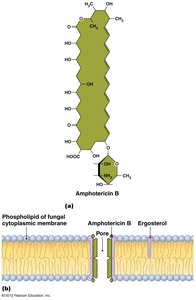
Amphotericin B: Binds to ergosterol in fungal membranes, forming pores and causing leakage.
Azoles: Inhibit ergosterol synthesis, affecting membrane structure in fungi, protozoa, and some worms.
Polymyxins: Disrupt membranes of Gram-negative bacteria; toxic to human kidneys.
Inhibition of Metabolic Pathways
Antimetabolites and Selective Toxicity
Antimetabolic agents interfere with metabolic pathways unique to pathogens. These drugs are effective when the pathogen's metabolism differs from the host's.
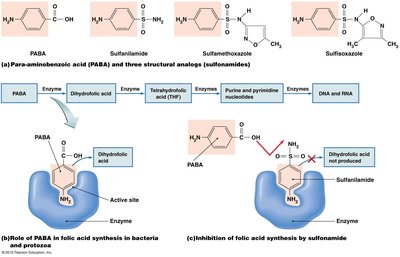
Sulfonamides: Inhibit folic acid synthesis by mimicking para-aminobenzoic acid (PABA).
Quinolones: Interfere with malaria parasite metabolism.
Heavy metals: Inactivate microbial enzymes.
Antiviral agents: Block viral uncoating or protease activity (e.g., amantadine, protease inhibitors).
Inhibition of Nucleic Acid Synthesis
Targeting DNA and RNA Processes
Some drugs block DNA replication or RNA transcription, affecting both prokaryotic and eukaryotic cells. These are mainly used in research or cancer therapy, but some are used against specific pathogens.
Nucleotide/nucleoside analogs: Distort nucleic acid structures, inhibiting replication and transcription (used against viruses and cancer cells).
Quinolones/Fluoroquinolones: Inhibit prokaryotic DNA gyrase (e.g., ciprofloxacin).
Rifampin: Inhibits RNA polymerase during transcription.
Reverse transcriptase inhibitors: Target HIV replication; not harmful to humans due to lack of this enzyme.
Clinical Considerations in Antimicrobial Therapy
Spectrum of Action
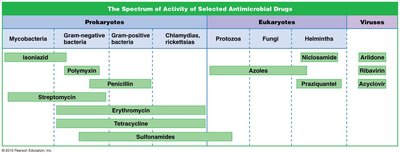
The spectrum of an antimicrobial drug refers to the range of pathogens it affects.
Narrow-spectrum: Effective against a limited group of organisms.
Broad-spectrum: Effective against a wide variety of organisms; may lead to secondary or superinfections by disrupting normal flora.
Efficacy Testing
Several laboratory tests are used to determine the efficacy of antimicrobial agents:
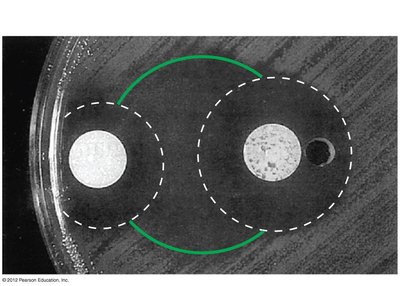
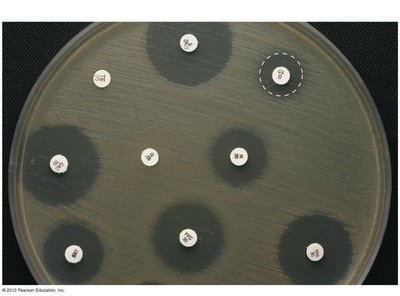
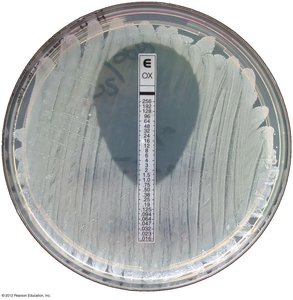
Diffusion susceptibility (Kirby-Bauer) test: Measures zones of inhibition around antibiotic disks.
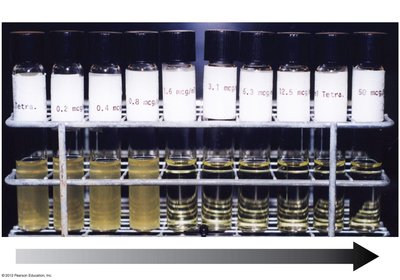
Minimum inhibitory concentration (MIC) test: Determines the lowest concentration that inhibits visible growth.
Minimum bactericidal concentration (MBC) test: Identifies the lowest concentration that kills the organism.
Etest: Combines aspects of Kirby-Bauer and MIC tests.
Routes of Administration
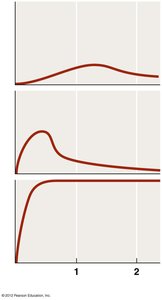
The method of drug administration affects its distribution and concentration in the body.
Topical: For external infections.
Oral: Self-administered, no needles required.
Intramuscular (IM): Injection into muscle tissue.
Intravenous (IV): Direct delivery into the bloodstream.
Safety and Side Effects
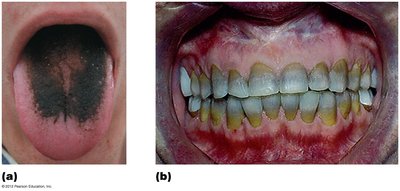
Antimicrobial drugs can cause adverse effects, including toxicity, allergies, and disruption of normal microbiota.
Toxicity: May affect kidneys, liver, or nerves; special caution for pregnant women (e.g., tetracyclines can affect fetal bones and teeth).
Allergies: Rare but potentially life-threatening (e.g., anaphylactic shock).
Disruption of normal microbiota: Can lead to secondary infections or overgrowth of resistant organisms (superinfections).
Resistance to Antimicrobial Drugs
Mechanisms and Spread of Resistance
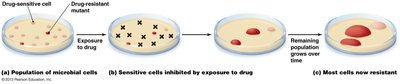
Microbial resistance to drugs can be intrinsic or acquired through mutations or horizontal gene transfer (e.g., R-plasmids).
Mechanisms of resistance:
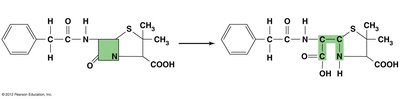
Enzyme production that destroys or deactivates the drug (e.g., beta-lactamase)
Prevention of drug entry
Alteration of drug targets
Altered metabolic pathways
Efflux pumps to expel drugs
Biofilm formation
Production of protective proteins (e.g., MfpA in Mycobacterium tuberculosis)
Multiple and Cross Resistance
Pathogens may develop resistance to multiple drugs, especially in healthcare settings where drug use is frequent. Cross-resistance can occur among drugs with similar structures or mechanisms.
Strategies to Retard Resistance
Maintain high drug concentrations to kill all sensitive cells.
Use drug combinations (synergism vs. antagonism).
Limit use of antimicrobials to necessary cases.