 Back
BackAntimicrobial Proteins and Adaptive Immunity: Complement System, NK Cells, and Antibodies
Study Guide - Smart Notes
 Tailored notes based on your materials, expanded with key definitions, examples, and context.
Antimicrobial Proteins and Innate Immunity
Complement System
The complement system is a group of over 30 globular proteins that play a crucial role in both innate and adaptive immunity. These proteins are primarily synthesized by the liver and circulate in the blood in an inactive state. Upon activation, the complement system enhances inflammation, promotes immune clearance, facilitates phagocytosis, and induces cytolysis of pathogens.
Activation Pathways:
Classical Pathway: Triggered when antibodies bind to a microbe, exposing complement-binding sites and initiating a reaction cascade (complement fixation).
Alternative Pathway: Initiated by the binding of complement protein C3b directly to microbial surfaces.
Lectin Pathway: Involves lectins (plasma proteins) binding to specific sugars on microbial surfaces, activating the complement cascade.
Outcomes of Complement Activation:
Inflammation: C3a stimulates mast cells and basophils to release histamine and other inflammatory mediators, attracting neutrophils and macrophages.
Immune Clearance: C3b binds antigen-antibody complexes to red blood cells, which are then transported to the liver and spleen for removal by macrophages.
Phagocytosis: C3b coats microbial cells (opsonization), enhancing their recognition and ingestion by phagocytes.
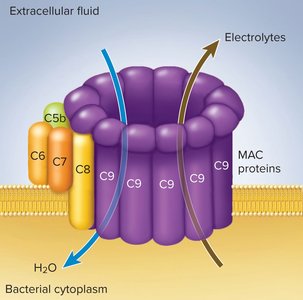
Cytolysis: C3b initiates the assembly of the membrane attack complex (MAC), which forms a pore in the pathogen's membrane, leading to cell lysis.
Natural Killer (NK) Cells
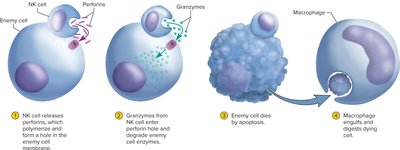
Natural killer (NK) cells are lymphocytes that provide rapid responses to virally infected cells and tumor formation as part of innate immunity. NK cells patrol the body, recognizing and binding to abnormal cells, including infected, cancerous, or transplanted cells.
Upon recognition, NK cells release perforins, which polymerize to form pores in the target cell membrane.
Granzymes are then secreted into the target cell through these pores, degrading cellular enzymes and inducing apoptosis (programmed cell death).
Macrophages subsequently engulf and digest the dying cell.
Adaptive (Specific) Immunity
General Aspects of Adaptive Immunity
Adaptive immunity is the third line of defense and is characterized by its systemic effect, specificity, and memory. It can be classified into two main types: cellular (cell-mediated) and humoral (antibody-mediated) immunity.
Systemic: Acts throughout the body, not just at the site of infection.
Specificity: Targets specific pathogens based on unique antigens.
Memory: Provides long-lasting protection by responding more rapidly and effectively upon re-exposure to the same pathogen.
Forms of Adaptive Immunity
Cellular (Cell-Mediated) Immunity: Involves T lymphocytes directly attacking and destroying infected or abnormal cells. Effective against intracellular pathogens, cancer cells, and transplanted tissues.
Humoral (Antibody-Mediated) Immunity: Involves B lymphocytes producing antibodies that tag extracellular pathogens and toxins for destruction.
Classification of Immunity
Type | How Acquired | Duration | Example |
|---|---|---|---|
Natural Active | Infection/exposure | Long-term | Recovery from measles |
Artificial Active | Vaccination | Long-term | MMR vaccine |
Natural Passive | Maternal antibodies | Temporary | Placental transfer, breastfeeding |
Artificial Passive | Injection of antibodies | Temporary | Antivenom for snakebite |
Antigens
An antigen (Ag) is any molecule capable of binding to an antibody and eliciting an immune response. Most antigens are large, complex molecules such as proteins, polysaccharides, glycoproteins, or glycolipids. The body distinguishes 'self' from 'non-self' based on antigenic properties.
Epitopes (antigenic determinants): Specific regions of an antigen recognized by the immune system.
Haptens: Small molecules that are not antigenic by themselves but can elicit an immune response when attached to a larger carrier molecule (e.g., penicillin, poison ivy).
Antibodies (Immunoglobulins)
Antibodies (Abs), also known as immunoglobulins (Igs), are Y-shaped proteins produced by B cells. They circulate in body fluids and are also found on the surface of immune cells. Antibodies recognize and bind to specific antigens, marking them for destruction or neutralization.
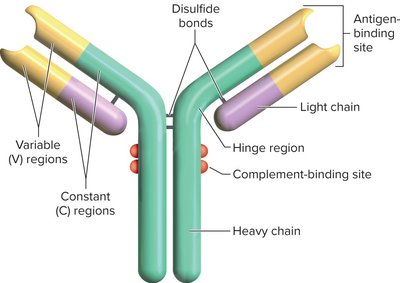
Structure: Each antibody monomer consists of two heavy chains and two light chains, linked by disulfide bonds. The variable (V) regions confer antigen specificity, while the constant (C) regions determine the antibody class and function.
Antigen-binding site: Formed by the V regions of both heavy and light chains, allowing specific binding to epitopes.
Classes of Antibodies
Class | Structure | Main Functions |
|---|---|---|
IgA | Monomer/dimer | Prevents pathogen adherence to mucosal surfaces; passive immunity to newborns |
IgD | Monomer | B cell receptor; B cell activation |
IgE | Monomer | Allergy and parasite defense; binds to basophils and mast cells |
IgG | Monomer | Main antibody in secondary response; crosses placenta; complement fixation |
IgM | Pentamer | Main antibody in primary response; strong agglutination and complement activation |
Generation of Antibody Diversity
The human immune system can produce up to 1 trillion different antibodies, despite having only about 20,000 genes. This diversity is achieved through:
Somatic recombination: DNA segments are shuffled to create new combinations for antibody genes.
Somatic hypermutation: B cells undergo rapid mutation in lymphoid tissues, generating new antibody variants.
Lymphocytes
There are three main types of lymphocytes:
Natural Killer (NK) Cells: Part of innate immunity, responsible for destroying infected or abnormal cells.
T Lymphocytes (T cells): Mediate cellular immunity; develop in the thymus through stages of selection to ensure self-tolerance and immunocompetence.
B Lymphocytes (B cells): Mediate humoral immunity by producing antibodies.
T cell development: Involves positive selection (ensuring proper receptor formation) and negative selection (eliminating self-reactive cells) in the thymus. Surviving T cells become naïve lymphocytes, ready to respond to antigens in secondary lymphoid tissues.
