Back
BackAseptic Technique, Bacterial Culture Methods, and Differential Media in Microbiology
Study Guide - Smart Notes
 Tailored notes based on your materials, expanded with key definitions, examples, and context.
Transfer of Bacteria and Aseptic Technique
Background and Importance
Aseptic technique is a fundamental practice in microbiology, designed to prevent contamination of cultures, media, and the laboratory environment. It ensures that only the intended microorganisms are introduced into culture media, which is essential for accurate study and experimentation.
Aseptic technique: Procedures used to exclude contaminants when handling bacterial cultures.
All culture media are sterilized (commonly by autoclaving) and should remain sealed until use.
Inoculation: The process of introducing microorganisms into a culture medium.
Types of Culture Media
Forms and Functions
Culture media provide the nutrients and environment necessary for bacterial growth. Different forms of media are used depending on the experimental requirements.
Broth cultures: Liquid media that support the growth of large numbers of bacteria in a small volume; easy to transport.
Agar slants: Solid media in test tubes solidified at an angle, providing a large surface area for growth.
Agar deeps: Solid media in upright tubes, used for growing bacteria that require reduced oxygen or for motility testing.
Inoculation Tools and Procedures
Inoculating Loops and Needles
Microbiologists use specialized tools for transferring bacteria to and from culture media.
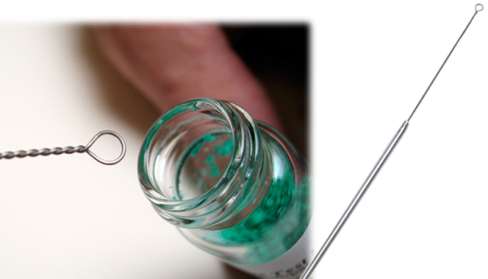
Inoculating loop: A looped wire used for transferring bacteria; sterilized by heating before and after use.
Inoculating needle: A straight wire used for stabbing into solid media.
Aseptic Technique Procedures
Proper aseptic technique involves several key steps to minimize contamination:
Work with one culture at a time to prevent cross-contamination.
Label all tubes clearly before inoculation.
Sterilize the inoculating loop by heating it in a flame or incinerator for 2–4 seconds.
Open tubes carefully, holding them at a 20-degree angle and passing the mouth through a flame to reduce airborne contamination.
Do not set down tube caps or allow the tube rim to touch surfaces.
Gently resuspend sediment in broth cultures before sampling.
Isolation of Bacteria
Pure Culture Techniques
Obtaining pure cultures is essential for studying the characteristics of specific bacterial species. Early methods involved serial dilution, but the development of solid media by Robert Koch revolutionized bacterial isolation.
Pure culture: A culture containing only one species of microorganism.
Solid media allow for the separation and visualization of individual colonies.
Dilution Series
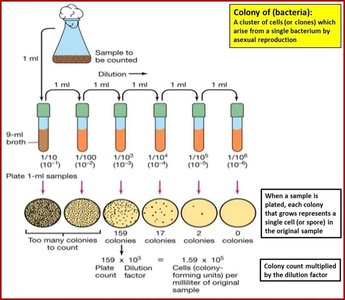
Dilution series are used to reduce bacterial concentration for easier counting and isolation.
Each dilution step reduces the concentration by a factor of 10 (10-fold dilution).
After plating a measured volume, colonies are counted and multiplied by the dilution factor to estimate the original concentration (CFU/mL).
Streak Plate Technique
Principle and Application
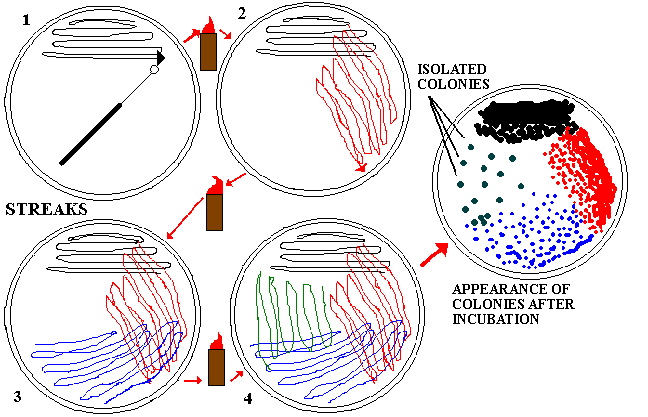
The streak plate method is a common technique for isolating pure bacterial colonies from a mixed sample.
A sterile loop is used to streak bacteria across the surface of an agar plate in a pattern that thins out the sample, leading to isolated colonies.
Each isolated colony arises from a single bacterium or a group of identical bacteria.
Counting Bacteria: Spread Plate and Pour Plate Methods
Spread Plate Technique
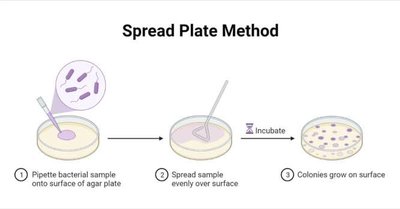
This method is used to count viable bacteria in a sample by spreading a diluted sample over the surface of an agar plate.
Only living bacteria form visible colonies.
Provides accurate counts for samples with moderate bacterial concentrations.
Pour Plate Technique
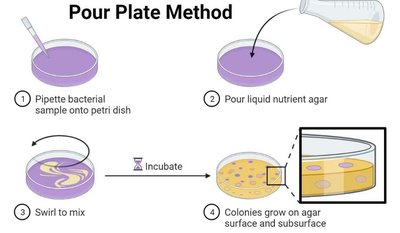
In this method, diluted bacterial samples are mixed with molten agar and poured into Petri dishes. Colonies grow both on the surface and within the agar.
Useful for counting bacteria that prefer low oxygen environments.
Media Types: Differential and Selective Media
Differential Media
Differential media contain indicators that reveal differences between bacterial species based on their metabolic activities, often resulting in color changes.
Examples: MacConkey agar, CLED agar, TCBS agar, XLD agar.
Allow visual distinction of bacteria based on colony color or appearance.
Selective Media
Selective media contain substances that inhibit the growth of unwanted microorganisms, allowing only specific bacteria to grow.
Often combined with differential properties for efficient identification.
MacConkey Agar
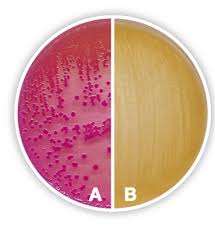
MacConkey agar is both selective and differential, used to isolate and differentiate Gram-negative enteric bacteria based on lactose fermentation.
Bile salts and crystal violet inhibit Gram-positive bacteria.
Neutral Red pH indicator and lactose differentiate lactose fermenters (pink colonies) from non-fermenters (colorless/tan colonies).
Xylose Lysine Deoxycholate (XLD) Agar
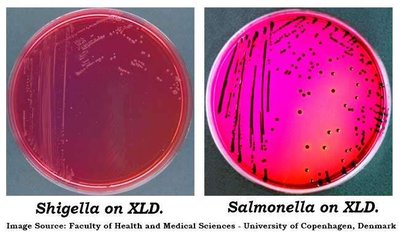
XLD agar is used to isolate and identify pathogenic Gram-negative bacteria, especially Salmonella and Shigella.
Most enteric bacteria ferment xylose, producing yellow colonies.
Shigella does not ferment xylose, resulting in red colonies.
Salmonella decarboxylates lysine and produces H2S, forming red colonies with black centers.
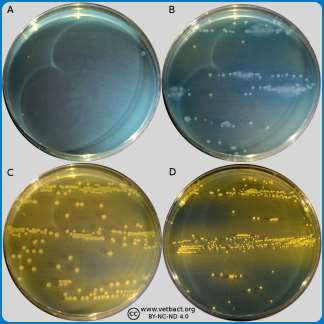
Cysteine Lactose Electrolyte Deficient (CLED) Agar
CLED agar is a differential medium primarily used for urine cultures to isolate and quantify urinary pathogens.
Electrolyte deficiency prevents swarming of Proteus species.
Bromothymol blue indicator differentiates lactose fermenters (yellow colonies) from non-fermenters (blue/translucent colonies).
Escherichia coli forms yellow colonies; Proteus forms blue colonies.
Thiosulfate-Citrate-Bile Salts-Sucrose (TCBS) Agar
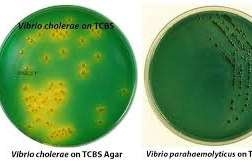
TCBS agar is selective and differential for Vibrio species, especially Vibrio cholerae and Vibrio parahaemolyticus.
High pH and bile salts inhibit most bacteria except Vibrio.
Sucrose fermentation produces yellow colonies (e.g., V. cholerae).
Anaerobic Media
Media for Anaerobic Bacteria
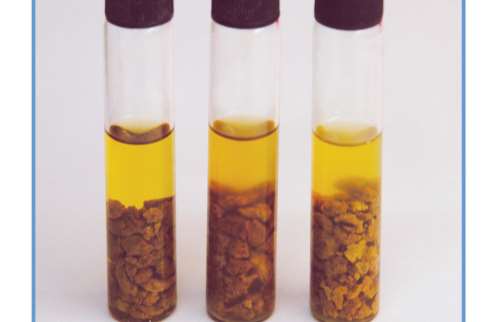
Anaerobic media are designed to support the growth of bacteria that cannot tolerate oxygen.
Examples: Robertson’s cooked meat medium, thioglycolate broth.
Bacterial Oxygen Preferences
Classification Based on Oxygen Requirement
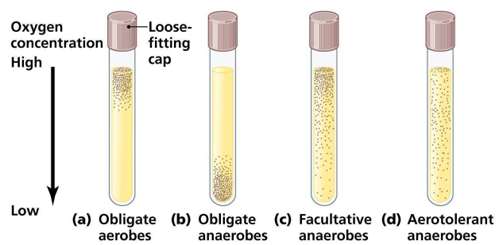
Bacteria are classified by their oxygen requirements, which can be visualized by their growth patterns in thioglycolate broth.
Obligate aerobes: Require oxygen; grow at the top of the tube.
Obligate anaerobes: Killed by oxygen; grow at the bottom.
Facultative anaerobes: Grow throughout the tube but best at the top.
Aerotolerant anaerobes: Grow evenly throughout; not affected by oxygen.