 Back
BackBacterial Gene Regulation: Operons, Control Mechanisms, and Quorum Sensing
Study Guide - Smart Notes
 Tailored notes based on your materials, expanded with key definitions, examples, and context.
Bacterial Gene Regulation
Introduction to Gene Regulation
Gene regulation refers to the cellular processes that control the timing, location, and amount of gene expression. In bacteria, gene regulation is essential for adapting to environmental changes and efficiently using resources. - Gene expression is the process of transcription and translation of a gene to produce a protein. - Proteins perform tasks such as structural support or catalyzing reactions. - Regulation ensures that proteins are produced only when needed, conserving energy and resources. 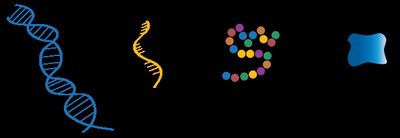
Constitutive vs. Regulated Genes
Not all genes are expressed at all times. Some are always active, while others are regulated based on cellular needs. - Constitutively active genes ("housekeeping" genes) are always on and necessary for basic cell maintenance. - Examples include genes encoding enzymes for cellular respiration, RNA polymerase, ribosomal subunits, tRNAs, and glycolysis enzymes. - Regulated genes respond to environmental changes such as nutrient availability, temperature, stress, or biofilm formation.
Operons: Structure and Function
Definition and Components of an Operon
An operon is a cluster of genes under the control of a single promoter and regulatory elements, allowing coordinated expression. - Promoter: DNA sequence where RNA polymerase binds to initiate transcription. - Operator: DNA sequence where a repressor protein can bind to block transcription. - Regulatory gene: Encodes the repressor protein. - Structural genes: Encode proteins with related functions. 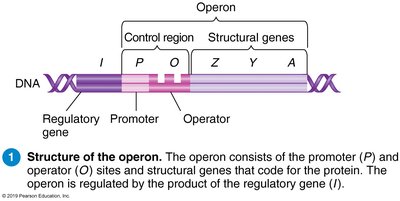
Mechanics of Operon Regulation
Operons can be regulated by repressors or activators, which bind to DNA and affect transcription. - Repressor protein binds to the operator to prevent RNA polymerase from transcribing downstream genes. - When the repressor is not bound, transcription occurs. - The repressor protein can change shape (conformation) depending on the presence of specific molecules (inducers or corepressors). 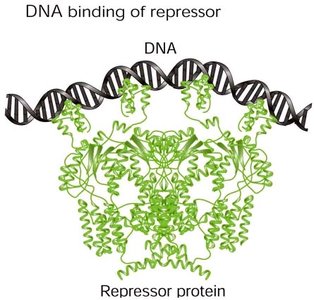
Types of Operons
Inducible Operons
Inducible operons are usually off but can be turned on in response to specific signals. - Default state: OFF (repressor bound to operator, transcription blocked). - Inducer binds to the repressor, changing its shape so it cannot bind the operator, allowing transcription. - Example: lac operon, which is induced when lactose is present. 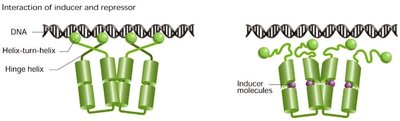
Repressible Operons
Repressible operons are usually on but can be turned off when a specific molecule is present. - Default state: ON (repressor not bound to operator, transcription occurs). - Corepressor binds to the repressor, enabling it to bind the operator and block transcription. - Example: trp operon, which is repressed when tryptophan is abundant. 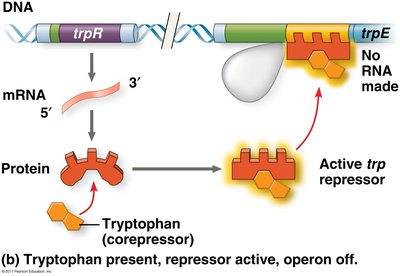
Regulation of Specific Operons
trp Operon (Repressible)
The trp operon encodes enzymes for tryptophan synthesis. - When tryptophan is absent, the repressor is inactive and cannot bind the operator, so transcription occurs. - When tryptophan is present, it acts as a corepressor, binding to the repressor and enabling it to block transcription. - This is an example of feedback inhibition. 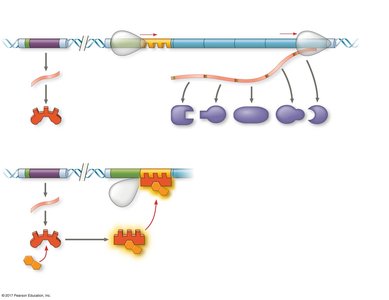
lac Operon (Inducible)
The lac operon encodes enzymes for lactose uptake and utilization. - In the absence of lactose, the repressor binds the operator and blocks transcription. - When lactose (specifically allolactose) is present, it binds the repressor, causing it to release from the operator, allowing transcription. - The lac operon is also subject to positive control by the cAMP-CRP complex, which enhances transcription when glucose is low. 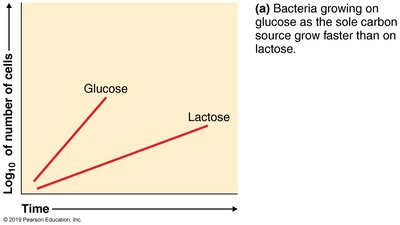

Positive vs. Negative Control
Negative Control
Negative control involves repressors that block transcription. - Both the lac and trp operons are examples of negative control.
Positive Control
Positive control involves activators that enhance transcription. - The cAMP-CRP complex in the lac operon is an example, promoting RNA polymerase binding when glucose is low.
Quorum Sensing
Definition and Mechanism
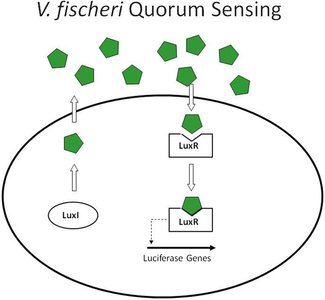
Quorum sensing is the ability of bacteria to communicate and coordinate behavior via signaling molecules called autoinducers. - Bacteria secrete and respond to autoinducers, enabling group behaviors such as biofilm formation and bioluminescence. 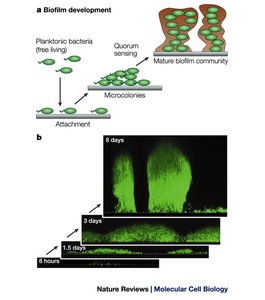
Example: Vibrio fischeri and Bobtail Squid
Vibrio fischeri bacteria use quorum sensing to produce light in the bobtail squid's light organ. - At low cell density, no luminescence occurs. - At high cell density, autoinducers accumulate, activating luciferase genes and causing bioluminescence. 
Key Terms and Comparisons
Summary Table: Operon Types and Control Mechanisms
Operon Type | Default State | Regulatory Molecule | Example |
|---|---|---|---|
Inducible | OFF | Inducer | lac operon |
Repressible | ON | Corepressor | trp operon |
Important Terms
- Promoter: DNA sequence for RNA polymerase binding. - Operator: DNA sequence for repressor binding. - Activator: Protein that enhances transcription. - Repressor gene: Encodes the repressor protein. - Repressor protein: Blocks transcription by binding operator. - Inducer: Molecule that inactivates repressor. - Corepressor: Molecule that activates repressor. - Operon: Cluster of genes regulated together.
Conclusion
Bacterial gene regulation is a complex and highly adaptive process, allowing cells to respond to environmental changes and efficiently manage resources. Understanding operons, control mechanisms, and quorum sensing is fundamental to microbiology and biotechnology. ----------------------------------------
