 Back
BackBacterial Growth: Culture, Requirements, and Measurement
Study Guide - Smart Notes
 Tailored notes based on your materials, expanded with key definitions, examples, and context.
Bacterial Growth
Introduction
Bacterial growth refers to the increase in the number of bacterial cells in a population rather than an increase in cell size. Understanding the requirements and methods for culturing, isolating, and measuring bacterial growth is fundamental in microbiology, especially for laboratory and clinical applications.
I. Culture Media
Types of Culture Media
Culture media provide the necessary nutrients and environmental conditions for microbial growth. They can be classified based on their physical state and purpose:
Liquid Media (Broth): Used for growing large numbers of bacteria in a homogenous environment.
Semisolid Media (Agar): Used for isolating and differentiating bacterial colonies.
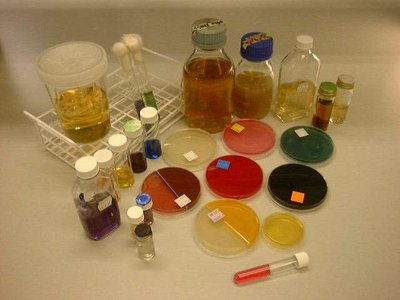
Examples: Nutrient agar, blood agar, MacConkey agar.
II. Isolating Pure Colonies (Cultures)
Methods for Isolating Pure Cultures
Isolating pure colonies is essential for studying the characteristics of a single bacterial species. The main methods include:
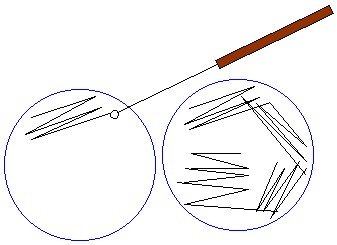
Streak Plate Method: Involves spreading bacteria across an agar plate using an inoculation loop to separate individual cells, which then form isolated colonies.
Pour Plate Method: A diluted sample is mixed with melted agar and poured into a Petri dish. Colonies grow both on the surface and within the medium.
Spread Plate Method: A diluted sample is spread evenly over the surface of an agar plate, allowing colonies to grow only on the surface.
Key Point: These methods are used to obtain isolated colonies for further analysis and identification.
III. Requirements for Growth
A. Physical Requirements
Bacteria require specific physical conditions for optimal growth:
Temperature: Different bacteria have different temperature preferences:
Psychrophiles: Grow at 0–25°C (cold-loving).
Psychrotrophs: Grow above 15°C, tolerate cold.
Mesophiles: Grow at 25–40°C (moderate temperature; includes most pathogens).
Thermophiles: Grow at 40–70°C (heat-loving).
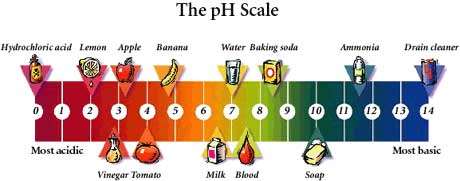
pH: Most bacteria grow best at neutral pH (6.5–7.5). Acidophiles and alkaliphiles prefer acidic and basic environments, respectively. Buffers are used in media to maintain stable pH.
Osmotic Pressure: Isotonic environments are ideal. Halophiles are salt-loving bacteria that thrive in high-salt environments (e.g., Dead Sea).

B. Chemical Requirements
Bacteria need various chemical elements for growth:
Carbon: Main component of cellular molecules.
Nitrogen: Needed for proteins, nucleic acids.
Phosphorus: Important for nucleic acids and ATP.
Oxygen: Bacteria are classified by their oxygen requirements:
Obligate aerobes: Require oxygen (e.g., Mycobacterium tuberculosis).
Obligate anaerobes: Cannot survive in oxygen (e.g., Clostridium tetani).
Facultative anaerobes: Can grow with or without oxygen (e.g., E. coli).
Microaerophiles: Require low oxygen levels (e.g., Streptococcus).
Aerotolerant anaerobes: Tolerate oxygen but do not use it (e.g., Lactobacillus).
Organic Growth Factors: Compounds such as vitamins and amino acids that bacteria cannot synthesize and must obtain from the environment. Fastidious organisms have complex nutritional requirements.
Oxygen Toxicity and Enzymes
Obligate anaerobes are killed by toxic by-products of oxygen metabolism (e.g., superoxide radicals, hydrogen peroxide) because they lack enzymes such as superoxide dismutase (SOD) and catalase, which detoxify these compounds.
Superoxide Dismutase (SOD): Converts superoxide radicals to hydrogen peroxide.
Catalase: Converts hydrogen peroxide to water and oxygen.
Equations:
IV. Growth of Bacterial Cultures
A. Bacterial Division and Generation Time
Bacteria typically reproduce by binary fission, a process in which one cell divides into two identical daughter cells. The time required for a bacterial population to double is called the generation time.
Example: E. coli has a generation time of about 20 minutes under optimal conditions.
Exponential Growth: Bacterial populations grow exponentially, doubling with each generation.
B. Stages of Growth (Bacterial Growth Curve)
A typical bacterial growth curve in a closed system (batch culture) has four phases:
Lag Phase: Cells adapt to new environment; little or no cell division.
Log (Exponential) Phase: Rapid cell division; population doubles at a constant rate.
Stationary Phase: Growth rate slows; number of new cells equals number of dying cells due to nutrient depletion and waste accumulation.
Death (Decline) Phase: Number of dying cells exceeds new cells; population decreases.
V. Measurement of Bacterial Growth
A. Direct Methods
Direct Microscopic Count: Uses a Petroff-Hausser counting chamber to count cells under a microscope. Quick but cannot distinguish live from dead cells.
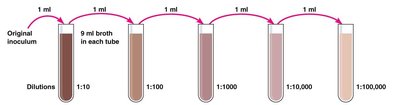
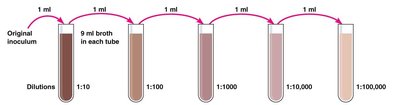
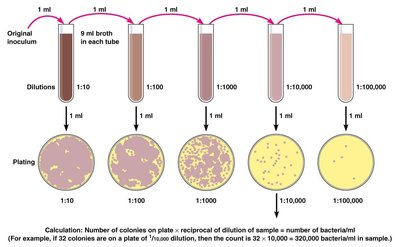
Viable Plate Count: Only counts living cells capable of forming colonies. Involves serial dilution and plating on agar. Results expressed as colony-forming units per milliliter (CFU/ml).
Filtration: Used for samples with low bacterial counts. Sample is filtered, and the filter is placed on agar to count colonies.
B. Indirect Methods
Turbidity Measurement: Uses a spectrophotometer to measure the cloudiness (optical density) of a bacterial suspension. Higher absorbance indicates higher cell density.
Key Formula:
Example Calculation: If 35 colonies are counted on a plate from a 10-4 dilution and 1 ml is plated, then:
Advantages and Disadvantages of Measurement Methods
Method | Advantages | Disadvantages |
|---|---|---|
Direct Microscopic Count | Quick, simple | Cannot distinguish live/dead cells, not suitable for low concentrations |
Viable Plate Count | Counts only live cells | Requires incubation, time-consuming |
Filtration | Good for low concentrations, allows further analysis | Possible overgrowth, requires incubation |
Turbidity (Spectrophotometer) | Rapid, non-destructive | Cannot distinguish live/dead cells, less accurate at high densities |
VI. Quorum Sensing
Definition and Significance
Quorum sensing is a process by which bacteria communicate and coordinate behavior based on cell density, often leading to biofilm formation and increased resistance to antibiotics.
Summary Table: Key Environmental Factors Affecting Bacterial Growth (FATTOM)
Factor | Description |
|---|---|
Food | Availability of nutrients |
Acidity | pH of the environment |
Time | Duration of exposure to conditions |
Temperature | Optimal growth temperature |
Oxygen | Requirement or tolerance for oxygen |
Moisture | Water availability |
