 Back
BackBacterial Regulatory Systems: Mechanisms of Gene Expression Control
Study Guide - Smart Notes
 Tailored notes based on your materials, expanded with key definitions, examples, and context.
Bacterial Regulatory Systems
Overview of Gene Expression Regulation
Bacteria employ sophisticated regulatory systems to control gene expression in response to environmental and cellular signals. These mechanisms ensure that proteins are synthesized only when needed, optimizing resource use and cellular function.
Genotype vs Phenotype: Genotype refers to the genetic makeup, while phenotype is the observable trait resulting from gene expression.
Constitutive genes: Expressed at a constant rate regardless of environmental conditions.
Regulated genes: Expression varies according to cellular needs and environmental changes.
Operon theory: Genes are organized in clusters (operons) controlled by a single promoter, allowing coordinated regulation.
Transcription factors: Proteins that modulate gene expression by binding to DNA and influencing transcription.
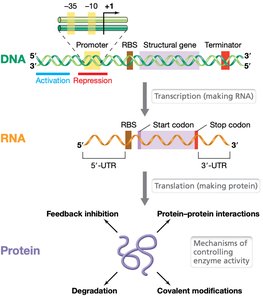
DNA-Binding Proteins
DNA-binding proteins are essential for regulating transcription. They interact with specific DNA sequences to either activate or repress gene expression.
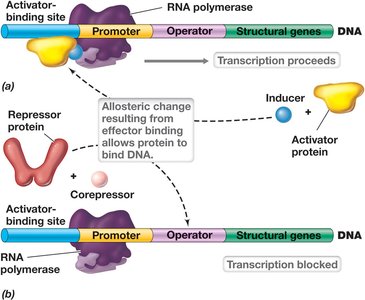
Activator: Facilitates transcription by binding to activator-binding sites (positive control).
Repressor: Inhibits transcription by binding to operator sites (negative control).
Effector molecules: Small molecules that modulate the activity of activators or repressors.
Inducer: Turns on gene expression by activating an activator or inactivating a repressor.
Co-repressor: Turns off gene expression by activating a repressor.
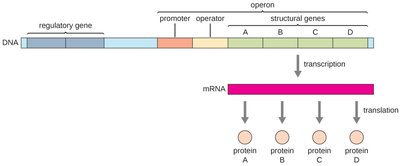
Operons and Regulons
Operons are clusters of genes under the control of a single promoter, transcribed as polycistronic mRNA. Regulons consist of multiple operons regulated by the same transcription factor.
Operon: Allows coordinated expression of genes with related functions.
Promoter: DNA segment where RNA polymerase initiates transcription.
Operator: DNA segment controlling transcription, often the binding site for repressors.
Regulon: Group of operons regulated by a common transcription factor.
Transcriptional Regulation
Negative Control: Repressible and Inducible Operons
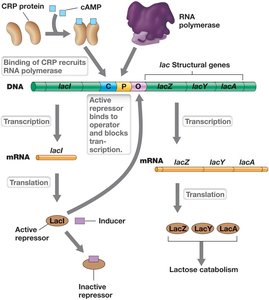
Negative transcriptional control involves repressors that block transcription. Operons can be repressible (default ON, turned OFF by co-repressor) or inducible (default OFF, turned ON by inducer).
Repressible operon: Typically involved in anabolic pathways (e.g., arg operon for arginine biosynthesis).
Inducible operon: Typically involved in catabolic pathways (e.g., lac operon for lactose utilization).
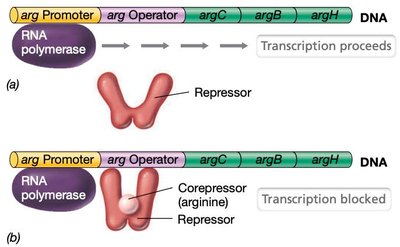
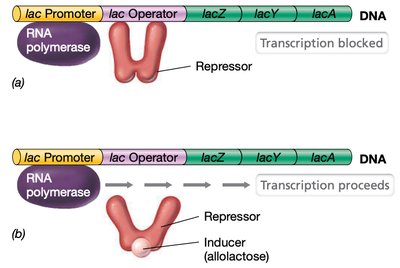
Comparison of Inducible and Repressible Operons
Operon Type | Default State | Regulation Mechanism | Example |
|---|---|---|---|
Inducible | OFF | Inducer inactivates repressor | lac operon |
Repressible | ON | Co-repressor activates repressor | arg operon |
Positive Control: Activator Proteins
Positive transcriptional control involves activator proteins that enhance transcription by recruiting RNA polymerase to the promoter. The maltose operon is a classic example.
Activator protein: Binds to activator-binding site and facilitates transcription.
Inducer: Activates the activator protein (e.g., maltose for maltose operon).
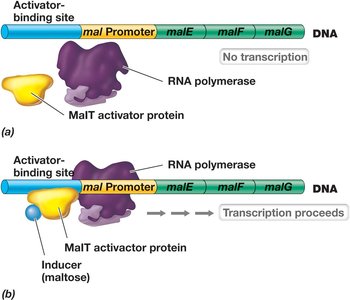
Global Control Systems
Global control systems regulate transcription of multiple genes across different regulons. Catabolite repression and alternate sigma factors are key examples.
Catabolite repression: Ensures preferential use of glucose over other carbon sources. Mediated by cyclic AMP (cAMP) and CRP (cAMP receptor protein).
Diauxic growth: Two-phase growth when two energy sources are available; glucose is consumed first, then lactose.
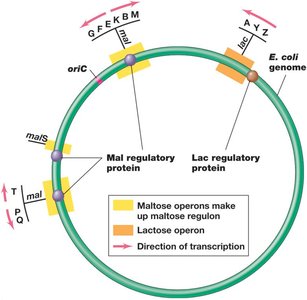
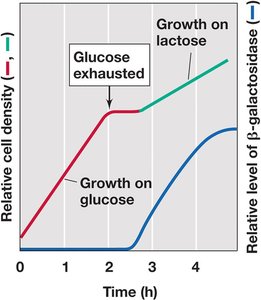
Alternate Sigma Factors
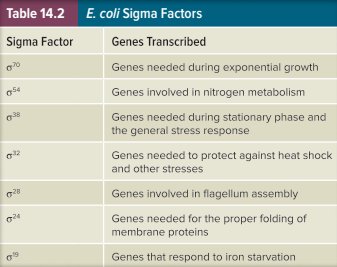
Sigma factors are subunits of RNA polymerase that direct the enzyme to specific promoters, allowing bacteria to regulate sets of genes in response to environmental changes.
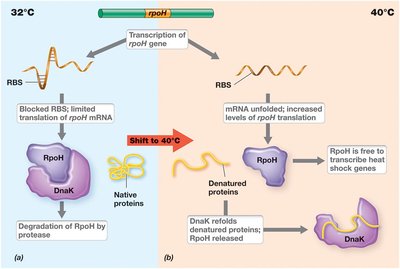
Sigma factor 32 (RpoH): Controls heat shock response; levels increase during stress, leading to transcription of heat shock genes.
Other sigma factors: Regulate genes for nitrogen metabolism, stationary phase, flagellum assembly, membrane protein folding, and iron starvation.
Sigma Factor | Genes Transcribed |
|---|---|
σ70 | Exponential growth |
σ54 | Nitrogen metabolism |
σ38 | Stationary phase, stress response |
σ32 | Heat shock response |
σ28 | Flagellum assembly |
σ24 | Membrane protein folding |
σ19 | Iron starvation response |
RNA-Based Regulation
Regulatory RNAs
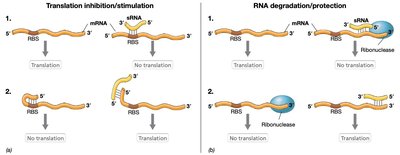
Small RNAs (sRNAs) are noncoding RNAs that regulate gene expression post-transcriptionally by base pairing with target mRNAs, affecting translation and stability.
Block translation: sRNA binds to mRNA, preventing ribosome access.
Open ribosome binding site: sRNA binding can expose the RBS, promoting translation.
Increase stability: sRNA binding can protect mRNA from degradation.
Decrease degradation: sRNA binding can make mRNA more susceptible to degradation.
Riboswitches
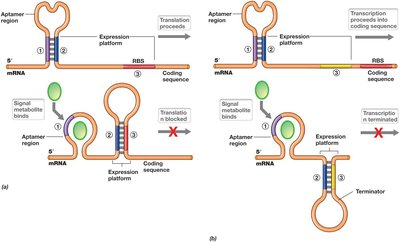
Riboswitches are regulatory segments within mRNA that bind small metabolites, causing structural changes that affect gene expression at the level of transcription or translation.
Aptamer region: Recognizes and binds specific metabolites.
Expression platform: Structural changes in this region determine whether transcription or translation proceeds.
Attenuation
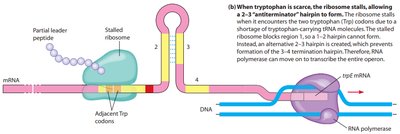
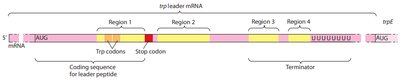
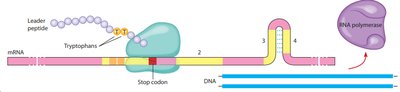
Attenuation is a regulatory mechanism that causes premature termination of transcription, often in amino acid biosynthetic operons such as the trp operon in E. coli.
Leader sequence: The first part of mRNA folds into alternative secondary structures, influencing transcription completion.
Antiterminator hairpin: Forms under low tryptophan, allowing transcription to proceed.
Terminator hairpin: Forms under high tryptophan, causing transcription termination.
Summary Table: Key Regulatory Mechanisms
Mechanism | Regulatory Protein | Effector Molecule | Example |
|---|---|---|---|
Negative Control (Repression) | Repressor | Co-repressor | arg operon |
Negative Control (Induction) | Repressor | Inducer | lac operon |
Positive Control | Activator | Inducer | maltose operon |
Global Control | CRP, Sigma factors | cAMP, environmental signals | catabolite repression, heat shock response |
RNA-Based Regulation | sRNA, riboswitch | Metabolites, base pairing | trp operon attenuation, riboswitches |
Additional info: Expanded explanations and context were added to clarify regulatory mechanisms and their biological significance, as well as to make the notes self-contained for exam preparation.
